Editorial Team
9 min read
NVIDIA’s new conversational model builds on Google’s Gemma and follows its own Nano 4B. Company tests show stronger instruction control and faster generation, but memory overhead, first-response delays and competing models’ strengths complicate deployment.
NVIDIA released Nemotron 3.5 Bolt E4B 4GB on October 23, adding a downloadable model for assistants that converse with users and invoke software tools on local hardware. The chipmaker’s latest addition to Nemotron, its family of openly distributed AI models, targets roughly 4GB of memory in selected workloads. Its own results show why that target alone cannot establish whether an assistant will respond quickly enough.
The release fulfills an October 15 announcement that placed E4B alongside a larger Bolt model for local agents and Super VL for server workloads. NVIDIA supplies both models and the GeForce RTX, Jetson and Spark hardware it promotes for running them. This release expands the software available to those customers, while giving developers another option for keeping conversations and tool use on their own systems.
The release model card identifies Bolt as a post-trained version of Google’s Gemma-4-E4B-it, with 8 billion total parameters, described as 4 billion effective. The compact download uses Q4_K_M quantization, which reduces the precision of stored weights, and a 64K-token context window for instructions, conversation history and tool results.
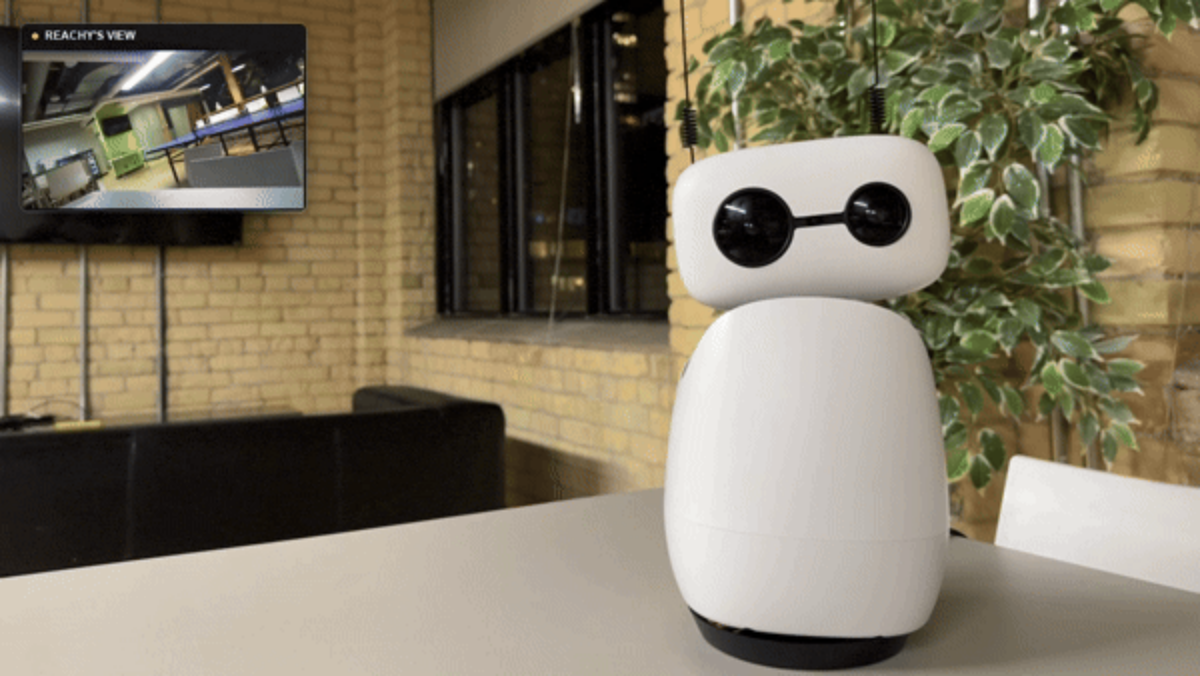
NVIDIA’s Reachy Mini demonstration runs on Jetson Orin Nano 8GB. Bolt handles dialogue and animation-script calls; a separate Cosmos 3 Edge model supplies visual understanding. Image: NVIDIA. Source: NVIDIA Research.
NVIDIA had already entered this market with Nemotron 3 Nano 4B in March, its first model specifically optimized for on-device conversational agents. Nano used a hybrid Mamba-Transformer architecture, compressed through pruning and distillation from NVIDIA’s Nano 9B v2. Bolt takes a different route by adapting an existing Google model.
Google introduced Gemma 4 in April as an open model family, with E4B designed for constrained devices. Function calling, structured output and native image and audio input were already part of that offering. Google advertised a 128K context window for its edge models, twice Bolt’s documented window. Developers can therefore consider the original Gemma as well as NVIDIA’s adaptation.
NVIDIA’s technical report explains why it chose that starting point: Gemma’s conversational strengths. NVIDIA used reinforcement learning with verifiable rewards and human feedback to improve instruction following, tool use and formatting. It tried supervised fine-tuning that improved tool calling further, but dropped that stage after conversational quality and verbosity worsened.
Bolt retains controls for enabling or disabling reasoning and provides ways to cap reasoning tokens. Its added conversational mode inserts an instruction requesting short answers with restrained formatting. The revised chat template puts assistant text before tool calls, allowing an acknowledgment before an action. These are useful design choices for spoken interaction, though the model card cautions that restricting reasoning can cut a thought short and requires task-specific evaluation.
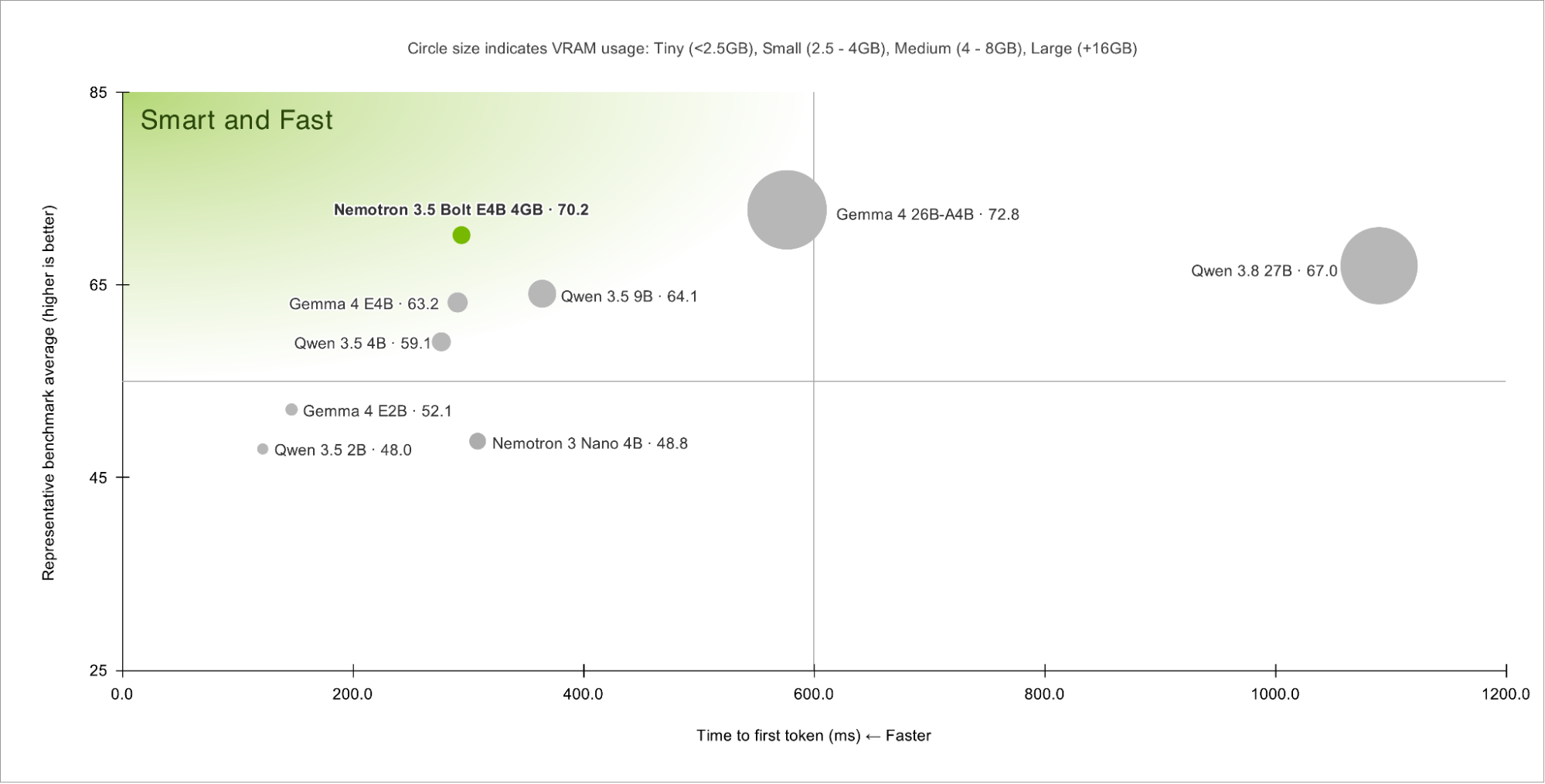
NVIDIA’s company-reported comparison averages six benchmarks for Q4_K_M models tested on RTX 5090 with approximately 3,000 input and 50 output tokens. Circle sizes indicate memory categories; this comparison covers one GPU. Source: NVIDIA Research.
The Jetson deployment guide describes approximately 4GB as a model-workload target and says total memory depends on context length and runtime overhead. NVIDIA’s measurements show both the attraction of the compact model and the limits of its name.
These figures are from NVIDIA’s release measurements. Each configuration uses Q4_K_M weights at batch size one, llama.cpp with CUDA and AIPerf, with no cached context, approximately 3,000 input tokens and 50 output tokens.
| Hardware | Reported peak memory | Time to first token | Generation rate |
|---|---|---|---|
| RTX 5070, 12GB | 3.5GB | 548ms | 133.4 tokens/second |
| RTX Spark, 32GB | 3.1GB | 930ms | 67.0 tokens/second |
| Jetson Orin Nano, 8GB | 4.2GB | 5,785ms | 15.5 tokens/second |
| Jetson AGX Orin, 32GB | 4.2GB | 3,687ms | 24.0 tokens/second |
A second workload, with 32K cached tokens, 2K new input tokens and 256 output tokens, pushed reported memory use above 4GB on all four systems. The Orin Nano used 4.9GB and took 6,259ms to produce its first token. These are language-model measurements; they do not include every stage of a voice assistant, such as speech processing or action execution. Nor do they show that a device with only 4GB of total memory is sufficient.
Distribution also creates configuration choices. Ollama’s E4B listing supports Windows, Linux and Apple Silicon, extending access beyond NVIDIA hardware. Unsloth’s GGUF package offers several quantization variants. Their download sizes and performance should not be equated with NVIDIA’s measurements of its specific Q4_K_M release.
The companion DFlash model drafts several candidate tokens for Bolt to verify together. NVIDIA says this speculative-decoding process preserves the target model’s output distribution. The local GGUF drafter is an additional BF16 file of about 737MB, excluding the target model. That file size is not a measurement of combined runtime memory.
On the coding subset of SPEED-Bench, NVIDIA compared Q4_K_M Bolt with DFlash against Q4_K_M Gemma E4B with its own MTP drafter, at batch size one. Bolt generated 272.6 tokens a second on an RTX 5070 against Gemma’s 225.9, a roughly 21% gain. On RTX Spark N1X, the rates were 124.4 and 118.4, a roughly 5% gain. Both configurations were accelerated; the results do not measure complete conversational interactions.
A separate experiment in the technical report tested BF16 Bolt in NVIDIA NIM, its packaged inference service, with and without DFlash. With reasoning enabled and one concurrent request, DFlash raised generation speed from 124.7 to 341.2 tokens a second on RTX PRO 6000, or 2.74 times. Mean request latency fell from 5.3 to 2.0 seconds. Those results used greedy decoding, a 1,024-token output ceiling and one run per configuration across 11 SPEED-Bench categories.
The distinction matters: that larger gain is against Bolt without a drafter on different hardware and precision, not against Gemma in the compact local test. NVIDIA says first-token time changed by less than 100ms across its NIM comparisons because speculative decoding accelerates generation rather than processing the initial prompt. The server-oriented drafter is also a separate artifact, using NVFP4 weights instead of the local drafter’s BF16 weights.
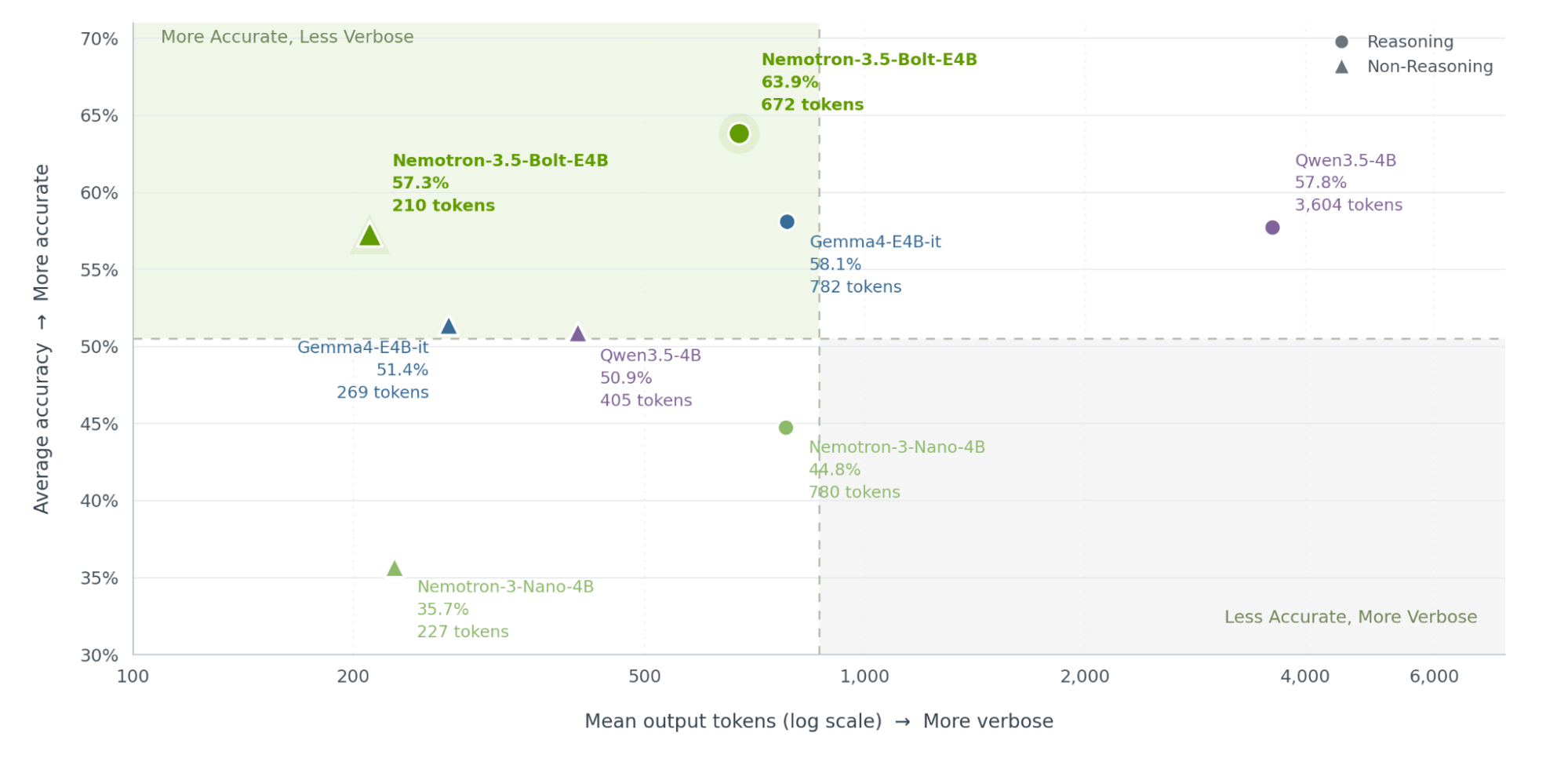
NVIDIA’s company-reported BF16 results compare average accuracy and output length across 21 benchmarks. Circles indicate reasoning mode and triangles non-reasoning mode. The token axis is logarithmic; aggregate scores do not establish leadership on every task. Source: NVIDIA Research.
NVIDIA reports roughly 40% higher average scores than Nano 4B across its selected conversational-agent benchmarks, and up to roughly 80% fewer output tokens in reasoning-enabled comparisons with peers. Those aggregate and best-case claims do not establish equivalent savings in application costs or waiting time. The announcement’s principal quality table uses BF16 checkpoints; the small local release uses quantized weights.
In the report’s Q4_K_M comparison, Bolt records lower scores than at least one rival on each of four tool-use tests, although some gaps are small. NVIDIA says it selected repeat counts to limit score variation to one or two percentage points, so narrow leads should not be treated as decisive.
Larger differences illustrate the choice more clearly. The following are NVIDIA’s reported scores for quantized models, all with reasoning enabled. Each row measures a different capability; the scores should be compared within rows.
| Evaluation and metric | Bolt E4B | Gemma 4 E4B | Qwen3.5-4B |
|---|---|---|---|
| Tau2-Bench: task completion through tools and dialogue, average accuracy | 52.32 | 38.72 | 61.74 |
| IHEval: resolving conflicting instructions, conflict accuracy | 82.40 | 66.61 | 62.87 |
| LongBench v2: understanding long prompts, overall accuracy | 48.67 | 45.70 | 58.28 |
The LongBench comparison uses the subset with fewer than 48K tokens, rather than testing each model’s maximum advertised context. Bolt’s stronger instruction hierarchy result coexists with weaker task completion and long-context results. Alibaba’s Qwen3.5-4B was already available by March, with native vision, reasoning and non-reasoning modes, and a 262K context window. It is another established option for developers weighing these capabilities.
Some of NVIDIA’s evaluation machinery also remains unavailable for inspection: Brevity Bench and When2Call-MT were awaiting public release. The former helped NVIDIA choose the instruction used for conversational mode, making outside testing of that behavior particularly useful.
Adaptation affected capabilities beyond text. The report finds broadly retained translation quality but small, consistent declines in multilingual knowledge and reasoning against Gemma. Vision results also fell, and training the vision encoder alone did not meaningfully restore them. Conversely, NVIDIA measured improvements on VoiceBench and AudioMC speech tests. The AudioMC comparison is constrained by both models’ 30-second audio-input limit: 53.1% of its conversations contained at least one turn beyond that limit, so it does not cover the complete unrestricted conversations.
The weights are offered for commercial and noncommercial use under OpenMDW 1.1. NVIDIA’s BF16 checkpoint is intended primarily for customization, post-training and evaluation. Its published fine-tuning examples use two H100 80GB GPUs for low-rank adaptation, or eight for full-parameter fine-tuning. These are recipe configurations, not stated minimum requirements; they illustrate why a small inference target does not define the resources needed for customization.
The hosted trial and downloaded weights also entail different data arrangements. NVIDIA’s API trial disclosure says inputs and outputs are recorded to provide the trial and improve its products and services. That service should not be confused with running the model locally.
Developers must establish which inputs their chosen package actually serves. The Jetson guide and model-card examples focus on text chat, while the technical report describes a BF16 NIM package accepting text, images and audio. In NVIDIA’s Reachy Mini robot demonstration, Bolt handles dialogue and calls animation scripts; a separate Cosmos 3 Edge model supplies visual understanding. The demonstration establishes that division of work, rather than general autonomous physical-task performance.
The deployment decision now turns on measurements of the full application: memory alongside speech and perception, delay before a useful response, successful tool execution, and recovery when tools fail. Developers need those results for their chosen weights, reasoning settings and hardware, alongside equivalent tests of Gemma and Qwen. The published benchmarks make Bolt a candidate for that comparison; they do not settle it.
Charta Health is expanding its insurer tools with a $55 million Series B. Its promise of billing accuracy across payers and providers faces a harder test: showing that better coding reduces disputes rather than simply changes payments.
Operand has raised $31 million across seed and Series A funding for AI due diligence software aimed at private equity firms. Its pitch is to reconstruct businesses from public records and internet traces, but evidence of accuracy and deal-level economics remains limited.
Caitlin Kalinowski resigned over the deliberation and oversight behind OpenAI’s Pentagon agreement. The company says its safeguards prohibit domestic surveillance and autonomous weapons, leaving a dispute over how those limits were established and will be enforced.
The startup formerly known as QuilrAI pairs enterprise AI agents with Guardian agents and charges by agents under management. Its expansion pitch faces established alternatives and unanswered questions about security performance and cost.
Luminal’s Standard Capital-led Series A backs software for running AI models more efficiently on existing GPUs and alternative chips. Its reported processing volume leaves revenue and comparable customer savings unresolved.
Officials project at least US$40 billion in investment from a proposed Philippine technology hub. Its initial land offer leaves later rent and facility costs open, while water supply, ancestral claims and access to jobs remain contested.
Tesla is inviting selected customers to buy its two-seat Cybercab, with December deliveries estimated. A mandatory autonomy subscription and service-area limits make the purchase price only part of the ownership proposition.
The local AI inference project and its ggml engine now promise major-version bumps for incompatible library changes. The release also shows why clearer labels cannot eliminate the cost of keeping downstream apps current.
A 73–25 procedural vote moved a broad energy-permitting deal forward. Its data-center transmission charges could shift costs from other customers, but utility oversight, tribal rights and clean-energy protections remain disputed. Another Senate test is scheduled for November 16.
Commerce Secretary Howard Lutnick faces questions over delayed restrictions on suspected Nvidia chip diversions and the company’s access to rulemaking. Commerce disputes claims of chilled enforcement, while China’s trade leverage complicates the account.

Fermi has signed preliminary agreements for 600MW of powered land with a customer identified in reporting as Amazon. Customer funding and a lighter construction burden offer a route forward, but the developer has lost its TensorWave lease and faces land and financing deadlines.
Meta reports more than 2 million weekly Business Agent businesses, but leaves paid demand undisclosed. Its AI financing has also grown beyond the initial $35 billion offering plan.
Google says its Teamwork framework produced seven mathematical results with Gemini 3.1 Pro, three reproduced with Gemini 3.7 Flash. Human-checked proofs and a formal verification support the research claim, but novelty varies and the cost of reproducing it in the paid preview remains unresolved.
tvOS 27.2.1 brings Siri AI to second-generation and newer Apple TV 4K boxes, according to updated reporting. Eligible owners can keep their existing streamer, but need a nearby paired device with Siri AI enabled.
OpenAI is rolling out ChatGPT Wallet to eligible US Pro subscribers, giving its dots agents tokenized card payments for existing website checkouts. Users approve purchases with biometrics, while merchant acceptance, reliability and demand remain tests for the limited launch.
ASUS is testing its first humanoid robot at an electronics factory, targeting customer pilots in 2027. Its manufacturing experience supplies real tasks and training data, but sustained reliability and commercial economics remain unproven.
Cerebras expects Microsoft cloud-inference revenue to begin in early 2027, subject to service milestones. Quarterly revenue rose 55%, but OpenAI delivery delays, preferential customer terms and long-term infrastructure commitments complicate the expansion.
Meta has expanded Muse’s phone-calling feature beyond early testers to paid US subscribers. The rollout puts routine errands behind a subscription, while business acceptance and an earlier human-contractor experiment complicate the promise of autonomous calls.
Anthropic deployed a fix for authentication problems affecting Claude services and closed the incident on November 13. Later reporting described residual failures, whose connection to the login incident remains unconfirmed.
Treasury Secretary Scott Bessent said agencies had backed export restrictions on Nvidia customer Megaspeed for months. He challenged Commerce’s handling of the case and Nvidia’s safeguards, while Megaspeed denies illicit chip exports to China.