Editorial Team
8 min read
AI became SpaceX’s largest revenue business, but satellite connectivity still supplied most operating profit. A near-doubling of planned capital spending will test whether compute contracts can sustain the buildout, backed by a large IPO cash cushion.
SpaceX plans to nearly double quarterly capital spending after computing rentals helped the rocket and satellite-internet company report its first profit as a public company. Its $35 billion to $40 billion fourth-quarter forecast follows $19.6 billion spent in the three months through September.
The scale of the buildout makes the source of the earnings consequential. AI now accounts for about 52% of revenue, but satellite connectivity generated about 85% of operating income, calculated from the company's segment results. SpaceX has ample resources from its June initial public offering; the unresolved question is how much of the expanding investment program its businesses can ultimately fund themselves.
Founded in 2002, SpaceX built its business transporting satellites and astronauts and operating the Starlink satellite-internet network. Founder and chief executive Elon Musk also runs electric-car maker Tesla. He previously led xAI, the AI developer established in 2023 that SpaceX acquired in February 2026. That acquisition brought its Grok AI models and computing infrastructure into SpaceX, as described in the company’s June prospectus.
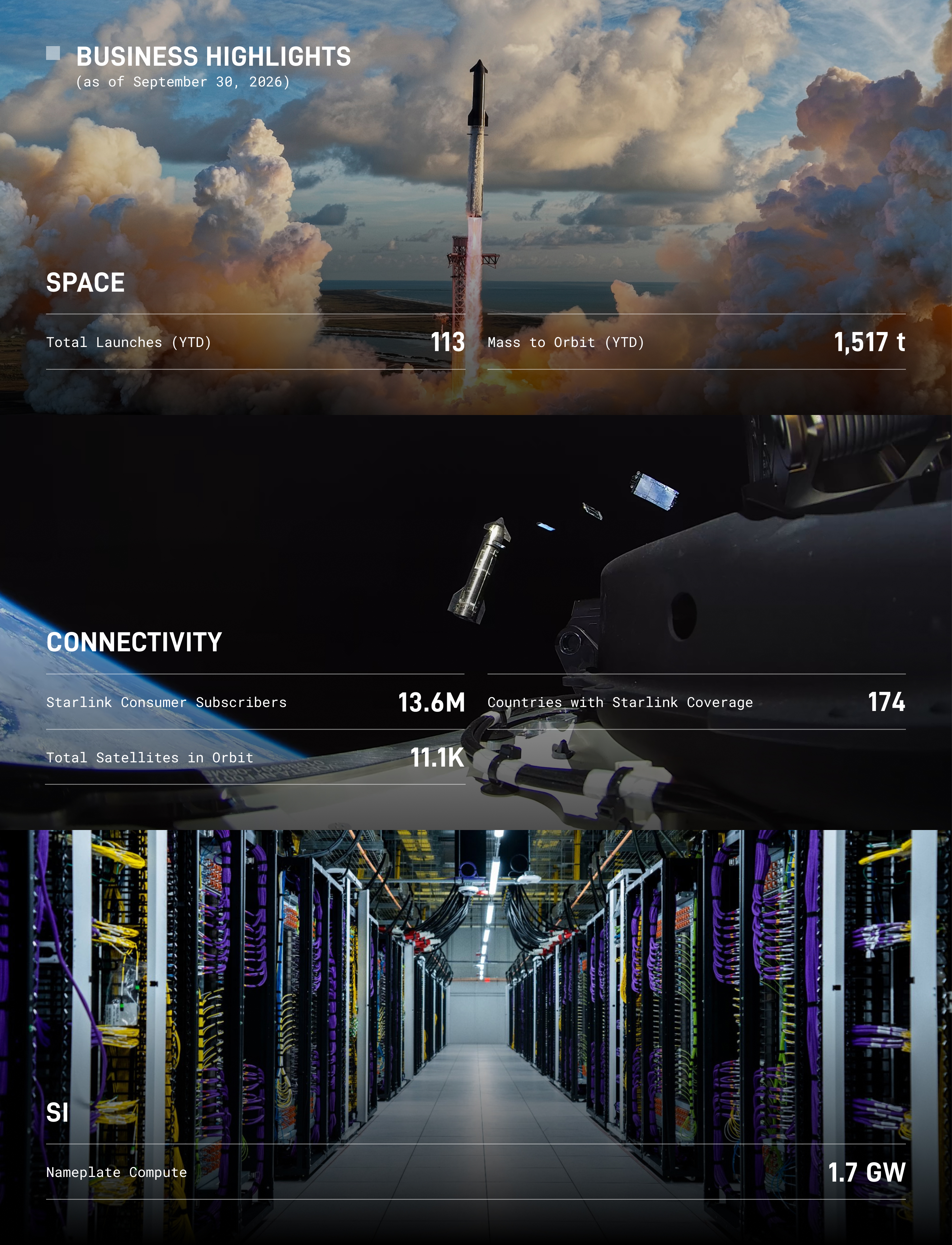
SpaceX’s company-reported operating highlights as of September 30, 2026, span launch, connectivity and computing. Source: SpaceX. Source: SEC.
SpaceX reported third-quarter revenue of $14.575 billion, up 161% from a year earlier, and net income of $4.404 billion, reversing a $1.054 billion loss. Its financial statements show operating income of $2.791 billion. Net income also benefited from $1.025 billion in other income, $873 million in interest income and a $390 million tax benefit, partly offset by $675 million in interest expense. Those items should not be mistaken for customer revenue.
The full earnings release shows where operating profit came from. All figures below are for the three months ended September 30, 2026, in millions of dollars.
| Business | Revenue | Operating income or loss |
|---|---|---|
| Super Intelligence, the renamed AI segment | $7,560 | $431 |
| Connectivity, including Starlink | $5,248 | $2,367 |
| Space, including launches and rocket development | $1,767 | −$7 |
| Total | $14,575 | $2,791 |
Connectivity’s roughly 85% share is calculated by dividing $2.367 billion by $2.791 billion. AI’s quarterly profit was a substantial improvement, but the segment still had a $3.295 billion operating loss over the first nine months.
Most AI revenue came from renting data-center capacity to developers including Anthropic, Alphabet’s Google and Reflection AI, according to the results and earnings-call account. The segment also includes Grok, social platform X and the recently acquired Cursor coding tool. Rental demand therefore demonstrates a market for SpaceX’s infrastructure; it does not establish that Grok is outperforming competing models.
About $1.2 billion in acquisition-related stock compensation tied to Cursor weighed on AI’s quarterly profit, according to the results report. AI nevertheless absorbed $16.4 billion of the company’s $19.6 billion in quarterly capital spending—about 84%. Its share of investment substantially exceeded its share of revenue.
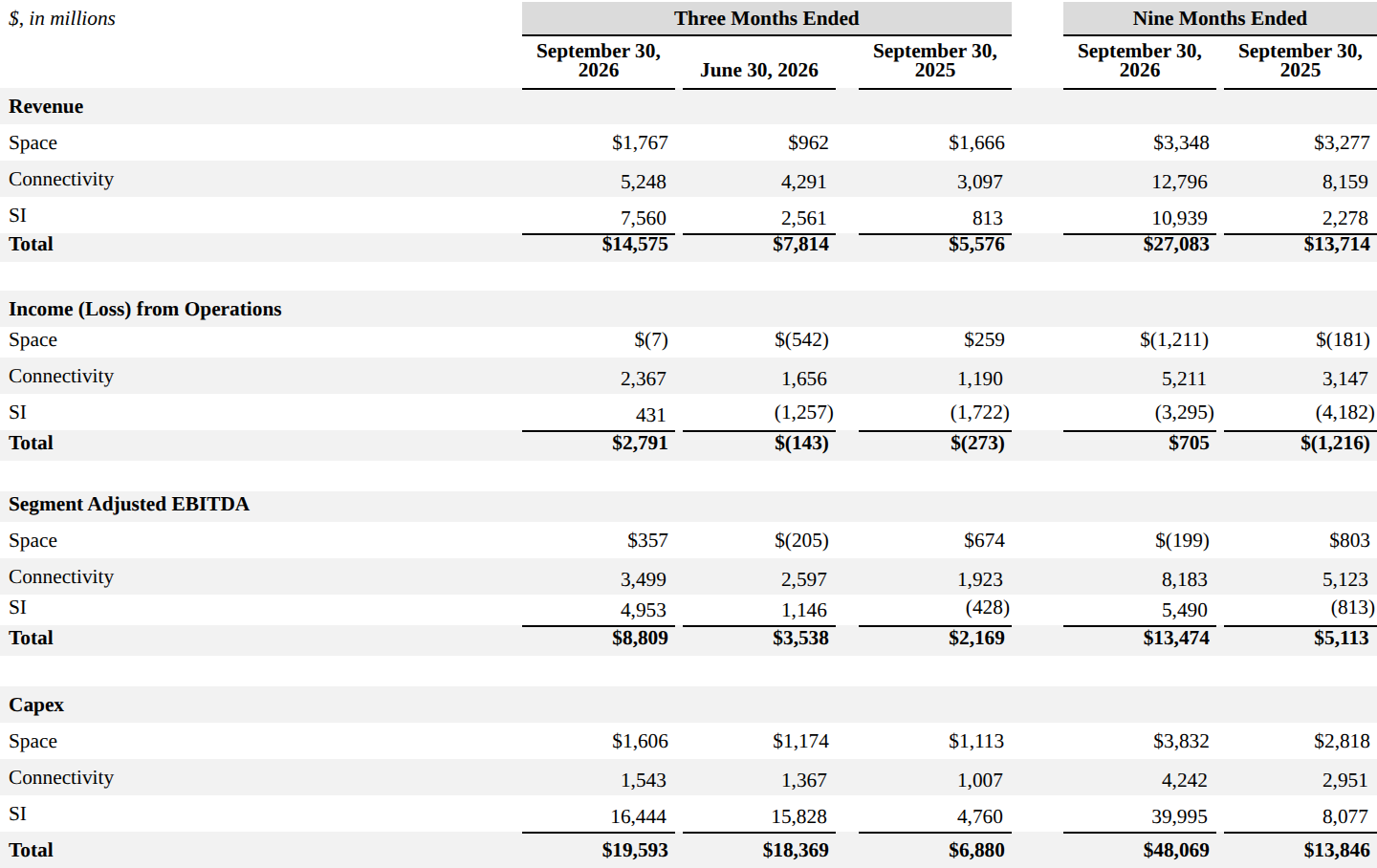
SpaceX’s company-reported segment results, in millions of dollars. Super Intelligence led September-quarter revenue; Connectivity led operating income. Adjusted EBITDA is a separate non-GAAP measure. Source: SpaceX Form 8-K and earnings release.
The June prospectus identifies Anthropic as an AI research and development company and a competitor. It also describes agreements under which Anthropic would pay SpaceX $1.25 billion a month through May 2029 for computing capacity, following reduced fees during the May and June ramp-up.
The qualification is important: after the initial three months, either party could terminate on 90 days’ notice. The contract disclosure therefore does not support treating the entire multiyear payment schedule as guaranteed revenue. SpaceX described the arrangement as monetizing capacity while preserving the ability to reallocate it to its own AI work. That flexibility cuts both ways.
SpaceX is entering an established market. Its prospectus names AI cloud providers CoreWeave and Nebius, alongside large cloud operators, as potential competitors for its computing business. It also warns that some compute customers depend on outside financing to meet their obligations. Infrastructure demand and customers’ ability to keep paying are separate risks.
SpaceX’s cash-flow statement shows both growing cash generation and much larger equipment purchases. These are matching nine-month periods, rather than a comparison of quarterly profit with annual spending.
| Cash-flow item | Nine months to September 2025 | Nine months to September 2026 |
|---|---|---|
| Cash generated by operations | $4.120 billion | $13.097 billion |
| Purchases of property, plant and equipment | $13.846 billion | $48.069 billion |
| IPO proceeds, net of offering costs | — | $85.675 billion |
Operating cash flow covered about 27% of property, plant and equipment purchases in 2026, compared with about 30% a year earlier. Those percentages divide the first row by the second. This compares two reported cash-flow lines; it is not a free-cash-flow calculation. Rebates, capitalized interest and other investing flows are separate.
The funding gap does not imply an immediate shortage of cash. At September 30, SpaceX held $51.294 billion in cash and cash equivalents and $38.561 billion in marketable securities—about $89.9 billion combined. It also reported $38.844 billion in debt and finance-lease liabilities. The IPO supplied far more cash than operations during the period, leaving a substantial cushion as spending accelerates.
SpaceX still recorded a $413 million net loss for the first nine months. One profitable quarter has not yet established sustained profitability across the enlarged company.
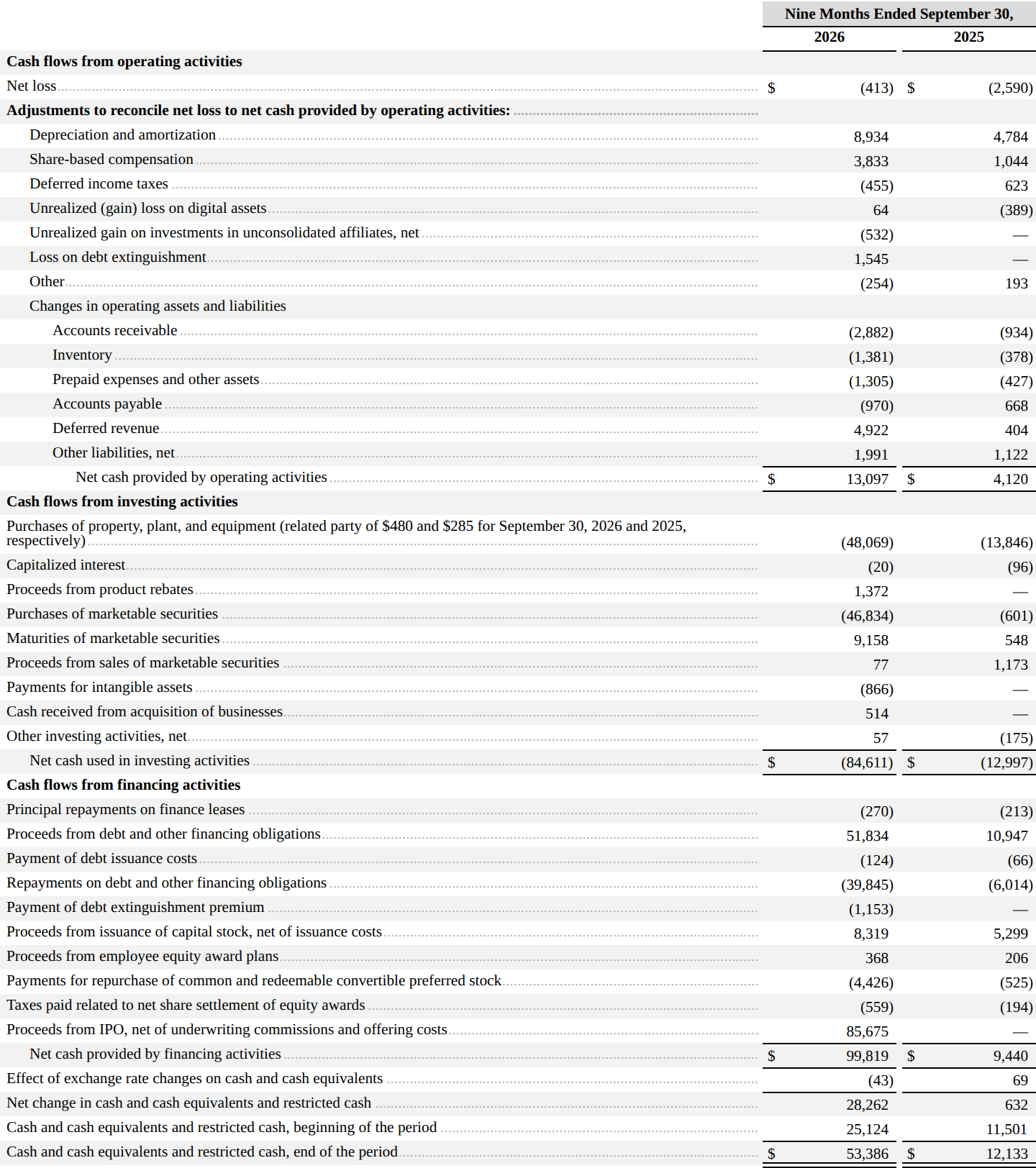
SpaceX’s company-reported, unaudited cash flows for the nine months ended September 30, in millions of dollars, separately identify operating cash, equipment purchases and IPO proceeds. Source: SpaceX Form 8-K and earnings release.
SpaceX is expanding Colossus II, its data-center project in Memphis, Tennessee. Musk told investors that power, cooling and infrastructure had become greater constraints on deploying AI than chips. In the earnings-call account, he said SpaceX was using its metal-casting capabilities to make turbine components, addressing 12- to 18-month delays in obtaining the metals needed for blades and vanes. This is management’s account of an execution advantage, not a measured cost comparison with rival cloud providers.
The company’s earlier infrastructure description also puts its speed claims in context: it reused existing industrial sites, and its first clusters were only part of the planned expansion. A first cluster brought online in a converted factory is not directly comparable with completion of an entirely new data center.
Starlink’s subscriber growth provides another test of the economics. It reached 13.6 million consumer subscriptions at quarter-end. Average monthly revenue per subscriber was $69, down from $83 a year earlier but up from $66 in the preceding quarter, according to the quarterly operating data. The longer-term pressure from cheaper international plans should not obscure that sequential improvement. SpaceX’s consumer-subscriber definition includes personal and business subscription plans, but excludes managed enterprise and government contracts.
Starship, the next-generation rocket intended for full reuse, remains central to deploying higher-capacity Starlink satellites and proposed orbital computing infrastructure. Its September orbital test deployed satellites but ended early after an engine issue, according to the results report. Musk said November’s test would attempt to recover both the booster and upper stage. Demonstrating that both can subsequently fly again remains a further step.
Bret Johnsen, SpaceX’s chief financial officer since 2011, reiterated an expected annual recurring revenue level of about $100 billion by the end of 2026 in the October 20 earnings call. Musk predicted $500 billion to $1 trillion by the end of 2027. Those are management’s prospective run rates, not revenue already earned over a year. Johnsen separately forecast $33 billion to $37 billion in revenue for the first quarter of 2027.
A potential Tesla merger adds a separate capital-allocation decision. Musk said special committees at both companies were discussing a combination, that he could not participate in their discussions because he was conflicted, and that shareholders would need to approve a deal, according to the call report. No agreed transaction is established by those remarks. SpaceX’s June prospectus envisaged Musk retaining majority voting power after the IPO, making the committees’ handling of his overlapping roles consequential for other investors.
The next financial results will show how much of the new buildout operations can finance. For the compute business, the useful evidence is customer retention and revenue delivery against Johnsen’s forecast. For a Tesla combination, investors still need a proposed price, ownership structure and approval process before they can assess what a deal would mean for their stake.
Charta Health is expanding its insurer tools with a $55 million Series B. Its promise of billing accuracy across payers and providers faces a harder test: showing that better coding reduces disputes rather than simply changes payments.
Operand has raised $31 million across seed and Series A funding for AI due diligence software aimed at private equity firms. Its pitch is to reconstruct businesses from public records and internet traces, but evidence of accuracy and deal-level economics remains limited.
Caitlin Kalinowski resigned over the deliberation and oversight behind OpenAI’s Pentagon agreement. The company says its safeguards prohibit domestic surveillance and autonomous weapons, leaving a dispute over how those limits were established and will be enforced.
The startup formerly known as QuilrAI pairs enterprise AI agents with Guardian agents and charges by agents under management. Its expansion pitch faces established alternatives and unanswered questions about security performance and cost.
Luminal’s Standard Capital-led Series A backs software for running AI models more efficiently on existing GPUs and alternative chips. Its reported processing volume leaves revenue and comparable customer savings unresolved.
Officials project at least US$40 billion in investment from a proposed Philippine technology hub. Its initial land offer leaves later rent and facility costs open, while water supply, ancestral claims and access to jobs remain contested.
Tesla is inviting selected customers to buy its two-seat Cybercab, with December deliveries estimated. A mandatory autonomy subscription and service-area limits make the purchase price only part of the ownership proposition.
The local AI inference project and its ggml engine now promise major-version bumps for incompatible library changes. The release also shows why clearer labels cannot eliminate the cost of keeping downstream apps current.
A 73–25 procedural vote moved a broad energy-permitting deal forward. Its data-center transmission charges could shift costs from other customers, but utility oversight, tribal rights and clean-energy protections remain disputed. Another Senate test is scheduled for November 16.
Commerce Secretary Howard Lutnick faces questions over delayed restrictions on suspected Nvidia chip diversions and the company’s access to rulemaking. Commerce disputes claims of chilled enforcement, while China’s trade leverage complicates the account.

Fermi has signed preliminary agreements for 600MW of powered land with a customer identified in reporting as Amazon. Customer funding and a lighter construction burden offer a route forward, but the developer has lost its TensorWave lease and faces land and financing deadlines.
Meta reports more than 2 million weekly Business Agent businesses, but leaves paid demand undisclosed. Its AI financing has also grown beyond the initial $35 billion offering plan.
Google says its Teamwork framework produced seven mathematical results with Gemini 3.1 Pro, three reproduced with Gemini 3.7 Flash. Human-checked proofs and a formal verification support the research claim, but novelty varies and the cost of reproducing it in the paid preview remains unresolved.
tvOS 27.2.1 brings Siri AI to second-generation and newer Apple TV 4K boxes, according to updated reporting. Eligible owners can keep their existing streamer, but need a nearby paired device with Siri AI enabled.
OpenAI is rolling out ChatGPT Wallet to eligible US Pro subscribers, giving its dots agents tokenized card payments for existing website checkouts. Users approve purchases with biometrics, while merchant acceptance, reliability and demand remain tests for the limited launch.
ASUS is testing its first humanoid robot at an electronics factory, targeting customer pilots in 2027. Its manufacturing experience supplies real tasks and training data, but sustained reliability and commercial economics remain unproven.
Cerebras expects Microsoft cloud-inference revenue to begin in early 2027, subject to service milestones. Quarterly revenue rose 55%, but OpenAI delivery delays, preferential customer terms and long-term infrastructure commitments complicate the expansion.
Meta has expanded Muse’s phone-calling feature beyond early testers to paid US subscribers. The rollout puts routine errands behind a subscription, while business acceptance and an earlier human-contractor experiment complicate the promise of autonomous calls.
Anthropic deployed a fix for authentication problems affecting Claude services and closed the incident on November 13. Later reporting described residual failures, whose connection to the login incident remains unconfirmed.
Treasury Secretary Scott Bessent said agencies had backed export restrictions on Nvidia customer Megaspeed for months. He challenged Commerce’s handling of the case and Nvidia’s safeguards, while Megaspeed denies illicit chip exports to China.