Editorial Team
6 min read
Epic plans to support SteamOS with its new Linux launcher. Fortnite remains unavailable on Linux, and Epic says the Steam Deck lacks features required by its planned anti-cheat system.
Epic Games, the company behind Fortnite and the Epic Games Store, plans to support SteamOS with its new native Linux launcher. That could give users of Valve’s Linux-based gaming operating system an official application for their Epic libraries. It does not make Fortnite playable on Steam Deck, Valve’s handheld gaming PC: Epic identifies a separate security barrier on that device.
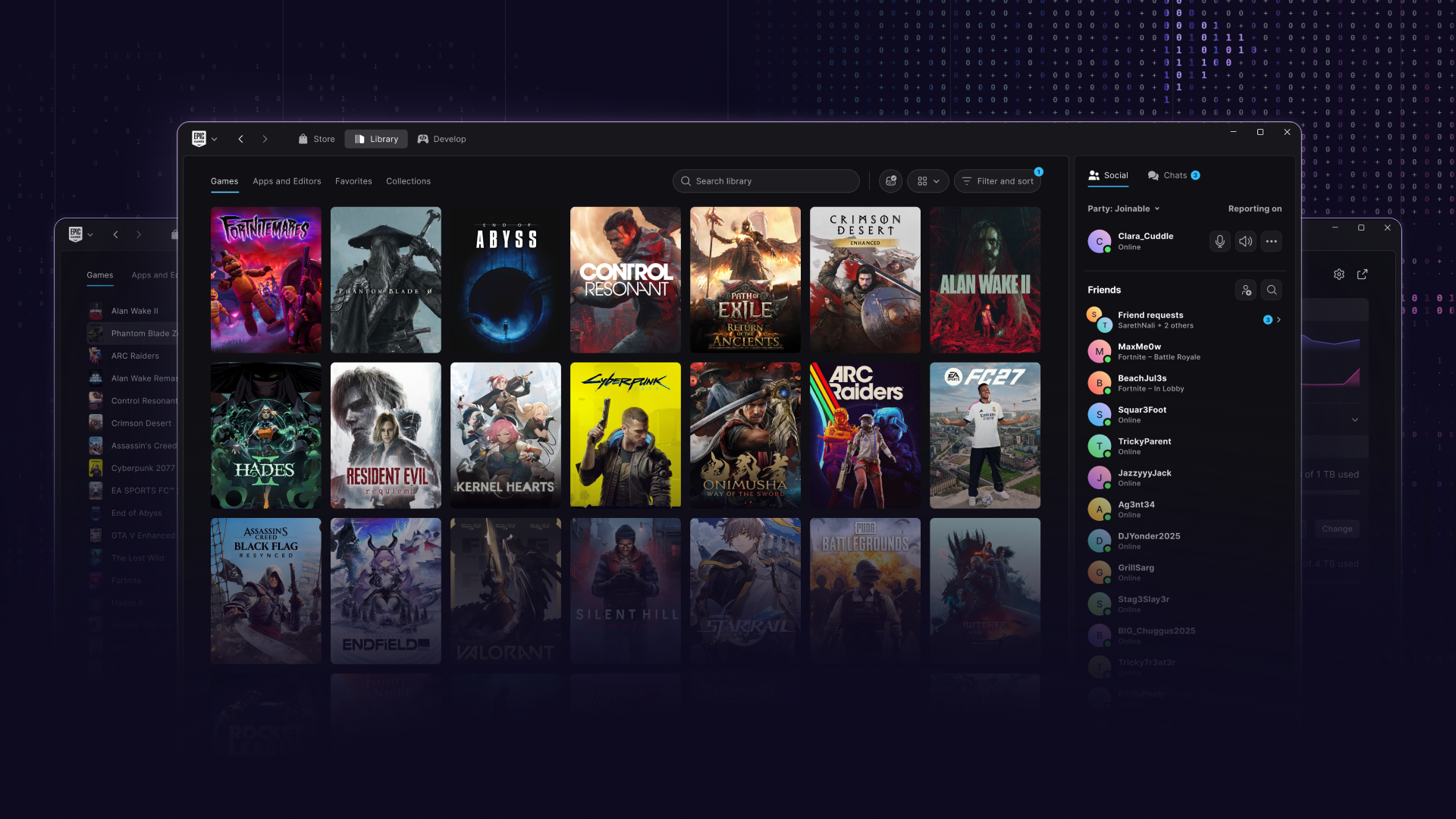
Epic’s promotional image of its launcher Preview. The pictured games do not establish Linux compatibility. Image: Epic Games. Source: Epic Games Store launcher announcement.
Jake Jones, Epic Games’ communications director, said the company plans to support as many Linux distributions as possible, explicitly including SteamOS alongside Fedora, Cachy and Omarchy. In a statement to a Linux gaming publication, published November 6, he said Epic was testing distribution formats and would restore AppImage during November.
The Linux launcher is already available in Preview. Epic announced that release on October 14, covering Windows, macOS and Linux, while warning that the initial version was light on features. The newer statement clarifies the intended breadth of Linux support rather than announcing a finished SteamOS release.
Epic describes the rebuilt application as faster and more responsive, with library organization, download management and cross-platform social features. It says existing purchases, installed games, cloud saves and progress carry over through the user’s account. These are changes to the application used to buy, organize and launch games; they do not establish that each game will run on Linux.
The packaging has already changed. The Preview initially used AppImage, then switched to a .deb package for Debian and Ubuntu; its FAQ listed Fedora support as forthcoming. Epic’s commitment to restore AppImage shows that the installation route remains unsettled. An official Flatpak release, suggested in the reporting as a convenient possibility for SteamOS, is not an announced plan.
Nor has Epic explained how SteamOS installation and game launching will work or whether the interface will suit handheld controls, according to the report on the expansion. Supporting the operating system leaves those practical questions open.
The launcher is Epic’s storefront and library application. Bringing it to SteamOS could reduce reliance on third-party clients, but it would not by itself convert Windows games into Linux games. Windows titles still need a compatibility layer such as Wine or Proton, and Epic has not detailed how its launcher will handle that, as the compatibility analysis explains.
Heroic already provides an alternative client for accessing Epic games. Whether Epic’s official application will deliver better compatibility than that existing option remains unanswered. The Linux gaming report carrying Jones’s statement also notes that rival game store GOG plans Linux support for its Galaxy client in 2027. Epic is joining a broader move toward official clients, with community alternatives already available.
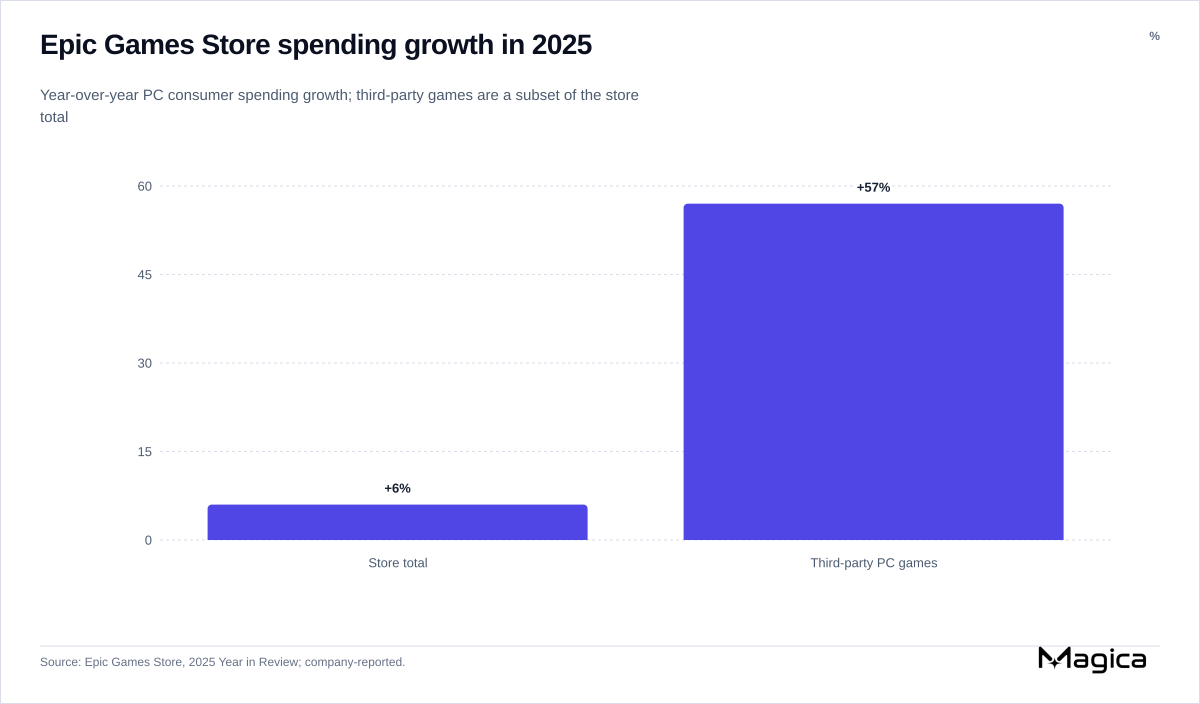
Company-reported PC consumer spending growth in 2025. Figures include taxes and exclude third-party purchases through developers’ own in-game payment systems. They do not isolate Linux users. Chart: Magica; data: Epic Games. Source: Epic Games Store 2025 Year in Review.
Epic reported in its 2025 store review that PC players spent $1.16 billion on the store, up 6% from 2024. Spending on third-party PC games reached $400 million, up 57%. These are company-reported consumer spending figures, inclusive of taxes, rather than Epic’s net revenue. The third-party figure excludes in-game purchases processed through developers’ own payment systems.
The engagement picture was mixed: Epic reported 6.65 billion total gameplay hours in 2025, down 14%, while third-party gameplay hours rose 4% to 2.78 billion. None of these figures isolates Linux users or establishes demand for the SteamOS launcher.
For developers, Epic’s terms provide another reason to consider its distribution channel. Since June 2025, developers have kept the first $1 million of annual net revenue per product before the standard split of 88% to the developer and 12% to Epic applies. Epic says it takes no revenue from in-game purchases made through developers’ own payment systems. Expanding supported platforms could broaden that channel’s reach, but launcher availability alone cannot deliver compatible games or sales.
Epic’s Fortnite support page says its online game is not available on Linux yet. The company plans to bring it through the launcher once rebuilt Easy Anti-Cheat protections work with a critical mass of distribution maintainers—the teams responsible for the different Linux operating-system distributions. That is a conditional commitment, not a release date.
Epic’s EAC Linux v2 technical explanation also supplies the history behind the delay. Easy Anti-Cheat has supported native Linux clients since 2014 and Windows games running through Wine or Proton since 2021. The latter support is optional for each game. Epic says many developers have not enabled it because its Linux implementation offered less protection than its Windows version; it gives the same reason for Fortnite’s absence.
The proposed replacement, EAC Linux v2, checks the system underneath the game. It requires signed operating-system kernels and modules, TPM 2.0 security hardware, Secure Boot and measurements recording the boot process. Other requirements include kernel lockdown, disabling the kexec feature that can replace a running kernel, and enabling BPF security hooks. Non-handheld systems must also enable IOMMU memory-access protections with passthrough disabled.
Epic says it will use existing Linux security features, a systemd service and eBPF programs rather than install an equivalent of its Windows anti-cheat kernel driver. The service would run only while a protected game is active. Players could maintain a separate boot configuration for those games; failing the requirements would produce an error message, not an account ban, according to Epic.
Epic also maintains an initial list of accepted signing keys, which it says it wants to make open source with community contributions. That list already includes keys used by Ubuntu, Fedora, Debian and Universal Blue, whose distributions include Bazzite. Listing a key is only one requirement, however. Distribution maintainers must work with Epic on compliant configurations and any additional keys. This gives Epic a role in deciding which boot configurations its anti-cheat accepts.
Epic explicitly says Steam Deck does not support the features required for EAC v2, while adding that it is talking with Valve and hopes to support the device in future. It does not identify in that answer which individual requirements the handheld fails.
Epic plans to pilot EAC Linux v2 in Fortnite, test its effectiveness in a live environment and then offer it to more developers. That sequence leaves both the validation of the protections and wider developer adoption ahead. Developers already using Linux EAC support will be able to retain the older implementation for broader compatibility or adopt v2 for what Epic describes as better protection. The new system is therefore not an automatic upgrade across every protected game.
For SteamOS users, the next concrete evidence is a supported installation method, an explanation of Windows-game compatibility and a usable handheld interface. For Fortnite players on Steam Deck, the decisive development would be Epic and Valve resolving the documented security-feature gap. The launcher roadmap alone does not establish that outcome.
Xbox players report accessing GTA 6 ahead of their local November 19 launch by switching their console location to New Zealand. PS5 access depends on the purchase region, and circulating suspension claims remain unverified.
Rockstar says PS5 Pro’s processor cannot run GTA VI’s simulation at higher frame rates. Its upgrades instead improve image clarity and shadows, making visual quality the key comparison against cheaper consoles with the same 30fps target.
Sony says PS5 players must install a system software update to play Grand Theft Auto VI on November 19, even if they have preloaded the game. The latest patch follows two other security updates within a month; Sony has not explained the requirement’s technical purpose.
Sensor Tower estimates 15.88 million digital preorders for Rockstar’s next Grand Theft Auto game. Premium purchases signal strong demand, but publisher Take-Two’s shrinking bookings and undisclosed multiplayer plans complicate the longer-term picture.
Red Dead Redemption 2 is reported at 75% off in India's PlayStation sale, but edition differences, changing offers and regional eligibility complicate the headline savings. Sony says the promotion runs through November 30, with some deals ending earlier.
Nintendo's Switch 2 remake surpassed one million physical units in its US launch week, Circana analyst Mat Piscatella says. The ranking covers data through November 7 and includes boxed download codes, limiting what it says about demand for physical media.
GTA 6 reportedly offers nearly 100 missions and a roughly 50-hour campaign. A preview details how players can nurture or lose its protagonists’ romance, extending relationship mechanics the series has used before.
Sony’s pending application would turn a PlayStation controller into a bridge for payment and account information. Nintendo offered controller payments in 2014, and PlayStation already supports Apple Pay, leaving convenience and implementation as the proposal’s real tests.
Operation Vital Signal will let Doc heal and revive teammates across the map, reducing the need to abandon defensive positions. Thunderbird is also getting stronger, while early previews leave questions about Doc’s targeting and activation mechanics.
MachineGames is producing Wolfenstein 3 with returning actors Brian Bloom and Debra Wilson. Bethesda also confirmed a new id Software project led by Hugo Martin, but neither game has a release window.
GitHub disabled a Picofly firmware repository and its forks after Nintendo alleged they bypass Switch copy protection. Other firmware repositories remained available, limiting what the sweep establishes about access or piracy.
Microsoft is testing a choice of Guide position, rotating dynamic backgrounds and new library controls with Xbox Insiders. Alpha Skip-Ahead members get access first; a wider release has no announced date.
Xbox’s PC backward-compatibility library has grown from four to 25 original-console games. The expansion brings a large Star Wars contingent and new achievements, but access and feature support remain selective.
Nintendo says its Switch 2 remake has set a four-day sales record for its games on the console, giving the platform a holiday-season hit while leaving its effect on hardware demand unproven.
Sony will retire its PlayStation Plus PC app on December 10, 2026, saying fewer than 0.4% of eligible Premium members use it. The closure removes a PC streaming option while leaving console benefits intact.
Sony has reportedly ended Haven Studios’ heist shooter after mixed playtest feedback and retention results. The studio will support other PlayStation teams, with no job cuts resulting from the cancellation, a company spokesperson said.
Apple Arcade adds four games on December 3. The Lost Crown+ brings the complete content package to mobile and Mac, while Replanted adds an exclusive cosmetic mode to an existing remaster.
GTA VI will stream to Xbox One and Xbox Series consoles on November 19, extending access without a hardware upgrade. Players must buy the game separately, while Microsoft is replacing unlimited subscription streaming with monthly hour allowances and paid top-ups.
Valve is showing player-sourced framerate averages and distributions for thousands of Steam Deck games. The figures supplement compatibility badges, but mixed settings and uneven performance within games complicate buying decisions.
Silver Lake and Saudi Arabia’s PIF reportedly discussed a roughly $25 billion valuation for Unity. An acquisition would deepen their existing gaming ties through control of development tools and a large advertising business, but price, financing and operating plans remain unresolved.