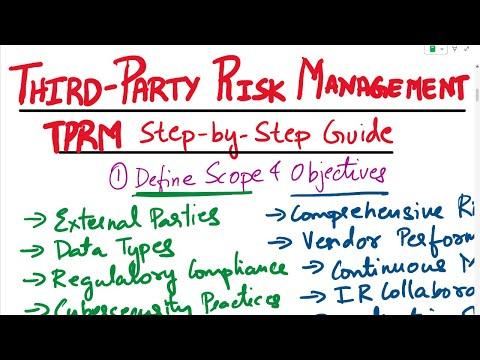
This blog post provides a detailed step-by-step guide for implementing a Third Party Risk Management (TPRM) program, covering key aspects such as defining scope and objectives, identifying third parties, conducting risk assessments, due diligence, contractual agreements, security controls, monitoring, incident response planning, audits, documentation, continuous improvement, employee training, and exit strategies.
Third Party Risk Management (TPRM) is an essential process for organizations to ensure that external vendors and partners do not pose significant risks. This guide outlines a step-by-step approach to implementing a TPRM program, detailing each critical component necessary for effective risk management.
The scope in TPRM refers to the boundaries and limits of the third-party risk assessment initiative. It outlines what the program will include and the specific areas it will focus on. Key components include:
Objectives in TPRM articulate specific, measurable, and achievable goals. Key components include:
Create a comprehensive inventory of all external entities with whom your organization has a business relationship. This may involve collaboration with various departments.
Categorize third parties based on the type and sensitivity of the data they access.
Examine existing contracts to identify external parties explicitly mentioned, including suppliers and service providers.
Collaborate with departments such as procurement, legal, IT, and business units to gather information about external entities.
Conduct a thorough risk assessment for each third party, focusing on:
Categorize third parties based on the level of risk they pose and the nature of their engagement.
Assign risk levels based on data sensitivity, service criticality, and overall impact on your organization.
Evaluate third parties in terms of regulatory compliance and categorize them accordingly.
Consider the strategic importance of each third party to your organization.
Conduct comprehensive due diligence on high-risk third parties, including:
Examine existing contracts to identify external parties and review key aspects:
Once risks are assessed, implement security controls to mitigate identified risks.
Implement technical controls such as firewalls, encryption, and access controls.
Enforce security policies and procedures governing third-party behavior.
Implement continuous monitoring mechanisms to ensure the effectiveness of security controls.
Collaborate with third parties to develop incident response plans.
Establish mechanisms for continuous monitoring of third parties, including:
Engage with third parties to collaboratively develop incident response plans.
Clearly define roles and responsibilities in the event of a security incident.
Establish protocols for sharing critical information related to incidents.
Implement mechanisms for timely detection and reporting of incidents.
Conduct regular audits to ensure ongoing compliance with security standards.
Establish a regular schedule for audits based on the criticality of the third party.
Define the scope covering cybersecurity controls and compliance with agreements.
Maintain comprehensive documentation of audit findings and recommendations.
Establish a centralized register documenting details about each identified third party.
Develop risk profiles outlining potential risks and vulnerabilities.
Communicate findings and recommendations to relevant stakeholders.
Regularly review KPIs and metrics for the TPRM program.
Establish a feedback mechanism to collect input from stakeholders.
Conduct sessions to analyze what worked well and what could be improved.
Develop comprehensive training programs to educate employees on TPRM.
Clearly define employee roles in identifying and managing third-party risks.
Train employees to recognize signs of potential risks related to third parties.
Examine existing agreements to understand termination terms.
Notify the third party in advance of the decision to terminate the relationship.
Establish a process for securely retrieving data from the third party.
Develop a comprehensive transition plan for the exit process.
Conduct a post-exit evaluation to assess the success of the transition process.
Implementing a TPRM program is an ongoing process that requires regular attention and adaptation to evolving threats and business relationships. By following these steps, organizations can effectively manage third-party risks, ensuring a secure and compliant operational environment. Regular communication with third parties is essential to maintain an open dialogue about security expectations and concerns.