
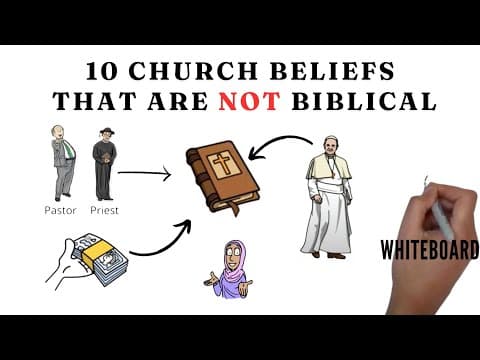
This article explores ten widely held beliefs about the church that lack biblical support, emphasizing the importance of grounding church practices in scripture rather than tradition.
For many, the church is a central part of life, serving as a place for worship and spiritual guidance. However, not everything believed about the church is rooted in the Bible. In this article, we will examine ten common misconceptions about the church that are not actually biblical, and some of these may surprise you.
When people think of church, they often envision a physical building. However, the Bible never refers to the church as a structure. In the New Testament, the term "church" comes from the Greek word "Ekklesia," meaning assembly or gathering of people. The essence of the church lies in the fellowship of believers, whether they gather in homes, public spaces, or even in secret during persecution. The church is defined by its people, not its walls.
Many individuals enter church services expecting a specific order of events: worship, announcements, a sermon, and communion. However, there is no strict biblical order for church services. Early Christians focused on key elements such as fellowship, prayer, teaching, and breaking bread together, without adhering to a set format. What truly matters is the heart behind the gathering—glorifying God and encouraging one another in faith.
A common belief is that only pastors, priests, or those with formal titles hold spiritual authority within the church. In reality, the Bible teaches that every believer is part of a royal priesthood, possessing spiritual authority. According to 1 Corinthians 12, every Christian has been given spiritual gifts to serve and build up the church. Leadership is not limited to those with titles; all believers are called to participate in God's work.
Many have been taught that giving 10% of their income to the church is a biblical command. However, in the New Testament, the emphasis shifts. In 2 Corinthians 9, Paul encourages believers to give as they have decided in their hearts, not reluctantly or under compulsion. The focus is on the spirit of generosity rather than a specific percentage. Whether one gives 5%, 10%, or even 50%, what matters is the attitude of love and joy behind the gift.
Some Christians believe that Sunday is the new Sabbath, a day of rest similar to the seventh day in the Old Testament. However, the Bible does not command Christians to observe Sunday as the Sabbath. The original Sabbath was for the Jewish people and was observed on Saturday. Early Christians met on Sunday to celebrate Jesus's resurrection, but there is no instruction that this replaced the Sabbath. The New Testament emphasizes resting in Christ every day, not just on one specific day.
There is a misconception that the church is exclusively for believers, excluding outsiders. While the church is indeed a gathering of believers, Jesus's mission was to reach all people. In Matthew 28, He instructs His followers to make disciples of all nations. The early church welcomed seekers, skeptics, and the curious, creating a space for anyone to encounter God's love and truth. Modern churches should strive to be inclusive, inviting all backgrounds to experience community.
In some traditions, there is a belief that certain leaders, such as the pope, are infallible in matters of faith and doctrine. However, the Bible does not support this notion. In Galatians 2, Paul rebukes Peter for his behavior, illustrating that even apostles can make mistakes. The Bible teaches that no human leader is perfect; all have sinned and fall short of the glory of God. Church leaders are important, but they are not immune to error, and all teachings should be measured against God's word.
The belief that women should not hold leadership roles in the church often sparks debate. However, a closer examination of scripture reveals otherwise. In Romans 16, Paul commends Phoebe as a deacon, and in Acts 18, Priscilla teaches the great preacher Apollos alongside her husband. Women played vital roles in the early church, serving, teaching, and leading. The idea that women cannot lead is more a cultural norm than a biblical mandate.
Some Christian traditions teach that clergy must remain celibate, renouncing marriage and family life. However, this is not a biblical command. Many apostles, including Peter, were married, and while Paul encouraged singleness for those who could handle it, he never mandated celibacy for church leaders. Both marriage and singleness are honored in scripture, each offering unique opportunities for serving God.
One of the most significant misconceptions is that the church is a place for judgment. Too often, Christians act as if it is their role to condemn others. However, the Bible calls us to a different standard. In Matthew 7, Jesus warns against judging others, reminding us to first examine our own faults. The church should be a place of grace, love, and restoration, where members support one another and extend the same grace they have received from Christ.
These ten beliefs highlight the importance of grounding our understanding of the church in scripture rather than tradition. The church is meant to reflect Christ's love, grace, and truth. As we strive to create communities that welcome everyone, empower all believers, and focus on what truly matters—knowing Jesus and making Him known—we can foster a more inclusive and supportive environment for all.



















