
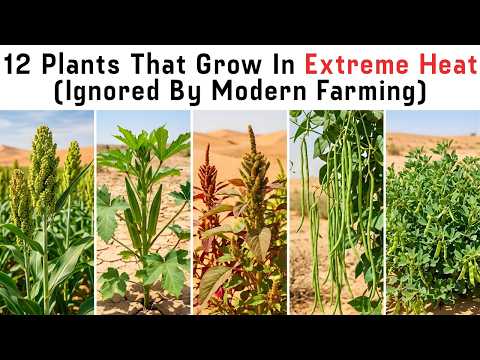
This article explores 12 drought-resistant crops that flourish in extreme heat, many of which have been ignored by modern agriculture. These crops, including okra, Armenian cucumber, Malabar spinach, cow peas, yardlong beans, moringa, sweet potato, sorghum, temporary beans, millet, amaranth, and roselle hibiscus, offer sustainable solutions for food production in a warming world, drawing on ancient agricultural wisdom.
What if the most drought-resistant food crops on Earth are not found in seed catalogs or garden centers but are instead growing in desert villages, ancient farmlands, and forgotten fields? These are plants that thrive when temperatures break records, producing food without irrigation while typical gardens wilt. Modern seed industries often sell varieties bred for perfect conditions that no longer exist, ignoring these resilient crops.
Climate change is destroying harvests, yet corporations overlook crops that flourish in extreme heat. Our ancestors fed entire civilizations through decades-long droughts by cultivating plants adapted to harsh conditions—knowledge that industrial farming hopes we forget.
Here are 12 crops that grow in extreme heat and why modern farming ignores them, ranked from impressive to absolutely incredible.
Originating in the scorching highlands of Ethiopia, okra thrives where other crops fail. American southerners adopted okra centuries ago because it reliably produces through brutal, humid summers.
For gardeners whose summer crops fail by July, okra is a dependable survivor.
Despite its name, this ancient vegetable originated between Turkey and Iran, where summer temperatures routinely exceed 100°F.
This crop is ideal for those tired of heat ruining cucumber harvests.
Regular spinach bolts and turns bitter above 75°F, but Malabar spinach thrives when temperatures exceed 80°F.
Malabar spinach provides fresh greens during hot months when lettuce fails.
Known as black-eyed peas, cow peas originated in Africa thousands of years ago.
Cow peas tolerate poor soil and drought, improving soil fertility for subsequent crops.
Originating in hot, humid Southeast Asia, yardlong beans produce pods up to 3 feet long.
Ideal for those who love green beans but face brutal summers.
From the foothills of the Himalayas, moringa has spread across tropical regions due to its unmatched nutrition and heat tolerance.
Moringa is a permanent food source in tropical climates requiring minimal care.
Originating in tropical Central and South America, sweet potatoes thrive where regular potatoes struggle.
Sweet potatoes are reliable calorie crops that store without refrigeration.
Domesticated 5,000 years ago in Africa's hottest, driest regions, sorghum fed empires where wheat and corn failed.
Sorghum is making a comeback as a grain that survives climate change.
Cultivated in the Sonoran Desert for over 8,000 years, temporary beans survive where regular beans perish.
Perfect for gardening in genuinely arid conditions.
Domesticated 7,000 years ago in China and Africa, millet is one of the oldest crops.
Millet is a reliable grain crop for heat-stressed gardens.
Central to the Aztec Empire, amaranth was banned by Spanish colonizers but is now returning.
Amaranth is a complete protein grain that thrives in extreme heat.
Known mostly as an ornamental flower, roselle hibiscus is grown for its edible calyces.
Roselle hibiscus produces food, medicine, and beauty while thriving in extreme heat.
Modern industrial farming bred plants for perfect conditions with unlimited irrigation and chemical inputs—conditions that are disappearing rapidly due to climate change. These 12 crops represent agricultural wisdom developed over thousands of years by people who had no choice but to succeed without modern technology.
They are not primitive alternatives but sophisticated solutions adapted to reality. Starting with two or three of these crops suited to your conditions can prove their worth through the hottest, driest summers. Saving seeds and expanding cultivation can transform your garden into a resilient food source.
These plants evolved to produce food when nothing else survives and are ready to do the same for you.
If you are interested in sustainable, heat-tolerant agriculture, consider planting these remarkable crops and rediscovering the wisdom of ancient farming traditions.



















