
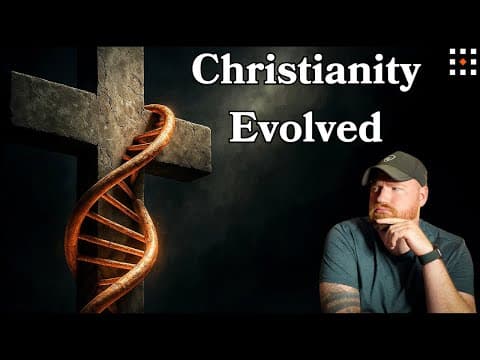
This blog post explores the parallels between the evolution of Christianity and biological evolution, highlighting how both have adapted, changed, and survived through various pressures and historical contexts. It discusses concepts such as descent with modification, vestigial traits, and co-option, drawing comparisons between evolutionary biology and the development of Christian theology.
Understanding the evolution of Christianity can be a profound experience, especially for those who have left fundamentalist backgrounds. This exploration reveals that religious texts and beliefs are man-made, shaped by historical and cultural contexts, much like biological evolution. Here, we will delve into how Christianity has evolved similarly to life on Earth, using concepts from evolutionary biology to illustrate these changes.
The principle of descent with modification states that new species evolve from existing ones while retaining some characteristics. For example, humans and apes share a common ancestor, evidenced by DNA and skeletal similarities. Similarly, Christianity evolved from Judaism, retaining elements like the Hebrew scriptures while introducing new themes through Christ and grace. This historical evolution suggests that Christianity is a man-made construct rather than a divine truth.
Vestigial traits are structures that once served a function but are no longer necessary. In biology, examples include the leg bones in whales and tailbones in humans. In Christianity, vestigial traits can be seen in practices like animal sacrifices and temple laws, remnants from Judaism that are no longer needed but still exist in some form within the New Covenant.
Convergent evolution occurs when separate species develop similar traits in response to similar environmental pressures. In Christianity, this can be observed in the various denominations that have emerged, each adapting to cultural and theological needs. For instance, the concept of sacrifice appears in both Christianity and ancient Mayan religions, reflecting a common human response to existential questions.
Co-option refers to a trait evolving for one purpose and later being repurposed. The idea of the Messiah in the Old Testament was initially a powerful king meant to free the people. Over time, this concept evolved into a sacrificial servant figure in Christianity, illustrating how religious ideas can adapt to new contexts.
Evolution often results in imperfect designs due to the constraints of existing structures. A classic example is the laryngeal nerve in giraffes, which is inefficiently routed. In Christianity, the concept of the Trinity attempts to integrate Jesus and the Holy Spirit into a monotheistic framework, resulting in a complex and often contradictory theological structure.
Adaptive radiation occurs when a single species evolves into multiple forms to fill various niches. This is evident in Christianity, where different denominations have emerged to address diverse theological perspectives and cultural contexts, such as Calvinism and universalism.
Survival of the fittest refers to the idea that traits aiding survival in specific environments are passed on. In Christianity, early church adaptations, such as the relaxation of Jewish laws for Gentile converts, allowed the faith to thrive in the Roman Empire, akin to moths adapting to darker environments.
Genetic drift describes changes in traits due to random sampling rather than advantages. In Christianity, certain texts, like the Gospel of Thomas, were excluded from the canon not necessarily due to their truth but due to historical accidents and the political climate of early Christianity.
The bottleneck effect occurs when a population experiences a sharp reduction, leading to decreased genetic diversity. In Christianity, significant events like the Council of Nicaea consolidated various beliefs, reducing diversity and shaping the future of the religion.
Mimicry involves one species evolving traits that resemble another for advantage. Christianity has adopted many traits from other religions, such as Christmas and Easter celebrations, which were influenced by pagan traditions.
An arms race in evolution describes the ongoing adaptations between predators and prey. In the context of Christianity, as science advanced, theological explanations had to evolve to maintain relevance, leading to reinterpretations of biblical texts to align with scientific understanding.
Punctuated equilibrium refers to long periods of stability interrupted by rapid change. Christianity has experienced such shifts, notably during the Reformation, which dramatically altered its trajectory and practices.
Mutations introduce new traits, some beneficial and others harmful. In Christianity, new doctrines and movements can emerge unexpectedly, sometimes leading to revitalization or rejection as heretical.
Hybridization occurs when two distinct species interbreed to create a new one. Christianity itself is a hybrid of Greco-Roman philosophy, Canaanite cosmology, and Jewish theology, resulting in a unique religious framework.
The founder effect describes how the traits of a founding population dominate a new group. In Christianity, Paul's theology significantly influenced the New Testament and shaped the religion's development, not necessarily due to its superiority but because of its early proliferation.
Environmental pressure dictates which traits are advantageous. Early Christianity developed during Roman occupation, responding to the cultural and political climate, much like polar bears adapting to cold environments.
Cultural evolution mirrors biological evolution, with ideas spreading and adapting over time. Doctrines in Christianity have evolved similarly, with concepts of hell transforming from fiery torture to metaphorical interpretations.
Shared ancestry is evident in both biology and religion. Christianity retains elements from earlier belief systems, such as Canaanite religion, which can be traced through historical texts and interpretations.
Some branches of evolution fail and die out. Similarly, early Christian sects like the Gnostics and Ebionites vanished not due to their beliefs being less valid but because they were less adapted to survive in their historical contexts.
Sexual selection involves traits evolving to attract mates rather than for survival. In Christianity, lavish cathedrals and ornate rituals developed not out of necessity but to impress followers and compete with other religions.
The evolution of Christianity parallels biological evolution in many ways, showcasing how both have adapted and transformed over time. Understanding these processes can provide insight into the nature of religion and its role in human society. As we continue to explore these themes, it becomes clear that both life and belief systems are shaped by their environments, histories, and the inherent need for survival and relevance.



















