
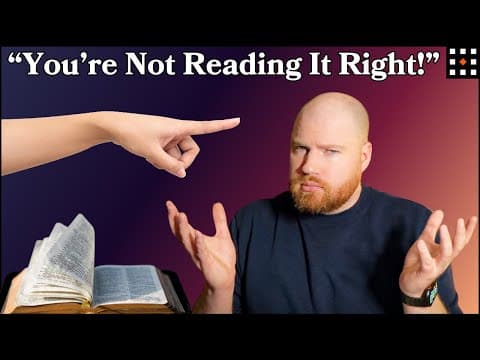
This blog post critiques five common methods Christians use to read the Bible, highlighting their contradictions and shortcomings. It discusses a testimony of a woman who claims to have found clarity in her faith through a specific reading lens, while also examining the broader implications of these reading strategies on understanding God’s character and the text itself.
In the realm of Christianity, the Bible is often regarded as the ultimate authority. However, the ways in which individuals interpret and engage with this sacred text can vary significantly. In this post, we will explore five common methods Christians use to read the Bible, highlighting their contradictions and shortcomings. We will also examine a testimony from a woman who claims to have found clarity in her faith through a specific reading lens, while questioning the broader implications of these strategies on understanding God’s character and the text itself.
Many Christians assert that others are not reading the Bible correctly. This claim often leads to a myriad of suggested approaches, each contradicting the other. The inconsistency in these interpretations raises questions about the reliability of the text and the nature of God as depicted within it.
To illustrate the complexities of biblical interpretation, let’s consider a testimony from a woman who recounts her journey through the Bible. Initially, she read the entire text and felt disillusioned, stating, "I didn’t like him [God]." After discussing her struggles with her pastor, she was encouraged to read the Bible again, this time focusing on understanding God rather than herself. She claims that this shift in perspective allowed her to fall in love with God. However, this narrative raises several questions:
While her testimony suggests a straightforward solution to her struggles, it overlooks the complexities of the biblical text. Many Christians have not read the Bible in its entirety, yet they often cling to interpretations that align with their beliefs. This raises the question: if the Bible is indeed the word of God, why do so many struggle to reconcile its teachings with their understanding of morality and justice?
Let’s delve into the five common methods Christians often suggest for reading the Bible, along with the inherent issues in each approach.
Many Christians believe that one must read the Bible with the guidance of the Holy Spirit to truly understand its meaning. However, this raises a significant issue: if the Holy Spirit is necessary for comprehension, how can outsiders evaluate the truth claims of the Bible? This reliance on the Holy Spirit can lead to a lack of accountability and critical thinking.
A literal interpretation of the Bible is favored by many, yet this approach can lead to justifying morally questionable practices such as slavery and genocide. Those who advocate for a literal reading often face criticism from others who argue for a more nuanced understanding of the text, creating further division among believers.
Contextual reading emphasizes understanding the historical and cultural background of biblical texts. While this method can provide valuable insights, it is often applied selectively. Critics argue that this approach can undermine the idea of an immutable moral truth, suggesting that morality is conditional rather than absolute.
Some Christians advocate for a spiritual reading of the Bible, suggesting that the text conveys deeper truths beyond its literal meaning. However, this method can lead to subjective interpretations that may not hold up under scrutiny. If one applies this approach to other religious texts, it raises questions about the validity of those texts as well.
Finally, many Christians encourage reading the Bible with faith, suggesting that skepticism should be set aside. This perspective implies that doubt is inherently sinful, which can discourage honest inquiry and critical thinking. It also raises the question of whether one can genuinely engage with the text if they are expected to ignore its problematic aspects.
The various approaches to reading the Bible highlight a fundamental inconsistency within Christianity. If believers cannot agree on how to interpret the text, it calls into question the reliability of the Bible as a moral and spiritual guide. The notion that one must adhere to a specific reading method to understand God’s will is problematic, especially when those methods contradict one another.
The exploration of these five common methods of reading the Bible reveals significant flaws and contradictions within Christian interpretations. While personal testimonies may suggest that a change in perspective can lead to a deeper understanding of God, the complexities of the biblical text and the diverse interpretations among believers challenge this notion. Ultimately, engaging with the Bible requires a critical and open-minded approach, one that acknowledges the text's inherent difficulties rather than glossing over them in favor of simplistic solutions.
As we continue to navigate the complexities of faith and interpretation, it is essential to encourage honest inquiry and critical thinking rather than perpetuating a cycle of doubt and shame. The journey of understanding the Bible is not just about finding answers but also about grappling with the questions it raises.



















