
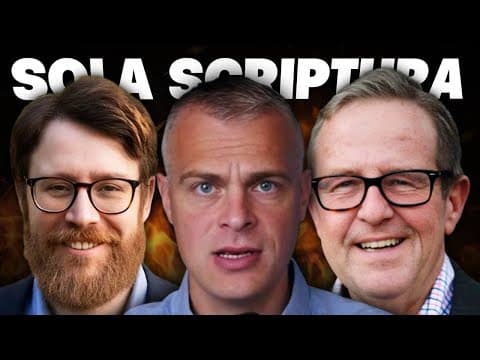
This article critically reviews a recent video defending Sola Scriptura, highlighting its flawed use of patristic quotations, misrepresentations of traditional theologians, and the hypocrisy of Protestant elites who demand respect for their sources but fail to engage with them properly. It emphasizes the need for honest and rigorous theological discourse on Scripture and tradition.
On December 10th, a highly anticipated review was presented addressing a recent video that attempts to defend the doctrine of Sola Scriptura. The video, produced by prominent Protestant scholars and theologians such as Jordan Cooper, Gavin Orland, and Michael Horton, was met with significant criticism for its poor quality and flawed arguments. This article provides a comprehensive critique of the video, focusing on its misuse of patristic quotations, misrepresentation of traditional theological sources, and the broader implications for theological discourse.
The Protestant community often encourages engagement with traditional theologians, urging critics and adherents alike to read respected figures such as Gerhard Kittel and others. This call is frequently accompanied by accusations that Catholic apologists and others misrepresent Protestant views. However, the video under review fails to meet these standards, instead relying on superficial and inaccurate references that undermine its credibility.
One of the most glaring issues in the video is the misuse of patristic quotations. For example, Michael Horton cites a supposed quote from Tertullian, which upon closer examination, is not a direct quotation but rather a statement made by another individual discussing Tertullian. This misattribution not only weakens the argument but also reflects a lack of rigorous scholarship.
The patristic quotations throughout the video are described as "terrible," indicating a pattern of careless or misleading use of early church writings. Such errors are particularly problematic given the importance of patristic sources in theological debates about Scripture and tradition.
The video exemplifies a broader issue within certain Protestant circles: the demand for respect and serious engagement with their theological tradition, contrasted with their own failure to engage deeply with Catholic or other perspectives. Instead of addressing substantive critiques, the video responds to entry-level or popular Catholic content, which does not represent the most robust or scholarly arguments.
This selective engagement is seen as hypocritical, as these Protestant elites call for their tradition to be taken seriously while neglecting to uphold the same standard themselves.
The video also perpetuates common misrepresentations regarding key theological concepts such as sacred tradition, the magisterium, and doctrinal development. These topics are often oversimplified or distorted, leading to misunderstandings and unfair critiques of Catholic doctrine.
For instance, the Protestant claim that "Scripture alone" is the sole authority is frequently challenged by pointing to creeds, confessions, and the writings of those who formulated them. However, the video fails to adequately address these complexities, instead reiterating simplistic slogans without engaging with the nuanced theological realities.
The frustration expressed in the critique stems from a desire for honest and rigorous theological dialogue. When Protestant scholars urge others to read their best authors and engage with their tradition seriously, they must also be willing to do the same with opposing views.
Engaging only with popular or entry-level content does not advance understanding or foster meaningful discussion. Both sides must commit to thorough scholarship and fair representation to move beyond entrenched positions and misunderstandings.
The reviewed video serves as a cautionary example of how theological arguments can falter when scholarship is superficial and engagement is selective. The misuse of patristic quotations, the hypocrisy in demanding respect without reciprocation, and the misrepresentation of complex theological concepts all contribute to a weak defense of Sola Scriptura.
For constructive theological discourse to flourish, all parties must prioritize accuracy, depth, and mutual respect. Only then can debates about Scripture, tradition, and authority be fruitful and edifying for the broader Christian community and beyond.



















