
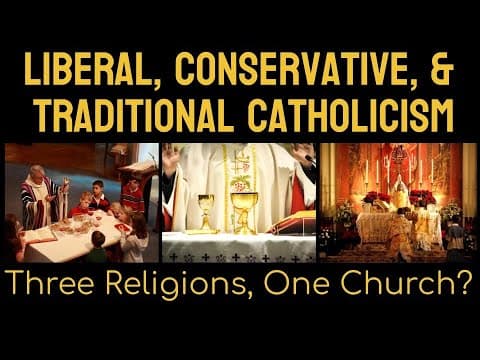
This blog post explores the divisions within the Catholic Church, focusing on the distinctions between liberal, traditionalist, and conservative Catholicism. It examines the historical roots of these divisions, the philosophical underpinnings of liberalism, and the implications for the future of the Church, advocating for a path towards unity based on truth and humility.
In this post, we delve into the divisions within the Catholic Church, particularly the distinctions between liberal, traditionalist, and conservative interpretations of the faith. The reality of these divisions is not just a matter of differing opinions but reflects deeper philosophical and historical roots that have shaped the Church's trajectory over the centuries.
The Catholic Church today faces significant divisions among its members, often categorized as liberal, traditionalist, and conservative. While some argue that political labels do not apply to the Church, it is essential to recognize that these terms can help describe the theological dispositions of various Catholic figures throughout history. The use of such labels is not intended to create division but to accurately reflect the realities observed within the Church.
The Enlightenment, a philosophical movement that emerged in the 18th century, laid the groundwork for modern liberal thought. It sought to replace traditional norms, such as hereditary privilege and state religion, with ideals of democracy, equality, and individual rights. Philosophers like John Locke argued for natural rights, which influenced both political and religious thought.
This philosophical revolution has had lasting effects on Catholicism, leading to the emergence of liberal Catholicism, which often prioritizes secular academic methods over traditional theological approaches. The tension between these differing interpretations of Catholicism can be traced back to the Enlightenment's challenge to divine revelation and traditional authority.
Liberal Catholicism can be characterized by a preference for secular methodologies and conclusions over the teachings of the Church. This trend gained momentum in the 19th and 20th centuries, particularly during and after the Second Vatican Council, which many perceived as a turning point that opened the door to liberal interpretations of Catholic doctrine.
Liberal Catholics tend to favor secular academic approaches to theological questions, often employing historical-critical methods when studying scripture. This group may prioritize contemporary moral philosophies, such as feminism, over traditional Catholic teachings. The essential definition of liberal Catholicism is that it comprises those who prefer secular methodologies and conclusions, sometimes even at the expense of established dogmas.
In contrast, traditional Catholics reject Enlightenment-inspired methodologies and rely on medieval philosophical traditions to explore theological questions. They emphasize the importance of dogma and the teachings of the Church Fathers, often advocating for practices such as the traditional Latin Mass.
Conservative Catholics occupy a middle ground, engaging with secular academic methods while maintaining a commitment to dogmatic orthodoxy. They appreciate Enlightenment thought but do not reject the core teachings of the Church, striving to integrate modern scholarship with traditional beliefs.
The struggle against liberalism within the Church has been ongoing since the Enlightenment. Popes throughout the 19th and early 20th centuries, such as Pius IX and Pius X, condemned modernist and liberal ideas, emphasizing the need to protect Catholic intellectual life from secular influences. Vatican I and subsequent papal teachings sought to reaffirm the importance of dogma and the authority of the Church in matters of faith and morals.
The Second Vatican Council marked a significant shift in the Church's approach to modernity. While the intention was to engage with contemporary society, many liberal theologians interpreted the council as a mandate for a more radical departure from tradition. This has led to a perception of a rupture between Catholic tradition and modern practice, with some viewing the changes as a revolution in Church thinking.
Healing the divisions within the Church requires acknowledging the existence of these intellectual factions rather than ignoring them. The pursuit of truth, guided by humility, is essential for fostering unity among Catholics. It is crucial for Church leaders to confront these divisions openly and to reaffirm the importance of dogma in maintaining the coherence of the faith.
Prayer is fundamental in seeking healing for the Church. Catholics are encouraged to pray for unity and for the guidance of the Holy Spirit in addressing the challenges faced by the Church today. Additionally, respectful dialogue among the different camps can help bridge gaps and foster mutual understanding.
The divisions within the Catholic Church reflect broader philosophical and historical struggles that have shaped its identity. By recognizing and addressing these divisions, Catholics can work towards a more unified Church that remains faithful to its teachings while engaging with the complexities of modernity. Ultimately, the path forward lies in a commitment to truth, humility, and the pursuit of genuine unity among all members of the Church.



















