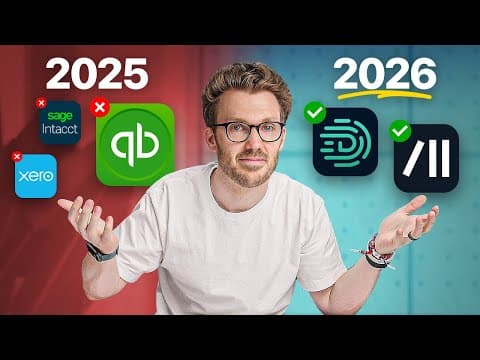
Many US accounting firms traditionally use QuickBooks or Zero, but new AI-powered accounting platforms like Digits and Kick are emerging as promising alternatives. This article reviews 19 accounting platforms, highlighting those to avoid, situationally useful ones, and the top AI-driven options that could revolutionize accounting practices for small to mid-market businesses.
Most US accounting firms currently rely on QuickBooks, while firms in other parts of the world often use combinations of Zero and Sage products. However, the landscape is changing rapidly, and many accounting firms are seeking alternatives that better meet their needs, especially with the advent of AI-powered tools.
This article explores 19 accounting platforms tailored for small businesses but specifically evaluates their suitability for accounting firms and bookkeepers working with clients. We will cover platforms to avoid, those that may be suitable in certain situations, and the two most promising AI-driven platforms that could dethrone QuickBooks and Zero.
FreshBooks: Good for simple invoicing but lacks the depth needed for accounting firms managing multiple clients.
Intact: Targets the mid-market but has better alternatives available.
Patriot: Somewhat dated and less competitive compared to newer platforms.
QuickBooks Desktop: Despite its popularity, it is outdated and even the developers discourage its use.
Sage Products (e.g., Sage 50 Cloud): Not considered the future of accounting software.
Wave: A solid all-in-one platform but lacks professional tools required for complex accounting tasks.
FreeAgent: Designed primarily for the UK market, not suitable for US firms.
Accounting Power: Post-acquisition by Iris, it has lost momentum and user base.
Accounting CS by Thomson Reuters: Provides consistency tools but is not seen as the future of accounting software.
NetSuite: A mid-market tool that can be complex and costly; suitable for clients needing IPO readiness or audit preparation but often overkill for small businesses.
Campfire: A mid-market tool built from scratch, more accessible than NetSuite or Intact, good for clients with multiple businesses.
Real: Alongside Campfire, making significant inroads in the mid-market ledger space.
QuickBooks Enterprise: Still useful for clients in rural areas with unreliable internet or those needing offline capabilities.
Puzzle: A new AI-first platform, promising but still early in development.
Soft Ledger: Multi-entity accounting platform, simple and potentially good for franchise situations.
Zoho Books: Not great as a standalone accounting platform but valuable when integrated with the full Zoho suite.
ODOO: An all-in-one software suite with accounting features, suitable for niche firms supporting businesses fully on ODOO.
Digits has recently evolved into a full double-entry ledger platform suitable for basic cash basis accounting. Its standout feature is automated transaction classification, including custom classification models tailored to how your firm codes transactions. This means new client files can automatically adopt your firm's classification style, saving significant time.
Digits also offers automated bank reconciliations and a built-in AI assistant. It can integrate with QuickBooks Online, allowing firms to test the platform before fully transitioning.
Kick is an early-stage, AI-powered accounting platform that charges per client rather than per company. This is particularly advantageous for clients with multiple LLCs or entities, as all can be managed within a single workspace with proper double-entry ledgers.
Kick supports multi-entity accounting in one place, a feature typically found in more expensive mid-market platforms, but designed for small businesses. It has garnered excitement among accounting professionals as a viable alternative to QuickBooks Online and Zero.
One of the biggest challenges for accounting firms is finding qualified accountants. A combination of onshore and offshore hiring has proven effective for some firms.
Cloud Accountant Staffing is a reputable service that helps firms hire offshore accountants as part of their remote teams, rather than outsourcing entire projects. This approach maintains quality and control while expanding capacity.
The accounting software landscape is evolving, with AI-powered platforms like Digits and Kick offering innovative features that could disrupt the dominance of QuickBooks and Zero. While many traditional platforms remain in use, firms should consider testing these new tools, especially for cash basis bookkeeping and clients with multiple entities.
Choosing the right accounting ledger is crucial for efficiency and scalability. Firms are encouraged to explore these alternatives and build a tech stack that supports their growth and client needs.
For firms interested in building their accounting tech stack from scratch, comprehensive guides and app recommendations are available to help make informed decisions.