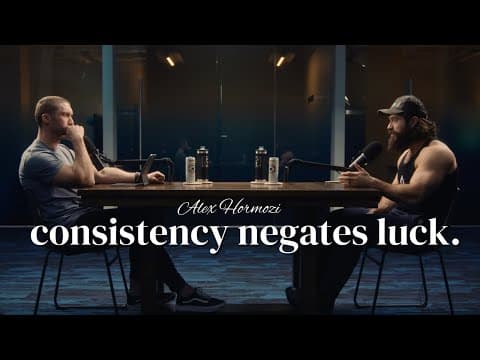
Alex Hormozi shares insights on the challenges of starting out, the importance of persistence, and how volume of effort negates luck. He emphasizes embracing early hardships, making quick decisions, and rooting for yourself to achieve long-term success.
Success is often perceived as a distant, daunting goal, but Alex Hormozi breaks down the journey into manageable truths that anyone can apply. In his talk, he emphasizes that the hardest part of success is the beginning, and once you get through that, everything else becomes easier. This article explores Hormozi's insights on perseverance, volume, decision-making, and self-belief.
Hormozi compares the early stages of success to fighting a bear with just a stick. At this point, you have minimal resources, no leverage, and no one to help you. The challenges ahead may grow bigger, but so do your skills and allies. Early on, it’s just you against the odds, and that fight is arguably harder than facing bigger challenges later with more support.
He points out that in the beginning, you are essentially burning your most valuable resource: time. You don’t have money to hire help or resources to delegate tasks. No one can learn skills for you, and no one can do the hard work on your behalf. This makes the early days painful and lonely.
Hormozi encourages reframing early hardships as valuable experiences that build context and skills. He references the movie Slumdog Millionaire, where random life experiences become the key to winning a game show. Similarly, skills and lessons learned in the trenches often provide huge advantages later.
Rather than lamenting the struggle, view these challenges as arrows in your quiver to slay future dragons. Expecting an easy path only makes the journey harder.
When you feel like you have nothing going for you, it also means you have nothing to lose by taking action. This mindset can make you more dangerous and willing to take risks others won’t. Hormozi shares his own experience of multiple failures before finding success, emphasizing that failure is part of the process.
He notes that people who are right most of the time can still be wrong in the big moments that matter. Success often comes after many failures, and the key is to keep going despite the naysayers.
Hormozi shares a story about a teacher who gave two classes different assignments: one to make a perfect clay pot, and the other to make as many pots as possible. The class focused on volume not only produced more pots but also better quality ones.
This illustrates the principle that volume negates luck. Success is not about a single perfect moment but about consistent effort over time. The money isn’t made in the buy or sell but in the wait.
A mediocre plan that you stick to will always outperform a perfect plan that you abandon. Hormozi stresses the importance of the "stick-to-it" muscle. Many people start and stop repeatedly because they haven’t yet been reinforced enough to persist.
The world belongs to optimists who believe big things can happen. You have to root for yourself before anyone else does, often clapping for yourself in an empty auditorium.
One of the greatest hacks for productivity is simply beginning. Once you start working, your output per unit of time increases because you get into the mood to work. Procrastination is often just avoiding the initial step.
Hormozi asks, "What would you do if you weren’t afraid?" This question helps in making big life decisions and overcoming hesitation.
Doing what most people can’t do often means extending the time horizon and persisting longer than others. There is immense opportunity on the other side of persistence without immediate positive reinforcement.
The longer you stick with something without external validation, the easier opportunities become because few people can endure that.
Hormozi highlights how making decisions faster can accelerate your progress. For example, if a normal person takes a week to make a decision, a more decisive person can make the same decision in a day. This speed compounds over multiple decisions, allowing you to move through life much faster.
Knowing what you want is 99% of the battle. Once you are clear, getting it becomes easier because you know what you are willing to give up to achieve it. This clarity helps in focusing your efforts and making sacrifices.
A leading indicator of a successful person is the ability to act even when nothing is happening yet. Progress often happens slower than expected initially, then faster than imagined later.
Exceptional people often walk a lonely path because they are different from others. Rather than resenting this, see it as a sign you are on the right path. If everyone were cheering you on, you might not be pushing boundaries.
Alex Hormozi’s insights remind us that success is a marathon, not a sprint. The early struggles, persistence, volume of effort, quick decision-making, and self-belief are crucial components. Embrace the hard beginning, root for yourself, and keep moving forward. The journey may be lonely and challenging, but the rewards on the other side are worth it.