
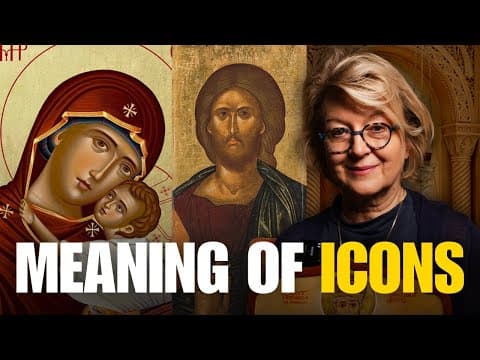
This article explores the iconostasis, a central screen in Orthodox churches that separates the congregation from the sanctuary. It delves into the symbolism of key icons such as the Mother of God, Jesus Christ, St. John the Baptist, and others, explaining the use of Greek letters, spiritual meanings behind iconographic elements like mountains and pillars, and the historical role of St. Luke as the first iconographer.
The iconostasis is a fundamental element in any Orthodox Church. It is a screen that separates the parishioners from the Holy of Holies, the most sacred part of the church located behind the altar. This article provides an in-depth explanation of the iconostasis, its icons, and the rich symbolism embedded within.
Standing before the iconostasis, one immediately notices two prominent icons: the Mother of God and Jesus Christ. These icons are always inscribed with Greek abbreviations — for the Mother of God, the letters "MP" and "ΘΥ" (an abbreviation for "Meter Theou" meaning "Mother of God"), and for Jesus Christ, "IC" and "XC" (short for "Iesous Christos"). These Greek letters remain consistent regardless of the country where the church is located.
The halo around Jesus often features a cross with Greek letters symbolizing "I am who I am," a profound theological statement.
In churches commemorating St. George, his icon is prominently displayed, often depicting him slaying a dragon. This symbolizes the triumph of good over evil.
Two angels, Michael and Gabriel, are also commonly represented on the iconostasis, serving as heavenly messengers.
St. John the Baptist is frequently depicted with wings behind him, symbolizing his role as a messenger who came before Jesus. This winged portrayal likens him to an angel, emphasizing his spiritual mission.
Interestingly, time is considered irrelevant in iconography, which allows for unique depictions such as St. John standing alive while simultaneously showing his head on a plate, representing his martyrdom.
Mountains appear frequently in icons, not necessarily reflecting the saint's geographical origin but symbolizing the steps or ladder to heaven. They represent spiritual ascent and closeness to the divine.
Pillars topped with icons of the four Evangelists — Matthew, John, Mark, and Luke — are common. These pillars symbolize the connection between Heaven and Earth, with the Evangelists serving as our link to the divine through their writings and teachings.
St. Luke holds a special place in iconography as the first iconographer. Originally a medical doctor, he possessed the skill to draw human anatomy accurately, a requirement for physicians of his time.
He is credited with painting the first icon of the Mother of God at her request before she departed from Earth. This icon was meant to bless the faithful and assure them of her intercession with her son, Jesus Christ.
Icons of Old Testament figures such as Moses, Noah, and Abraham are placed higher on the iconostasis, representing their status as saints from the Old Testament. The second layer typically features the Apostles.
In some Orthodox churches, especially in Russia and Serbia, the iconostasis can have multiple layers. This tradition arose partly because early churches were built from wood, which was unsuitable for frescoes due to its porous and expanding nature. Therefore, the iconostasis became the primary surface for sacred art.
A common observation is that saints on icons often appear flat. This is intentional, as icons are spiritual portraits rather than realistic depictions. The gold background and the icon itself represent heavenly light, where shadows do not exist. Unlike earthly light, which creates shadows, the divine light is omnipresent, illuminating everything equally.
This artistic choice emphasizes the spiritual nature of the saints and their closeness to God.
The iconostasis is much more than a decorative screen; it is a theological and spiritual gateway that connects the earthly congregation with the heavenly realm. Each icon, symbol, and artistic choice carries deep meaning, reflecting centuries of tradition and faith. Understanding these elements enriches the experience of worship and appreciation of Orthodox Christian art and spirituality.



















