
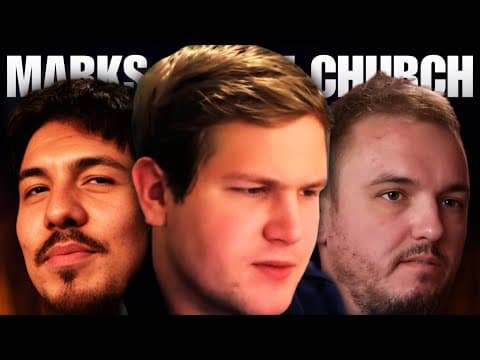
The recent debate between Catholic apologist Voice of Reason and Eastern Orthodox apologist Ubie Petetrus on the marks of the church revealed significant flaws in both arguments, highlighting the complexities of unity, holiness, and Catholicity within Christianity.
Around two weeks ago, a highly anticipated debate took place between Catholic apologist Voice of Reason and Eastern Orthodox apologist Ubie Petetrus. The focus of this debate was on the marks or notes of the church, specifically the claims that the Orthodox Church uniquely possesses the notes of unity, Catholicity, apostolicity, and holiness as outlined in the Nicene Creed.
Ubie Petetrus aimed to demonstrate that the Orthodox Church holds these marks uniquely. His argument revolved around establishing a minimum standard, asserting that the early church lacked unity on various points, which also applied to Catholicity, particularly in terms of numbers and geographical reach compared to groups like the Arians.
Conversely, Voice of Reason argued that Catholicism's geographical and numerical dominance over other Christian groups, alongside the disunity present in Eastern Orthodoxy, undermined Ubie's claims. While both debaters presented compelling points, they also exhibited significant flaws that left the audience unsatisfied with the conclusions drawn.
One of the main criticisms of Ubie's argument is that it inadvertently allows for the possibility of other groups, such as the Nestorian Church or the Anglican Church, to be considered as possessing the necessary unity and Catholicity. This raises questions about the effectiveness of the marks in distinguishing the true church from heretical sects. Ubie's reduction of Catholicity to doctrinal orthodoxy and unity to the presence of the Eucharist was seen as a significant weakness in his position.
On the other hand, Voice of Reason's assertion that Catholicity is defined by geographical and numerical success raises historical inconsistencies. There were periods in church history when the undivided church was overshadowed by heretical sects, challenging the notion that such victories are unique to the Catholic Church. Furthermore, the claim of unity within Catholicism is complicated by the existence of various schools of thought and disagreements, similar to those found in Orthodoxy.
The debate highlighted a deeper issue regarding the understanding of the marks of the church. The distinction between possessing a mark and having an element of it is crucial. For instance, while various groups may exhibit elements of unity or holiness, they do not possess these marks in their fullness. This distinction is essential in understanding the Catholic Church's claim to be one, holy, catholic, and apostolic.
The Catholic Church claims to be holy, but this does not imply that all its members are holy. Instead, the church is seen as the source of holiness, providing the means through sacraments and teachings that can lead to holiness. The presence of saints and the process of canonization serve as manifestations of this holiness, but they do not define it.
Unity is often demonstrated through the universal code of canon law, yet this does not negate the church's unity prior to its promulgation. The presence of various signs and manifestations of unity can fluctuate, but the essential mark of unity remains.
Critics may argue that the teachings of the Second Vatican Council contradict preconciliar traditions. However, historical theologians have acknowledged that while other Christian communities may possess certain elements of the marks, they do not fully embody them as the Catholic Church does. This nuanced understanding allows for a more comprehensive view of the church's relationship with other Christian bodies.
The debate between Ubie Petetrus and Voice of Reason illuminated the complexities surrounding the marks of the church. Both sides presented valid points but also revealed significant flaws in their arguments. A careful examination of the distinctions made by theologians regarding the notes of the church can provide a clearer understanding of what it means for the Catholic Church to claim to be one, holy, catholic, and apostolic. As discussions on this topic continue, it is essential to approach them with a balanced perspective that acknowledges the intricacies involved in defining the true church.



















