
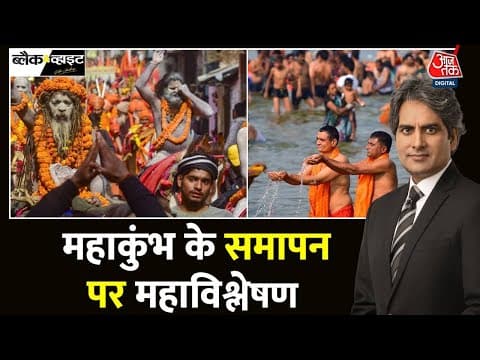
The Mahakumbh, a monumental religious gathering in India, witnessed participation from over 66 crore people, marking it as the largest survey of public sentiment. This event signifies a silent revolution in Indian society, reflecting a renewed pride in Hindu identity and cultural heritage, while also breaking down caste barriers and fostering communal harmony.
Namaskar, I am Sudhir Chaudhary, and welcome to Black and White. First of all, I wish you all a very happy Mahashivratri. Mahashivratri marks the wedding of Lord Shiva and Goddess Parvati, which can be considered the world's largest wedding procession. On this auspicious occasion, the Mahakumbh has concluded, leaving us with a sense of emptiness, as if we wish it could continue indefinitely.
Over the past 45 days, approximately 66 crore people participated in the Mahakumbh, making it the largest public gathering in history. This event can be viewed as the world's largest referendum, with a sample size that surpasses even the voter turnout of the last Indian general elections, where around 64 crore people cast their votes. Today, we will analyze this monumental event and discuss the silent revolution it signifies in Indian society.
The Mahakumbh was not just a religious event; it served as a significant survey reflecting the sentiments of 66 crore Hindus regarding their faith, culture, and traditions. This silent revolution indicates a profound ideological shift within Indian society, one that many political leaders and survey agencies seem to overlook. The participation of such a vast number of people without any incidents of violence or communal discord speaks volumes about the unity and harmony among the participants.
A New Confidence in Sanatan Dharma: The event showcased a renewed faith among Hindus in their cultural heritage. Participants expressed pride in their identity as Sanatanis, no longer feeling ashamed of their beliefs.
Absence of Controversy: Despite the massive turnout, there were no reports of religious intolerance or calls for the exclusion of other faiths. Instead, the atmosphere was filled with devotion, harmony, and respect.
Inclusivity Across Social Classes: The Mahakumbh was a celebration for the lower and middle classes, who often feel marginalized in societal narratives. Many participants were from humble backgrounds, demonstrating their belief in the spiritual significance of the event.
Breaking Caste Barriers: The event saw people from various castes and communities coming together to participate in the sacred rituals, highlighting a collective identity that transcends traditional divisions.
Rejection of Superstitions: The overwhelming participation indicates that the public does not view the Mahakumbh as superstition but as a vital aspect of their spiritual journey, reinforcing their beliefs in the sanctity of the rituals.
As the Mahakumbh concluded, many participants expressed a sense of loss, akin to the lyrics of a song from the film "Hum Dono" that resonates with the feeling of not wanting to part ways. This event was not just a religious gathering; it became a part of daily life for many, fostering connections and conversations about faith and spirituality.
This Mahakumbh was unique as it occurred in the digital age, where social media played a significant role in sharing experiences. Millions shared their moments from the event, showcasing the global interest in this monumental gathering. Despite some negative narratives surrounding the event, the overall sentiment was one of pride and celebration.
The Mahakumbh also highlighted the disconnect between political leaders and the sentiments of the common people. Many opposition leaders chose not to participate, which raises questions about their understanding of the electorate's mood. The event served as a reminder that the true essence of India lies in its cultural and spiritual heritage, which should not be politicized.
The Mahakumbh has not only set a record for participation but has also initiated a silent revolution in India. It has redefined the relationship between faith and identity, showcasing a society that is proud of its roots while embracing modernity. As we reflect on this event, it is crucial for leaders and policymakers to recognize the significance of this gathering and the message it conveys about the aspirations and beliefs of the Indian populace. The Mahakumbh has indeed marked a new chapter in India's spiritual journey, one that deserves recognition and respect.



















