
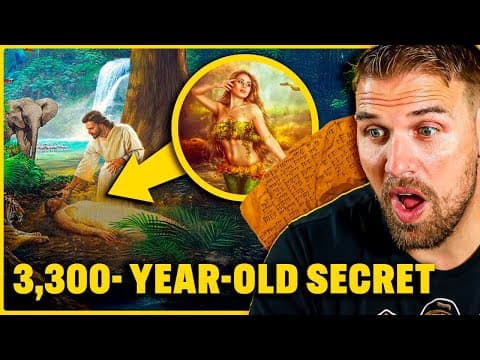
In 1929, archaeologists uncovered ancient tablets in Ugarit that revealed a pre-biblical narrative of creation, challenging the traditional biblical story of Adam and Eve. This narrative, featuring a divine garden, a primordial figure named Adamu, and a serpent, suggests that the biblical account may be a reinterpretation of older myths. The findings highlight the complex interplay between ancient mythologies and the development of monotheistic beliefs, prompting a reevaluation of the origins of
In 1929, French archaeologists working in Rash Shamra, the ancient city of Ugarit, made a groundbreaking discovery that would forever alter our understanding of biblical narratives. Beneath layers of dust and ruins, they unearthed a cache of clay tablets that had been hidden for over 3,000 years. These tablets contained stories that predated the Bible and challenged the very foundations of Judeo-Christian belief.
Among the tablets, two in particular—designated KTU1 100 and KTU 11107—contained narratives that were eerily familiar yet profoundly different from the biblical account of creation. Written in Ugaritic, a language closely related to biblical Hebrew, these texts told a tale of paradise lost, featuring a divine garden, a primordial figure named Adamu, and a malevolent serpent. The lead archaeologist, upon translating the first lines, remarked, "This changes everything."
The implications of these findings suggest that the biblical Adam may not have originated as a mere dust-formed human but rather as a transformed identity of an ancient earth goddess. This revelation invites us to reconsider the biblical creation narrative as a revolutionary adaptation of a much older mythology, one that biblical authors deliberately obscured.
Long before the Israelites settled in the promised land, the ancient Near East was rich with sacred stories of paradise lost. The Sumerians, for instance, spoke of a primordial paradise called Dilman, an Eden-like realm where sickness and death did not exist. This paradise was transformed by the water god Inky into a lush garden, a place of purity and beauty.
The biblical Eden is often depicted as a flat garden, but ancient texts suggest it was actually a mountain sanctuary. Genesis describes four rivers—the Pichon, Gihon, Tigris, and Euphrates—originating from Eden's heights, aligning with the geographical reality that rivers often begin in mountains. This mountain identity of Eden is further supported by the book of Ezekiel, which states, "You were in Eden, the garden of God; you were on the holy mountain of God."
The Ugaritic texts reveal a cosmic pattern where a sacred mountain serves as the axis of creation, connecting heaven and earth. At the heart of these mountain sanctuaries stood a sacred tree, a motif prevalent across Near Eastern cultures. In Canaan, religious activities centered around high places, often associated with the goddess Asher, whose worship persisted even in ancient Israel.
Unlike the Genesis account, the Canaanite story begins with a cosmic rebellion. In this narrative, a powerful deity named Horon, once favored by the creator god El, rebels against divine authority and is cast down. Transformed into a serpent, Horon poisons the tree of life, leading to a catastrophic loss of immortality. The divine council, in response, sends Adamu to restore order, but he is bitten by the serpent and faces mortality for the first time.
Adamu's wife, described as a good-natured woman, plays a significant role in this narrative. Unlike Eve, who is often portrayed as a temptress in the biblical account, Adamu's wife appeals directly to the gods for justice against the serpent. This portrayal highlights her agency and contrasts sharply with the traditional depiction of Eve.
The name Adamu itself has intriguing connections to ancient texts, where it appears as a goddess, specifically an earth goddess. This suggests that the biblical Adam may represent a deliberate dethroning of the goddess Adama, reflecting a broader trend of transforming polytheistic deities into monotheistic concepts. Scholars argue that the Genesis authors were familiar with these earlier Canaanite traditions, leading to a profound reinterpretation of the creation narrative.
The implications of these findings are profound. Rather than viewing Genesis as a direct divine revelation, we must recognize it as emerging from a rich mythological landscape. The biblical authors did not simply copy these earlier myths; they radically reinterpreted them, transforming divine drama into human moral choice.
Both the Ugaritic myth and the Genesis account reveal a tension between divine intention and cosmic resistance. In both narratives, the gods find themselves powerless against the serpent, suggesting that even divine plans can break down. This theme resonates with modern existential questions about the nature of evil and suffering in the world.
The discovery of the Ugaritic tablets invites us to reconsider not only the origins of biblical narratives but also the nature of religious tradition itself. The boundaries between pagan and biblical, myth and revelation, may be more permeable than previously assumed. As we continue to excavate the ancient world's secrets, we uncover a shared spiritual heritage that transcends individual cultures and religions.
The narratives of Adamu and Horon, preserved in clay for millennia, challenge us to explore the complexities of human storytelling and the quest for meaning. Ultimately, these ancient stories reveal not just the divine but the profound human capacity to grapple with life's fundamental questions, shaping civilizations across time and cultures.



















