
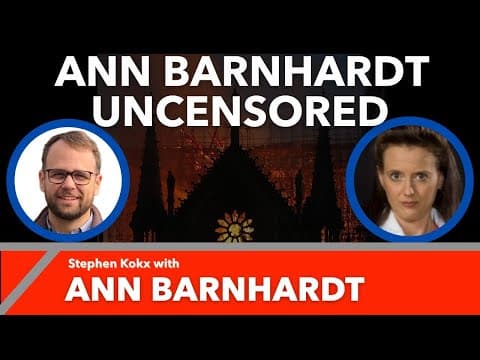
In this extensive interview, Ann Barnhardt shares her journey to Catholicism, critiques the current state of the Church under Pope Francis, and discusses the implications of Sedevacantism. She emphasizes the need for clarity in faith amidst the crisis and the importance of recognizing the true nature of the Church's authority.
Welcome to this episode of Church and State. My name is Stephen Cox, and today we have a special guest, Ann Barnhardt. Known for her outspoken views on various religious and political issues, Ann has been a prominent figure on YouTube for over 15 years. In this discussion, we delve into her background, her conversion to Catholicism, and her thoughts on the current state of the Church under Pope Francis.
Ann Barnhardt was born in 1976, just outside of Kansas City. Raised in a family with a mix of Christian beliefs, she experienced a leftist interpretation of Christianity during her childhood. By the age of 10, she had already begun to question the teachings she received, particularly after a Sunday school teacher claimed that Jesus of Nazareth was merely a construct of the Middle Ages.
Despite this, Ann felt a deep connection to God from a young age. She stopped attending church at 11 due to the hypocrisy she perceived but later felt compelled to read the Bible cover to cover multiple times. Her academic journey led her to major in animal husbandry and agricultural economics, where she gained expertise in cattle marketing and even owned a commodity futures brokerage by the age of 21.
Ann's conversion to Catholicism in 2007 was intellectual rather than emotional. Influenced by C.S. Lewis's Mere Christianity, she began to explore the faith deeply. She describes herself as a "Kennedy convert," initially hesitant to embrace Catholicism due to the negative associations she had with prominent Catholic figures like the Kennedys. However, her extensive reading and research ultimately led her to the conclusion that the Catholic Church is the one true Church.
After her conversion, Ann attended the Novus Ordo Mass and quickly noticed discrepancies in its teachings and practices. She found the emphasis on feelings over doctrine troubling, particularly during the RCIA process, where she felt that many leaders lacked basic knowledge of the faith.
Ann argues that the current state of the Church is a result of unchecked feminine influence, which she believes has led to a dilution of doctrine and a rise in heretical teachings. She points to the appointment of women in positions of authority within the Church as a significant issue, suggesting that this trend has contributed to the Church's current crisis.
The conversation shifts to the papacy, particularly the legitimacy of Pope Francis. Ann expresses her belief that Francis is an anti-pope, citing various actions and statements that she believes contradict Catholic doctrine. She discusses the implications of Sedevacantism, the belief that the papacy is currently vacant due to the invalidity of recent popes.
Ann emphasizes that the Church must be visible and that the current leadership does not reflect the true nature of the Church. She believes that the faithful must discern the voice of the true shepherd and not blindly follow leaders who promote heretical teachings.
The discussion also touches on geopolitical issues, particularly the situation in Israel and the Middle East. Ann expresses her concerns about the actions of Israeli leadership and the implications for global politics. She argues that the current support for Israel among evangelicals is waning, particularly among younger generations who are becoming more aware of the complexities of the situation.
In closing, Ann Barnhardt encourages the faithful to remain steadfast in their beliefs and to seek out the truth amidst the chaos. She emphasizes the importance of the sacraments and the need for clarity in faith. Ann's insights provide a thought-provoking perspective on the current challenges facing the Catholic Church and the broader implications for society.
As we navigate these turbulent times, it is crucial to engage in open discussions about faith, doctrine, and the future of the Church. Ann's journey and her critiques serve as a reminder of the importance of staying true to one's beliefs and seeking the truth in a world filled with confusion and contradiction.



















