
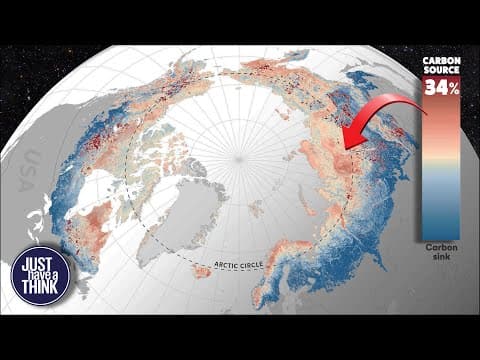
Recent research reveals alarming trends in Arctic carbon emissions, indicating that over a third of the region has shifted from being a carbon sink to a net carbon source. This shift, alongside rising global temperatures and the effects of climate change, raises serious concerns about the future of our planet.
The climate crisis is escalating, and recent data highlights a troubling trend: the global average surface temperature in January 2025 was reported to be 1.75 degrees Celsius warmer than preindustrial levels. This revelation comes on the heels of claims that January 2024 was the warmest on record, attributed to the El Niño phenomenon. However, as the climate shifts into a La Niña phase, which typically cools temperatures, the persistence of high temperatures raises questions about the reliability of these climate models.
Despite the predictions of mainstream climate science, which suggested a cooling trend, the reality appears more complex. Notable climate scientists like Stefan Rahmstorf and Johan Rockstrom have warned about tipping points and feedback loops for years. The situation is compounded by rising ocean surface temperatures and the reduction of reflective particles in the atmosphere due to the removal of sulphates from fossil fuels. Alarmingly, even the previously stable waters around Antarctica are now warming at unprecedented rates.
New research from the Arctic reveals that over a third of the region has transitioned from being a vital carbon store to a net carbon source. This shift is significant, as it indicates that the Arctic, which has historically absorbed carbon dioxide, is now contributing to atmospheric CO2 levels. This finding is based on extensive data collected from 200 study sites between 1990 and 2020, representing a sample four times larger than previous analyses.
The research indicates that when emissions from wildfires are included, the percentage of the Arctic that is a net carbon source rises to 40%. While some areas are becoming greener and experiencing longer growing seasons, only about 12% of these new regions are effectively absorbing CO2. Dr. Anna Virkkala, the lead author of the study, emphasized the need to account for the growing carbon footprint of fires in the Arctic, as they are reversing long-standing carbon uptake trends.
According to the National Oceanic and Atmospheric Administration (NOAA), the ten warmest years since 1850 have all occurred in the last decade. This trend suggests that we are on a trajectory to breach the lower limit of 1.5 degrees Celsius set by the Paris Accord. Professor Carl Rasmussen from Cambridge University argues that the focus should shift from when we will reach 1.5 degrees to when we will hit 450 parts per million (PPM) of atmospheric CO2, a threshold that could lock in long-term temperature increases.
James Hansen, a prominent climate scientist, has warned that average global temperatures are likely to remain at or above 1.5 degrees Celsius in the coming years, potentially rising to around 2 degrees by 2045. This scenario poses severe environmental, ecological, socio-economic, and geopolitical risks. However, some experts, like Valerie Masson-Delmotte, have contested Hansen's findings, suggesting that they do not align with all available observations.
The narrative surrounding climate change has been influenced significantly by the fossil fuel industry, which has successfully propagated the idea that we can overshoot climate targets and later develop technology to reverse the damage. This perspective has been criticized in a recent book that traces the financial motivations behind such beliefs, revealing how substantial investments in fossil fuels would become stranded assets if we swiftly transitioned to renewable energy.
Despite the advancements in technology that could aid in addressing climate change, the reality remains that the world is not on track to reduce greenhouse gas emissions sufficiently to meet the Paris goals. There is currently no known technology capable of removing hundreds of billions of tonnes of CO2 from the atmosphere effectively. Therefore, addressing the root causes of climate change is imperative.
The findings from the Arctic and the broader implications of rising global temperatures underscore the urgency of the climate crisis. As tipping points and feedback loops become more pronounced, the need for immediate and decisive action is critical. The scientific community continues to warn that political leaders may be underestimating the severity and speed of the consequences we face in the coming decades.
As we navigate this complex landscape, it is essential to remain informed and engaged in discussions about climate change and its far-reaching impacts on our planet.



















