
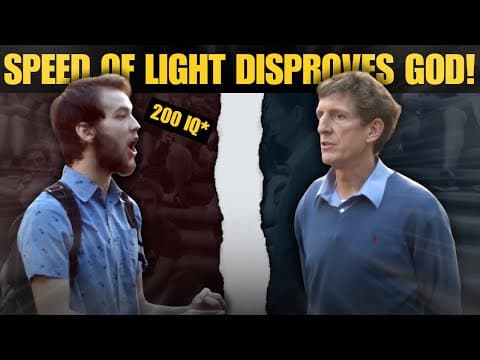
In a heated debate, an atheist challenges the existence of God using scientific reasoning, while Pastor Cliff Knechtle defends faith through personal experience and historical evidence. The discussion explores the relationship between science and belief, the nature of God, and the role of free will in faith.
In a thought-provoking debate, Pastor Cliff Knechtle engages with an atheist student on the existence of God, the role of science, and the nature of faith. The discussion raises critical questions about evidence, belief, and the human experience of spirituality.
The debate begins with the atheist questioning the clarity of God's communication, referencing the Exodus as a historical event where God supposedly demonstrated His power. The atheist argues that despite this clear evidence, the Jewish people exhibited little faith, suggesting that such evidence does not necessarily lead to belief.
Pastor Knechtle counters this by asserting that God’s purpose is not to eliminate doubt but to preserve human free will. He argues that if God were to remove all doubt, it would undermine human autonomy and the genuine nature of faith. Knechtle emphasizes that God offers evidence and love, inviting individuals to choose faith rather than coercing them into belief.
The atheist challenges the idea that faith should be based on evidence, particularly scientific evidence. He argues that if God is an omniscient creator, it would be beneficial for Him to include verifiable facts about the natural world in the Bible. The atheist posits that the absence of such information raises questions about the divine inspiration of the scriptures.
Knechtle responds by highlighting that faith often transcends scientific understanding. He shares personal anecdotes, including a conversation with a PhD candidate from MIT who found faith through historical evidence in the Gospels. Knechtle suggests that the desire to know God often outweighs intellectual skepticism.
A significant part of the debate revolves around the importance of relationships over scientific validation. Knechtle argues that the most meaningful aspects of life—love, family, and friendship—cannot be quantified by science. He asserts that while science is valuable, it should not be elevated to a position of ultimate authority in understanding human existence.
The atheist counters that relying solely on personal relationships as a basis for truth can be problematic. He argues that if God claims to be the ultimate authority, there should be objective evidence to support that claim. He challenges Knechtle to provide a single instance in the Bible that could not have been conceived by the minds of its authors.
Knechtle introduces the concept of sin as a barrier to understanding God. He argues that human nature often leads individuals to rationalize their desires, which can cloud their judgment regarding faith. He draws parallels between the reluctance of some to accept God and a criminal's evasion of the police, suggesting that doubt often stems from a desire to pursue one's own agenda rather than a genuine intellectual inquiry.
The atheist finds this analogy troubling, asserting that it dismisses the complexity of individual belief systems. He argues that many people grapple with religious questions and arrive at different conclusions based on their experiences and reasoning.
The debate touches on the resurrection of Jesus as a pivotal event in Christian faith. Knechtle claims that the resurrection is supported by historical evidence, including accounts of Jesus appearing to over 500 people after His death. The atheist challenges this by pointing out the lack of physical evidence, such as a preserved body, to substantiate the claim.
Knechtle argues that historical verification does not solely rely on physical evidence but also on the testimonies and experiences of those who witnessed the events. He emphasizes that the absence of contradicting evidence does not negate the validity of the resurrection.
The debate concludes with a reflection on the relationship between faith and reason. Knechtle maintains that while science is a valuable tool for understanding the world, it cannot encompass the entirety of human experience. He argues that faith involves a personal relationship with God that transcends empirical evidence.
The atheist, on the other hand, calls for a more rigorous examination of claims made by religious texts, advocating for a faith that is grounded in verifiable truth. The discussion highlights the ongoing tension between belief and skepticism, inviting readers to consider their own perspectives on faith, evidence, and the nature of God.



















