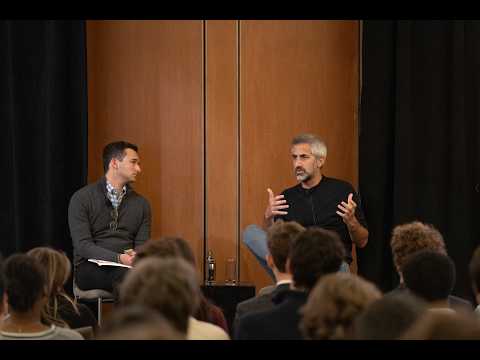
Nir Bar Dea, CEO of Bridgewater, shares insights on the firm's mission to understand global dynamics and discusses the significant shift from globalization to modern mercantilism. He highlights the historic scale of change underway, emphasizing the move towards nationalism, protectionism, and self-sufficiency, and reflects on Bridgewater's role in navigating this transformative era.
The Camel, an organization founded two years ago, aims to connect the best Jewish and Israeli entrepreneurs, founders, and business leaders with students at Harvard and MIT. The goal is to foster dialogue and share stories that inspire and educate. Since its inception, over 2,000 Harvard and MIT undergraduates have attended Camel events, which are open to everyone and typically feature at least one speaker per week.
This particular event was honored to host Nir Bar Dea, the CEO of Bridgewater, the world’s largest hedge fund. His presence marked a significant milestone for the Camel, fulfilling an early aspiration to bring such a prominent Israeli leader to campus.
Nir Bar Dea has been the CEO of Bridgewater since 2022. He is responsible for setting and driving the company’s strategic goals and overseeing its day-to-day management. He is a partner, a member of the Board of Directors, chairs the Executive Committee, and is part of the Operating Committee.
Before becoming CEO, Nir was appointed Deputy CEO in February 2021, leading Bridgewater’s transition from its founder, Ray Dalio. He established key decision-making committees that continue to guide the firm’s strategic and operational management. Nir began his career at Bridgewater in the research department, where he led transformative initiatives, including the creation of the firm’s investment engine and the formation of its current investment committee.
Beyond Bridgewater, Nir serves on the Global Board of Global Citizen, which focuses on eradicating extreme poverty worldwide, and on the board of Robin Hood, an organization dedicated to alleviating poverty in New York City. He is also a member of the Atlantic Council’s International Advisory Board, contributing to global security and policy initiatives. Nir holds an MBA from Wharton and a bachelor's degree in finance from the Interdisciplinary Center at IDC Herzliya. In 2020, he was named one of Fortune’s 40 under 40 in finance.
Nir explained that Bridgewater, which is celebrating its 50th anniversary, is an organization with an ambitious mission: to combine the best people and technology to build the deepest and most unique understanding of how the world works. This understanding encompasses the complex and evolving factors that drive economies and markets.
The firm’s goal is to monetize this understanding in various ways, which requires a continuous thesis about global developments. Nir emphasized that no single human brain can fully grasp all the moving parts, so Bridgewater relies on collective intelligence and technology.
Nir stated that we are currently experiencing the most radical change the world will see in our lifetime—an upheaval that occurs roughly once every 100 years. To comprehend this transformation, it is essential to view it through a historical lens, recognizing recurring patterns.
He identified two major secular arcs shaping the current global landscape:
Since World War II, the world has been on a trajectory of globalization, characterized by cooperation, efficiency, and interconnectedness. This era brought unprecedented economic integration and growth.
However, this paradigm is undergoing a complete reversal. The world is transitioning from globalization to what Nir calls "modern mercantilism."
Modern mercantilism represents a nationalist approach where countries prioritize "me first" policies over cooperation. This shift involves protectionism, tariffs, and a focus on self-sufficiency rather than efficiency.
Nir highlighted examples from the COVID-19 pandemic, such as shortages of essential goods like toilet paper and supply chain disruptions, which underscored the risks of dependency on global supply chains. These experiences have fueled the desire for greater self-reliance.
The shift from globalization to modern mercantilism has profound implications for economies, markets, and international relations. Nir suggested that understanding and navigating this change is central to Bridgewater’s mission.
He encouraged engagement and dialogue, emphasizing the importance of collective learning and adaptation during this transformative period.
Nir Bar Dea’s conversation at Harvard and MIT provided valuable insights into the evolving global landscape. His perspective as CEO of Bridgewater sheds light on the historic scale of change underway and the strategic responses required.
The transition from a cooperative, globalized world to one marked by nationalism and protectionism challenges individuals, businesses, and governments alike. Understanding these dynamics is crucial for anyone seeking to anticipate where the world is headed and how to thrive in the coming decades.
The Camel continues to facilitate such important conversations, connecting students with leaders who shape the future.