
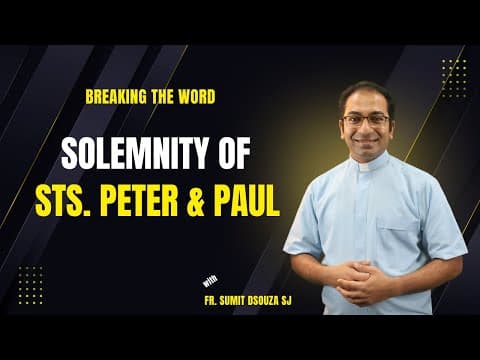
This blog post reflects on the solemnity of Saints Peter and Paul, exploring their unique journeys of faith, their transformative encounters with Jesus, and the call for believers to deepen their personal relationship with Christ and proclaim Him boldly.
Today, we celebrate the solemnity of Saints Peter and Paul, two pillars of the Church who, despite their differences, were united by one mission and one Lord. This reflection invites us to examine not only what others say about Jesus but also our own personal relationship with Him.
The first reading from the Acts of the Apostles recounts the gripping story of Peter's miraculous escape from prison. Imprisoned by King Herod and guarded by soldiers, Peter appears to be cut off from hope. Yet, in the darkness of night, an angel of the Lord appears, and the chains binding Peter fall away. He is led past the guards and out through the city gate, which opens by itself. Only after his escape does Peter realize that it was not a dream; God had indeed rescued him.
This passage serves as a powerful reminder of God's faithfulness to His chosen ones. Peter's deliverance is not due to his own power or strategy but rather God's mercy and purpose. The angel's intervention signifies that God's mission cannot be halted by earthly powers. The same Peter who once denied Jesus now finds strength in surrender and is rescued for a greater purpose.
The image of chains in this passage is deeply symbolic. Peter's physical chains represent the various forms of bondage we experience in life—fear, guilt, sin, addiction, doubt, or discouragement. Sometimes, we are imprisoned by external circumstances; other times, we are bound internally by our thoughts and wounds. However, the Gospel assures us that no chain is too strong for God. Just as Peter did not break his own chains, we too must recognize that true freedom comes when we allow God's light to enter our darkness.
On this feast of Saints Peter and Paul, we are reminded that God still breaks chains. Let us entrust our visible and hidden prisons to Him, for His grace can set us free and send us forth as witnesses of His power.
In the second reading from the second letter of St. Paul to Timothy, Paul writes from prison, sensing that his life is nearing its end. He states, "I am already being poured out like a libation," using the image of a sacrificial offering. Paul speaks not with regret but with peace, declaring, "I have fought the good fight, I have finished the race, I have kept the faith." These words echo the fulfillment of a life spent in total service to Christ.
Paul does not boast in his own strength but in God's faithfulness. He testifies that the Lord stood by him and gave him strength, enabling him to proclaim the Gospel to the nations. Even though he felt abandoned by others during his trial, Paul recognizes that God never left him. His trust is rooted in the hope that the Lord will rescue him from every evil attack and bring him safely to His heavenly kingdom.
Paul's words resonate with all who seek to live faithfully in a world that often misunderstands or opposes the Gospel. The imagery of a race and a fight reminds us that discipleship demands endurance. However, Paul's peace shows that a life poured out for Christ is not wasted; it is victorious, even in isolation or suffering. Just as Paul was never alone, we too can find courage and purpose in God's presence, especially when we feel abandoned or weary in our mission.
At a funeral, one often observes two types of people: some stand silently at the back or outside the church, distant observers who come out of duty or respect, while others are right in front, weeping, praying, and mourning—those who knew the deceased deeply and personally. This contrast mirrors the Gospel from Matthew, where Jesus asks His disciples, "Who do people say that the Son of Man is?" The disciples respond with popular opinions, but then Jesus asks a more profound question: "But who do you say that I am?"
This shift from hearsay to personal conviction is crucial. Peter answers boldly, declaring, "You are the Christ, the Son of the living God." His response is not based on hearsay but on a conviction born of a transformative encounter with Jesus. Jesus affirms that this insight was revealed by the Father and promises to build His Church upon this faith.
As we celebrate the feast of Saints Peter and Paul, we recognize that Peter represents the faith of the Church founded on Christ, while Paul symbolizes the Church's mission to the world. Despite their differences—Peter being impulsive and Paul being intellectual—both had a personal encounter with Jesus that shaped their lives and missions.
This feast invites us to reflect on our own faith. It challenges us to consider whether we merely know about Jesus or if we truly love Him. Like Peter, can we declare, "You are the Christ" not just with our lips but with our lives? Like Paul, do we allow our encounter with Jesus to change the direction of our lives?
Today’s feast encourages us not only to admire Saints Peter and Paul but to follow their example. We are called to draw near to Jesus, to know Him truly, and to proclaim Him boldly—not as strangers but as friends. May God bless us all as we strive to deepen our relationship with Him and live out our faith with conviction and courage.



















