
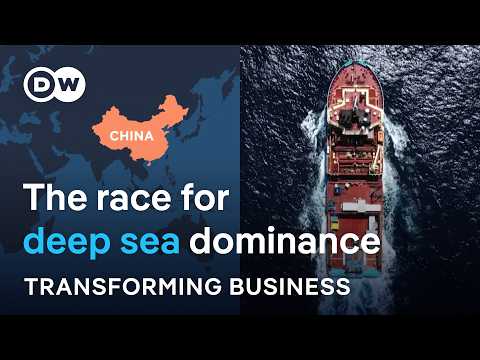
As the race for critical minerals intensifies, China leads in deep sea mining, raising concerns about environmental impacts and the US's ability to catch up. This blog explores the implications of deep sea mining, the technologies involved, and the potential risks to marine ecosystems.
The global economy is undergoing significant changes, particularly in the race for raw materials. Critical minerals have become a focal point of discussion, with China emerging as the undisputed leader in this arena. The United States views this dominance as a national security issue, as control over these essential metals equates to control over the future. A new frontier in this competition is the deep ocean, which harbors untapped sources of critical minerals. This blog delves into who is attempting to mine the ocean, their methods, and the potential consequences of such actions.
The deep sea is often likened to an alien world, filled with ghostly creatures and vast fields of metallic nodules. For mining companies, these nodules represent treasure chests packed with critical minerals necessary for electric vehicle (EV) batteries and wind turbines. Estimates suggest that there are at least 21 billion metric tons of these nodules in the area between Mexico and Hawaii, with a staggering worth of approximately $9 trillion—more than double the size of Germany's economy.
Critical minerals, including copper, nickel, cobalt, and lithium, are vital for the clean energy transition. The International Energy Agency projects that demand for these minerals will increase by four to six times by 2040 if the world adheres to the Paris climate goals. This urgency has prompted governments and companies to secure these resources for their economies.
Leading the charge in deep sea mining is The Metals Company, a Canadian firm that aims to be the first to secure mining permits from the International Seabed Authority (ISA). Their plan involves deploying bulldozer-like machines to vacuum up nodules from the ocean floor, which are unattached and can be collected with minimal disturbance. Despite being listed on NASDAQ in 2021 with a valuation of $2.9 billion, the company's market cap has since plummeted to around $600 million, although it still holds three exploration licenses in the Clarion-Clipperton Zone (CCZ).
The ISA, which has 169 member states, is responsible for regulating deep sea mining. However, the United States is not a member, having rejected the notion of deep sea resources as the common heritage of humanity in the 1970s. Critics argue that the ISA operates with a conflict of interest, as it relies on fees from mining companies to fund its operations, potentially compromising its ability to protect the environment.
Deep sea mining faces significant pushback from scientists who warn that we barely understand the ecosystems at risk. Dr. Beth Or, a deep sea microbiologist, emphasizes the importance of these ecosystems, which serve as nursery grounds for marine life and play a crucial role in regulating ocean chemistry. The deep sea also acts as a carbon sink, storing about 25% of global carbon emissions annually.
Mining activities not only remove nodules but also disturb entire ecosystems, with potential long-term consequences that are still largely unknown.
China is currently leading the deep sea mining race with five exploration licenses, followed by Russia and South Korea. The US, under the Trump administration, recognized the importance of securing critical minerals for energy supply, but its absence from the ISA complicates its position in this emerging field.
New startups like Impossible Metals are exploring alternative methods for deep sea mining that aim to minimize environmental impact. Co-founder Jason Gilham describes their approach, which utilizes autonomous underwater vehicles to selectively harvest nodules while avoiding disruption to marine life. Their latest model, Eureka 3, is designed to operate with minimal disturbance, but the environmental impact remains uncertain.
Proponents of deep sea mining argue that it could reduce the need for land-based mining, which often leads to deforestation and displacement of communities. However, critics like Dr. Or caution that land mining will not disappear with the advent of deep sea mining; instead, they may compete with each other, potentially leading to further environmental degradation.
Reports indicate that the amount of copper extractable from the Central Pacific would only meet about 1% of global demand for the energy transition by the next decade. Additionally, advancements in battery technology, such as iron phosphate batteries, may reduce reliance on cobalt and nickel. Recycling existing metals could also alleviate the pressure for new mineral extraction.
The question of whether to pursue deep sea mining is fraught with complexities. It raises critical considerations about balancing the need for minerals to support clean energy transitions against the potential for irreversible damage to biodiversity and marine ecosystems. As the debate continues, it remains to be seen whether the benefits of deep sea mining will outweigh the risks involved. Should we proceed with mining to expedite the transition to cleaner energy, or should we prioritize the preservation of vulnerable ecosystems? The answer is not straightforward, and it will require careful consideration and dialogue among stakeholders.



















