
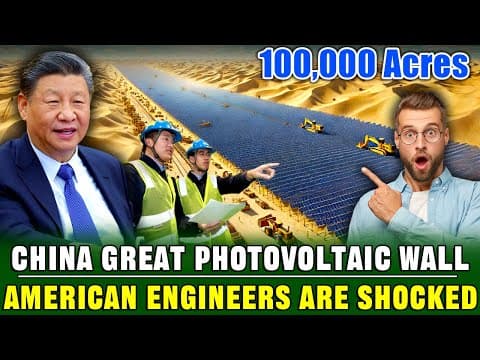
China is investing 100 billion yuan to build the Photovoltaic Great Wall in the Kubuqi Desert, a project aimed at combating desertification while generating renewable energy through 5 million solar panels. This initiative represents a significant step in ecological restoration and energy production, showcasing China's commitment to sustainable development.
China, a country with a vast and diverse landscape, has faced significant challenges due to desertification. Over 60 years ago, the desert encroached upon cities, leading to severe ecological issues. This phenomenon was so alarming that it was dubbed "the cancer of the earth". However, in a remarkable turn of events, China is now investing approximately 100 billion yuan to construct the "Photovoltaic Great Wall"—a groundbreaking project aimed at transforming the desert into a green energy powerhouse.
Desertification has long plagued China, with statistics indicating that over 2.622 million square kilometers of land were affected, accounting for 27.4% of the country's total area. Inner Mongolia alone faced a staggering desert area of 1.18 million square kilometers. This relentless spread of desert not only threatened China's ecological security but also posed risks to neighboring countries, leading to severe sandstorms that devastated agriculture and livestock.
In response to this crisis, the Chinese government initiated extensive sand control and afforestation projects over the past three decades. With the involvement of nearly 10 million volunteers, these efforts have included:
By implementing these strategies, China has successfully completed sand control tasks over 282 million mu and has significantly increased forest coverage in affected areas.
The Photovoltaic Great Wall is a monumental project located in the Kubuqi Desert, the seventh largest desert in China. Key features of this project include:
The design of the Photovoltaic Great Wall incorporates a unique approach known as "one panel for three uses". This involves:
This innovative model not only maximizes land use but also fosters a sustainable ecosystem, improving conditions for plant growth and reducing water evaporation.
To combat water shortages in the desert, a 500,000 cubic meter reservoir named "Moon Lake" has been constructed. This reservoir facilitates the use of treated coal mine wastewater for irrigation, ensuring that vegetation can thrive in the harsh desert environment.
The photovoltaic modules used in the Kubuqi Desert have undergone significant innovations to withstand the challenging conditions:
The Kubuqi Desert has already seen remarkable improvements, with vegetation coverage increasing to 53% and a 95% reduction in sandstorms. By 2025, the governance rate of the desert is expected to reach 83.6%, with ambitious plans to expand renewable energy capacity significantly by 2030.
China's advancements in desert photovoltaic technology have implications beyond its borders. The country has engaged in international cooperation, sharing its expertise with nations facing similar desertification challenges, particularly in the Middle East and Africa.
The Photovoltaic Great Wall represents a significant leap forward in China's efforts to combat desertification while simultaneously generating renewable energy. As the world looks towards sustainable solutions for environmental challenges, China's innovative approach serves as a model for integrating ecological restoration with energy production. The success of this project could pave the way for similar initiatives globally, showcasing the potential of renewable energy in transforming arid landscapes into productive ecosystems.



















