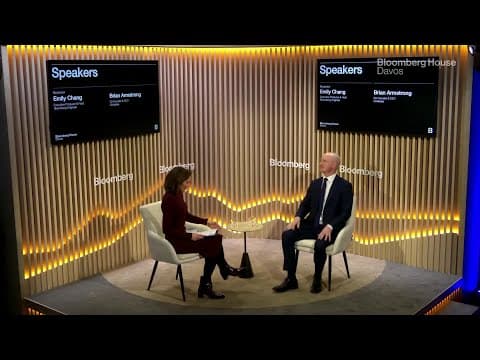
Coinbase CEO Brian Armstrong discusses the significant progress in crypto regulation, the challenges with the current market structure bill, the role of stablecoins, tokenization of assets, AI integration, and the future of crypto in emerging and developed markets. He emphasizes the importance of fair legislation, innovation, and the potential for crypto to revolutionize financial services globally.
Coinbase has had a landmark year, joining the S&P 500 and witnessing the passage of the first federal framework for stablecoins in the United States. Brian Armstrong, CEO of Coinbase, recently shared his insights on the current state and future of cryptocurrency, regulatory developments, and the integration of AI in the crypto space.
Armstrong confidently states that the future of finance is already here. The year 2025 marked a breakthrough for crypto, especially with the passage of the Genius Act, which provided much-needed regulatory clarity in the U.S. This clarity has led to over 200 companies announcing stablecoin integrations and major financial institutions adopting crypto infrastructure rapidly. Coinbase now powers crypto infrastructure for five of the top 20 largest banks globally.
The adoption is not limited to the U.S.; emerging markets with high inflation rates, such as Venezuela, India, Turkey, and Nigeria, are seeing significant crypto adoption, particularly stablecoins. Armstrong believes we are at a breakout moment for crypto, presenting a massive opportunity.
At Davos, Armstrong is meeting with world leaders, central bank governors, and bank CEOs to discuss economic freedom and the role of crypto in updating financial systems. A key focus is the ongoing market structure legislation in Washington, D.C., which has seen bipartisan support in the House and is under Senate deliberation.
Armstrong withdrew Coinbase's support for the current draft of the bill due to what he describes as "too many giveaways to traditional finance (TradFi)." He advocates for a level playing field where all U.S. companies compete fairly without undue protection for incumbents. He criticizes bank lobbying groups for attempting to ban competition, calling it un-American and harmful to consumers.
Despite some backlash, Armstrong remains optimistic about the bill's progress, noting that further negotiations are underway to address the concerns.
A significant debate centers on whether platforms like Coinbase can reward customers for holding stablecoins, which banks argue poses a deposit flight risk. Armstrong explains that unlike banks, which operate on fractional reserve lending (lending out deposited funds), Coinbase maintains 100% reserves, eliminating the risk of bank runs.
He emphasizes that Coinbase is regulated by the SEC, CFTC, and holds a national trust charter, negating the need for a bank license. The Genius Act further enshrines this regulatory framework. Armstrong calls for a shift in banks' perspectives to see crypto as an opportunity rather than a threat.
Despite recent market pullbacks, Armstrong remains bullish on the long-term prospects of Bitcoin and crypto. He notes Bitcoin's 100% increase over the past two years and reiterates his belief that Bitcoin could reach $1 million by 2030 due to its finite supply and increasing demand.
He advises against short-term trading, advocating for a buy-and-hold strategy to benefit from the long-term trend.
Armstrong highlights tokenization as a transformative trend, similar to stablecoins, enabling fast, cheap, and global payments. Tokenization extends to equities, bonds, and other asset classes, providing access to high-quality investments for the approximately 4 billion adults worldwide who are "unbrokered" and currently lack access to capital markets.
This democratization allows individuals who rely solely on labor income to participate in wealth creation through investments, breaking down traditional barriers.
Armstrong acknowledges President Trump's crypto-forward stance and his role in advancing clear crypto legislation. While Armstrong meets regularly with members of the Senate, regulators, and the House, he has met Trump a few times and finds him constructive on crypto issues.
He emphasizes that Coinbase's advocacy focuses on fair legislation that allows American companies to compete and win.
Regarding controversial topics like "Trump and Melania coins," Armstrong defers to existing ethics rules and the democratic process, noting that such matters are beyond Coinbase's primary focus.
Emerging markets with limited financial services access are leading in crypto adoption, with countries like India, Turkey, and Nigeria showing high per capita usage. However, the U.S. remains a significant market, with 52 million Americans having used crypto.
Armstrong describes Coinbase evolving into an "everything exchange," where users can manage multiple asset classes—including crypto, stocks, prediction markets, commodities—and access financial services like instant global payments and loans through a single platform.
AI is deeply integrated into Coinbase's operations, with about 50% of code written by AI (under human review) and AI handling approximately 60% of customer support tickets. AI also automates back-office functions such as compliance.
Armstrong sees AI and crypto as complementary technologies. AI agents will require their own wallets to make payments, and stablecoins and crypto wallets are poised to become the default payment mechanisms for AI agents. Coinbase has developed tools enabling this integration.
Additionally, Coinbase has launched an AI-powered feature called Coinbase Advisor, which offers portfolio management services like tax loss harvesting, portfolio rebalancing, and market notifications, typically available only to high-net-worth clients.
Prediction markets are an emerging category on Coinbase, allowing users to bet on outcomes ranging from sports to political elections and economic indicators. Armstrong believes prediction markets can provide higher signal accuracy due to real money stakes and could serve as alternatives to traditional media and tools for policymakers to gauge public opinion on legislation.
Coinbase has also introduced stock trading and CFTC-regulated perpetual futures, rapidly growing these offerings to compete with platforms like Robinhood.
With speculation about Binance reentering the U.S. market, Armstrong emphasizes Coinbase's strong brand and trust as key competitive advantages. Coinbase holds about half a trillion dollars in assets, which tend to be sticky, and offers a broad range of products to retain customers.
The company follows an "asset accumulation strategy," expanding product offerings to monetize assets better and reinvest in trust and growth.
Armstrong reflects on his personal growth from a shy software engineer to a CEO managing a 5,000-person company. He credits his board, executives, and coaches for support.
He highlights moments of controversial leadership, such as:
These experiences shaped his leadership style, emphasizing mission-driven, ethical, and courageous decision-making.
Armstrong warns that not having at least 5% of one's net worth in Bitcoin could be a significant missed opportunity. He reiterates Bitcoin's status as the best-performing asset class over the past decade and stresses that crypto will continue to update financial services, benefiting even those unaware of crypto.
He envisions a future where people can earn better rewards, access cheaper loans, send money globally with minimal fees, and raise capital efficiently through blockchain technology.
Brian Armstrong's insights paint a picture of a rapidly evolving crypto landscape, marked by regulatory progress, technological innovation, and expanding adoption. Coinbase aims to be at the forefront of this transformation, bridging traditional finance and the decentralized world to create a more efficient, inclusive, and modern financial system.
The journey is ongoing, with challenges in legislation and competition, but the potential for crypto to revolutionize finance remains immense.
To the moon indeed.
Thank you, Brian Armstrong, for sharing your vision and leadership in the crypto space.