
The tragedy of the commons, which suggests that individual interests lead to resource depletion, is not inevitable. Criticisms of Hardin's theory highlight the success of community-managed commons, local institutions, and collective action. Research by Eleanor Ostrom and others shows that commons can be sustainably governed through self-organization, offering valuable lessons worldwide.
In the previous session, we explored the challenges posed by the tragedy of the commons, a concept where individual interests can lead to the overuse and depletion of shared resources. This session shifts focus to solutions, specifically how communities can self-organize and govern those commons sustainably.
Garrett Hardin's proposed solutions to the tragedy of the commons emphasized that freedom in a commons brings ruin to all. His solution was socialism, advocating for control to prevent overuse. However, real-world evidence shows that natural ecosystems have suffered most in communist countries, and privatization or free enterprise does not always work efficiently either.
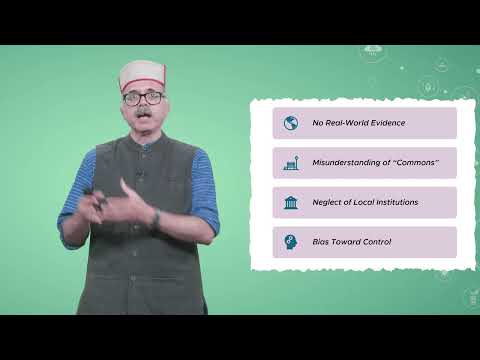
Several criticisms have been raised against Hardin's work:
Hardin's example was hypothetical and not based on actual field research. Critics argue that he generalized too much, ignoring the rich history of successful community-managed commons.
Hardin confused open access resources, where there are no rules or boundaries, with common pool resources that often have local rules and norms. Real commons are not free-for-alls; many communities have systems to manage use sustainably.
Hardin overlooked the ability of local communities to self-organize and set their own rules. Eleanor Ostrom and others have documented extensively how many traditional societies had councils, customs, and sanctions to prevent overuse.
For example, NS Jodha's work on the role of common property resources (CPRs) in the lives of the rural poor detailed how these resources are vital. CPRs include village pastures, common forests, wastelands, common threshing grounds, waste dumping places, watershed drainages, village ponds, tanks, rivulets, river beds, and groundwater.
Jodha showed that 74% of fuel wood for the poor in North Karnataka came from these CPRs in a study from the early 1980s.
Hardin's solutions favored top-down regulation or privatization, which in many cases displaced local communities and led to worse outcomes. Critics argue that his framing legitimized enclosure and exclusion, particularly against indigenous people and the poor.
The idea that commons are neither purely public nor private has been gaining ground and is widely studied. The International Association for the Study of Commons (IASC) is a global network of researchers, practitioners, and policymakers dedicated to understanding and improving how shared resources like forests, fisheries, water systems, and digital spaces are managed.
The IASC organizes biennial global conferences. For example, the 2017 conference in Utrecht attracted over 800 participants from 70 countries. India hosted the 2011 conference in Hyderabad for the first time, organized by the Foundation for Ecological Security, with Eleanor Ostrom present shortly after her Nobel Prize recognition.
The research led by Nobel laureate Eleanor Ostrom demonstrates that commons can be effectively managed through local institutions and collective action. Community-driven governance often outperforms top-down regulation or privatization in preserving shared resources.
IASC's case studies worldwide show diverse strategies for successful commons management, offering valuable lessons in various contexts.
The tragedy of the commons is not an unavoidable fate. While Hardin's theory highlighted potential pitfalls, extensive research and real-world examples reveal that communities can sustainably govern shared resources through self-organization, local rules, and collective action. Recognizing the nuanced nature of commons and empowering local institutions are key to preserving these vital resources for future generations.



















