
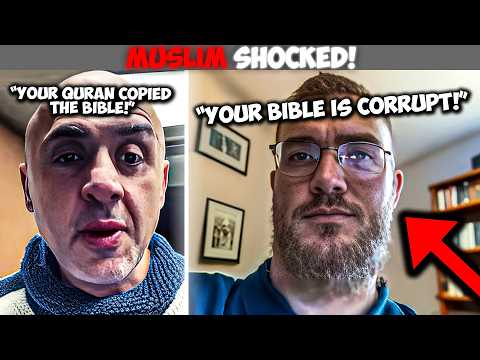
In a heated discussion, Sam Shamoun challenges a Muslim interlocutor on the authenticity and interpretation of religious texts, particularly the Quran and the Bible. The conversation explores the names of biblical figures, the integrity of the Bible, and the Quran's relationship with previous scriptures, ultimately questioning the validity of Islamic claims about biblical corruption.
In a recent discussion, Sam Shamoun engages a Muslim interlocutor in a debate about the Quran and the Bible. The conversation delves into various aspects of religious texts, including the names of biblical figures, the integrity of the Bible, and the Quran's relationship with previous scriptures. This blog post summarizes the key points of their exchange, highlighting the arguments presented and the implications for understanding these religious texts.
Sam begins by questioning the Muslim interlocutor about the names of significant biblical figures. He asks, "What was the name of Adam's wife?" The interlocutor responds correctly with "Eve," but Sam points out that the Quran does not mention her name. He continues by asking about the names of Adam's sons, emphasizing that the Quran also fails to provide this information. This line of questioning sets the stage for a broader critique of the Quran's narrative.
Sam argues that the Quran relies heavily on the Bible for its narratives. He states, "Why would I want to follow a poor copycat that comes into the seventh century which depends on a Bible that exposes it as a fraud?" This assertion highlights his belief that the Quran lacks originality and is dependent on biblical texts for its stories and teachings.
The discussion shifts to the concept of circular reasoning. Sam challenges the interlocutor's claim that parts of the Bible are true while others are corrupt. He argues that this reasoning is flawed, as it assumes the Quran's truth to validate the Bible. He states, "How do you know that the parts that agree with the Quran are true?" This question underscores the difficulty in establishing a foundation for the claims made about the integrity of both texts.
Sam references Quran 5:48, discussing its implications regarding the relationship between the Quran and previous scriptures. He explains that the verse suggests the Quran confirms the truth of the Torah and the Gospel. He emphasizes that the Quran's role is to testify to the truth of these earlier texts, which contradicts the claim that they are corrupt.
Continuing his argument, Sam points out that the Quran instructs Jews to refer to the Torah for guidance, raising the question of why Allah would direct them to a corrupt text. He states, "Why is Allah having the Jews go to a Torah that's corrupted instead of coming to Muhammad for judgment?" This rhetorical question aims to highlight inconsistencies in the Muslim perspective on the integrity of the Torah.
The conversation also touches on the role of Hadith in understanding the Quran. Sam challenges the interlocutor's claim of being a "Quran-only Muslim," arguing that without Hadith, one cannot fully comprehend the Quran's context or the historical figures mentioned within it. He asserts that the Quran cannot stand alone without external sources for interpretation.
As the discussion progresses, Sam addresses the nature of God as presented in the Bible, particularly in relation to Jesus. He cites John 17:3, where Jesus refers to the Father as the only true God. Sam argues that this statement contradicts Islamic teachings about the nature of God and challenges the interlocutor to reconcile these differences.
The debate between Sam Shamoun and his Muslim interlocutor reveals deep-seated differences in the understanding of religious texts. Sam's arguments focus on the integrity of the Bible, the Quran's dependence on earlier scriptures, and the implications of various Quranic verses. The conversation serves as a reminder of the complexities involved in interfaith dialogues and the importance of critically examining the foundations of one's beliefs. Ultimately, it invites readers to reflect on the nature of truth in religious discourse and the role of historical context in shaping our understanding of sacred texts.



















