
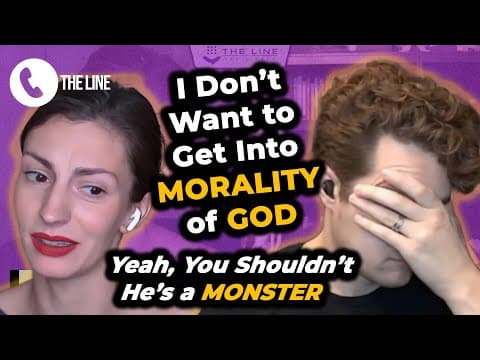
In a live discussion, a caller presents arguments for the Christian God based on biblical prophecies, while hosts Promise and Forrest challenge the validity of these claims. The conversation explores the nature of prophecies, the moral implications of biblical narratives, and the evidence for God's existence, ultimately revealing deep philosophical divides between belief and skepticism.
In a recent live discussion, a caller named Anthony engaged with hosts Promise and Forrest about his belief in the Christian God, primarily focusing on biblical prophecies as evidence for his faith. This conversation delved into the complexities of religious belief, the interpretation of scripture, and the moral implications of biblical narratives.
Anthony began by expressing his willingness to discuss his belief in God, specifically the Christian God. He emphasized the importance of having a straightforward conversation about faith without pretense. The hosts appreciated his candidness, noting that only a small percentage of viewers were willing to defend their beliefs publicly.
Anthony articulated that his belief in the Christian God is rooted in the structure of the Bible, which he sees as a compilation of writings from various authors over time. He argued that the New Testament supports the Old Testament through prophecies and types that prefigure Christ. He asserted that this construction demonstrates truth and divine foreknowledge, claiming that Christianity is falsifiable if a better explanation for these prophecies exists.
Promise challenged Anthony's assertion by questioning the validity of the prophecies themselves. She argued that many biblical prophecies are vague or self-fulfilling, as they are recorded after the events they predict. She likened this to ordering ketchup at a hot dog restaurant and being surprised when it arrives, suggesting that many biblical predictions are not particularly insightful or unique.
Forrest added to this critique by pointing out that many prophecies are general statements about human experiences, such as wars and famines, which have occurred throughout history. He questioned why these should be considered special or divine predictions when similar predictions can be made by anyone.
The conversation shifted to the issue of circular reasoning in biblical interpretation. Anthony maintained that the Old and New Testaments serve as distinct witnesses to the same truth, arguing that the New Testament does not merely validate the Old Testament but reveals deeper meanings through the life of Christ. However, Promise and Forrest countered that this reasoning is inherently circular, as it relies on the Bible to prove itself.
A significant portion of the discussion focused on the moral implications of the narratives within the Bible. Promise raised a poignant question regarding the necessity of innocent suffering in biblical stories, particularly the account of the Passover in Exodus. She questioned why God would require the death of innocent children to fulfill a prophecy about salvation, highlighting the moral dilemmas presented by such narratives.
Anthony struggled to address this moral concern, stating that he did not want to delve into the morality of God. This reluctance led to further frustration from the hosts, who argued that the moral implications of belief in God are crucial to understanding the nature of that belief.
As the conversation progressed, Forrest pressed Anthony to provide evidence for his belief in God outside of biblical texts. Anthony mentioned natural theology, which posits that one can know God through the existence of consciousness, morality, and design in the universe. However, the hosts challenged him to explain how these concepts definitively point to the Christian God rather than any other possible deity or explanation.
Anthony argued for the necessity of a first cause to avoid the problem of infinite regress in causality. He claimed that without a first cause, one cannot logically arrive at the present moment. However, Promise and Forrest countered that this reasoning does not necessarily lead to the conclusion that the first cause must be the Christian God, as there could be other explanations or entities that fulfill this role.
The discussion ultimately reached a stalemate, with both sides unable to convince the other of their perspectives. Anthony maintained that his belief in the Christian God was justified by the prophecies and the structure of the Bible, while Promise and Forrest argued that these claims lacked sufficient evidence and raised significant moral concerns.
The conversation highlighted the deep philosophical divides between belief and skepticism, illustrating how interpretations of scripture and the nature of evidence can lead to vastly different conclusions about the existence of God. As the hosts concluded the call, they expressed their frustration at the lack of progress in the discussion, emphasizing the importance of critical examination of beliefs in the pursuit of truth.



















