
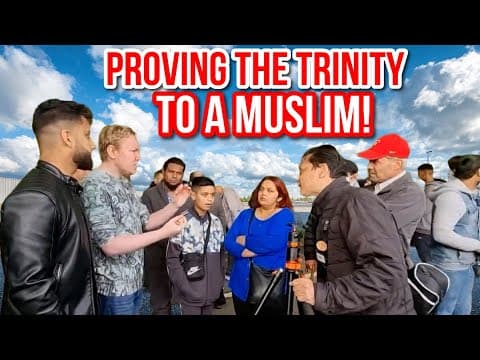
This blog post explores a heated debate on the concept of the Trinity between a Christian and a Muslim at Speakers Corner, focusing on scriptural interpretations, the nature of God, and the implications of progressive revelation.
In a recent discussion at Speakers Corner in Hyde Park, a Christian and a Muslim engaged in a spirited debate about the concept of the Trinity. This dialogue highlighted differing interpretations of scripture, the nature of God, and the implications of progressive revelation. The conversation was intense, with both sides presenting their arguments passionately.
The debate began with the Christian asserting the divinity of Jesus, referencing his interactions with Abraham as evidence of his divine nature. The Muslim interlocutor challenged this by asking where God explicitly states that He is three in one. The Christian responded by emphasizing that Jesus spoke of his divinity in various scriptures, but the Muslim countered that the Bible does not explicitly declare God as a Trinity.
The Muslim participant introduced the concept of progressive revelation, suggesting that God could reveal new aspects of His nature over time, including the possibility of being five in one. This claim was met with skepticism from the Christian, who argued that such a revelation would contradict previous revelations about God's nature.
The Christian attempted to support the Trinity by citing Matthew 28, where Jesus instructs his followers to baptize in the name of the Father, the Son, and the Holy Spirit. The Muslim responded by questioning the authenticity of this scripture, suggesting that early Christians did not baptize in this manner, as seen in the Acts of the Apostles where baptisms were performed in the name of Jesus alone.
The Christian argued that Jesus’ divine attributes, such as granting eternal life and raising the dead, affirm his divinity. The Muslim countered that having the power to perform miracles does not inherently make one divine, using the example of Paul, who also performed miracles but is not considered God.
A significant point of contention arose regarding the resurrection of Jesus. The Christian claimed that Jesus raised himself from the dead, while the Muslim pointed out that scripture also states God raised him. This led to a discussion about the nature of God and the interdependence of the Father, Son, and Holy Spirit in the resurrection.
The Christian maintained that Jesus is fully God, while the Muslim pressed for clarity on whether Jesus is part of God or fully God. The Christian affirmed that Jesus is fully God, leading to a discussion about the implications of this belief on the nature of God. The Muslim argued that if Jesus is fully God, then the concept of the Trinity implies multiple gods, which contradicts the monotheistic belief in one God.
The conversation shifted to the attributes of God, with the Muslim questioning whether attributes such as love and knowledge can be considered separate from God. The Christian explained that in Christianity, the Word of God (Logos) is identified with Jesus, which the Muslim found problematic, arguing that it suggests a division within the nature of God.
The debate concluded without a resolution, highlighting the complexities and nuances of theological discussions surrounding the Trinity. Both participants presented their views passionately, reflecting deep-seated beliefs about the nature of God and the interpretation of scripture. This dialogue serves as a reminder of the ongoing conversations about faith, belief, and the understanding of divine nature in different religious traditions.



















