
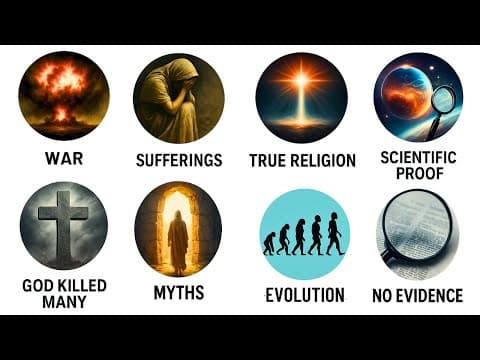
This blog post explores common atheist arguments against Christianity and provides counterarguments from a Christian perspective. It addresses misconceptions about religion, science, morality, and the nature of God, emphasizing the importance of faith, historical context, and the philosophical underpinnings of belief.
In the ongoing debate between atheism and Christianity, numerous arguments are presented by both sides. This blog post aims to address and debunk common atheist arguments against Christianity, providing a comprehensive Christian perspective on faith, reason, and the nature of God.
A common assertion is that religion is the primary cause of wars. However, historical evidence shows that less than 7% of wars were primarily religious in nature. When excluding Islamic conflicts, this figure drops to about 3%. Most wars have been fought for political control, resources, land, or ethnic rivalry. While religion can be misused to justify violence, it is not the main driver of conflict; human ambition and power struggles account for far more bloodshed.
While it is true that terrible acts have been committed in the name of religion, this does not prove that belief in God is false. Human evil can arise in any system, including atheistic regimes led by Stalin, Mao, and Pol Pot, which rejected religion entirely and were responsible for millions of deaths. The critical question is not whether humans misuse belief, but whether the belief itself is true.
The argument that if one were born in a different culture, they would not be a Christian is valid to some extent. However, this applies to atheists as well. Cultural background influences belief, but it does not determine truth. The key question remains: which worldview best explains reality, morality, and the universe?
The existence of many religions does not imply that all are false. Every person has a worldview that requires faith in something unseen, whether it be human reason, materialism, or divine purpose. The task is to test which worldview aligns with the evidence of existence, moral law, consciousness, and meaning.
The claim that there is no scientific proof of God misunderstands the nature of science. Science studies the natural world, while God exists beyond it. Many real things, such as love and moral truth, cannot be scientifically measured, yet their existence is widely accepted. The limits of science define what it can test, not what is real.
There are thousands of documented cases that challenge strict naturalism. Reports of possession and verified near-death experiences provide evidence that cannot be easily dismissed. While evidence may be debated, it does exist.
For over 2,000 years, scholars have studied apparent inconsistencies in scripture. Most contradictions can be clarified through historical context, translation differences, or multiple eyewitness perspectives. The four gospels, for example, highlight different details of the same events, which actually strengthens their authenticity.
It is true that ancient literature often omitted personal signatures. However, early church fathers recorded who wrote each gospel, and their testimonies consistently match traditional authorship. The lack of an author's name inside the text does not negate the strong historical evidence confirming their authorship.
Some secular scholars claim that the sayings of Jesus were altered by the early church. However, these scholars often disagree on which statements are authentic, indicating a lack of consistency in their claims. Historical and textual evidence shows that the gospels were copied and preserved with exceptional accuracy.
Some argue that early Christians exaggerated Jesus' divinity over time. However, the earliest Christian writings already reflect a high regard for Jesus, indicating that this view was present from the beginning of the movement.
While the Bible records slavery, it does not endorse it. Ancient laws regulated an existing system rather than approving it. Jesus explained that some Old Testament laws were concessions to human hardness of heart. Moreover, Christian movements played a significant role in abolishing slavery.
Scripture records divine judgments, but these are connected to justice and the preservation of moral order. The moral logic is that the creator, who gives life, has authority over it and may act to maintain justice.
While some secular nations are prosperous, correlation does not imply causation. Their success often stems from centuries of development based on Christian ethics. Atheist regimes, like communist China, demonstrate that denying God does not guarantee freedom or well-being.
Rejecting one more god because many exist misunderstands the issue. The question is not which god to choose first, but whether any creator exists at all. If one true creator exists, the existence of false gods does not negate that truth.
This question misrepresents the concept of God. By definition, God is the uncaused cause, the necessary being outside time and matter. An infinite chain of causes cannot go backward forever; there must be a first cause that itself was not created.
Science cannot disprove God because it studies the natural world, not what exists beyond it. Historically, belief in God has been a foundation for science, with early scientists believing that the universe's order reflected an intelligent designer.
The argument that God is a gap filler for scientific unknowns is flawed. Christianity teaches that God is the ultimate cause of everything, not just the unknown parts. Science can explain how things work but not why they exist in the first place.
Christianity teaches that God will eventually remove evil, but doing so now would require removing every human who has ever done wrong. The delay of judgment is seen as mercy, allowing for redemption and the exercise of free will.
Suffering is a complex issue. Christianity teaches that pain and death entered the world due to humanity's choices. While suffering serves a purpose, it is not the end of the story; God plans to restore creation.
This idea collapses under logic. Evil is the absence of good, and to call something evil assumes an objective moral standard. Without God, such a standard would not exist.
This question is a trick. Omnipotence does not mean doing the logically impossible. God cannot create contradictions; his power is perfect and does not extend to nonsense.
Evil was permitted because overcoming it reveals justice, mercy, and strength. Genuine freedom requires the ability to choose between right and wrong, and without that choice, love loses its meaning.
If this were true, religious teachings would focus on comfort. However, the Bible emphasizes human failure and moral responsibility, suggesting it was not crafted as wishful fiction.
Psychology can describe how belief feels but cannot determine whether what is believed in is real. The human desire for meaning and justice may point to why we seek God.
While spiritual experiences may produce brain activity, this does not negate their reality. If God exists, it is logical that encounters with him would register in the brain he designed.
Claims that Christianity borrowed from pagan myths collapse under scrutiny. The story of Jesus is rooted in Jewish history and prophecy, not in mythology.
Faith means trust based on evidence, not blind guessing. In Christianity, faith is confidence in what has been revealed about God, supported by historical record and reason.
Evolution and creation offer different explanations for life. While evolution claims life developed through random processes, creation teaches that life was intentionally designed by God.
While some historical events involved violence, the early spread of Christianity was characterized by personal conviction and compassion, not coercion.
Constantine did not invent Christianity; he legalized it. The faith existed for centuries before his reign, spreading through conviction and persecution.
While there are various Christian denominations, most differences concern secondary matters. Core beliefs about God and salvation show remarkable unity.
Historical sources outside the Bible, such as Josephus and Tacitus, confirm Jesus' existence and execution, supporting the claim that he was a real historical figure.
The size of the universe does not determine value. The vastness reflects scale and wonder, and faith teaches that God knows and loves every individual personally.
In conclusion, the arguments against Christianity often stem from misunderstandings of faith, history, and the nature of God. By addressing these misconceptions, we can foster a more informed dialogue about belief and reason.



















