
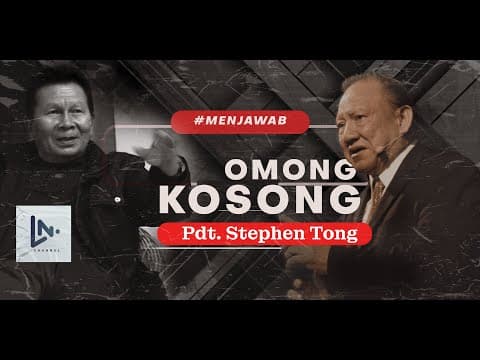
This blog post critically examines the claims made by Pastor Stephen Tong regarding Sunday worship, arguing that his assertions lack biblical support and historical accuracy. It emphasizes the importance of adhering to scripture as the ultimate authority in Christian faith and practice.
In a recent video, Pastor Stephen Tong made several claims regarding the observance of Sunday as a day of worship for Christians, labeling opposing views as "nonsense." This blog post aims to critically analyze his statements, providing a comprehensive examination of the biblical and historical context surrounding Sunday worship.
The discussion surrounding the observance of Sunday as a day of worship has been a contentious issue among Christians. Pastor Stephen Tong's assertions have prompted a need for clarification and a deeper understanding of the biblical texts and historical developments that inform this practice. This post will explore the key points raised by Pastor Tong and provide counterarguments based on scripture and historical evidence.
Pastor Tong made several statements in his video, which can be summarized as follows:
Pastor Tong asserts that Sunday is the "Lord's Day" because it commemorates the resurrection of Jesus. However, the term "Lord's Day" is not explicitly defined in the Bible as Sunday. The only reference to the "Lord's Day" is found in Revelation 1:10, where it does not specify which day it refers to. Therefore, the claim that Sunday is inherently the "Lord's Day" lacks biblical foundation.
Tong argues that Sunday has been sanctified as a day of worship following the resurrection of Christ. However, there is no scriptural evidence that God blessed or sanctified Sunday in the same manner as the Sabbath (Exodus 20:8-11). The Sabbath, the seventh day, is the only day explicitly mentioned in the Bible as being blessed and made holy by God.
While it is true that early Christians gathered on the first day of the week, this does not necessarily imply that they replaced the Sabbath with Sunday worship. Acts 20:7 mentions the breaking of bread on the first day of the week, but this does not indicate a formalized change in worship practices from Saturday to Sunday. The context suggests that this was a communal meal rather than a mandated worship service.
Pastor Tong claims that there is no biblical authority for the change from Sabbath to Sunday. This is a critical point, as many Christians believe that the New Testament does not provide explicit instructions to observe Sunday as a replacement for the Sabbath. The absence of such directives raises questions about the legitimacy of Sunday worship as a divinely ordained practice.
Tong's assertion that the Pope changed the Sabbath to Sunday is historically inaccurate. The transition from Sabbath to Sunday worship occurred gradually over centuries, influenced by various factors, including the rise of the early church and the Roman Empire's adoption of Christianity. The Council of Laodicea (around 363-364 AD) is often cited as a significant moment in this transition, but it was not solely the decision of the Pope.
The historical development of Sunday worship is complex. Early Christians initially continued to observe the Sabbath while also gathering on Sunday to celebrate the resurrection. Over time, as Christianity spread and became more institutionalized, Sunday began to take precedence as the primary day of worship. This shift was influenced by cultural, social, and political factors rather than a clear biblical mandate.
In conclusion, the claims made by Pastor Stephen Tong regarding Sunday worship lack solid biblical and historical support. It is essential for Christians to critically examine such assertions and rely on scripture as the ultimate authority in matters of faith and practice. The transition from Sabbath to Sunday worship is not as straightforward as some may suggest, and it is crucial to approach this topic with a discerning and informed perspective.
As believers, we are encouraged to seek the truth and ensure that our practices align with the teachings of the Bible, rather than relying solely on tradition or the opinions of church leaders.



















