
This blog post explores the complex question of whether Christians and Muslims worship the same God, addressing theological distinctions, historical perspectives, and contemporary debates surrounding the topic. It emphasizes the importance of understanding worship in a nuanced way and highlights the Catholic Church's position on the matter.
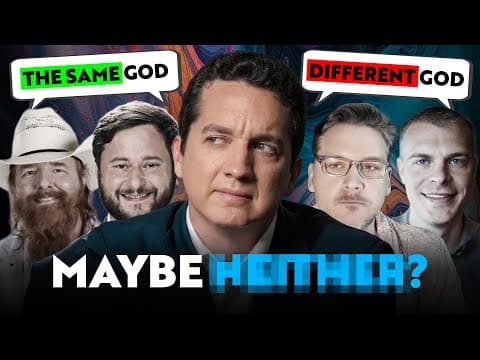
Over the past few weeks, the question of whether Christians and Muslims worship the same God has sparked significant discussion online. This debate was notably highlighted in discussions on the Tim Pool podcast and the Capturing Christianity platform, where differing theological perspectives were presented. While I initially hesitated to address this topic, the volume of requests for my insights has prompted me to share my thoughts, complementing the arguments made by my colleagues Joe Heshmire and Jimmy Aken.
First, it is essential to clarify what is meant by the phrase "Christians and Muslims worship the same God." This phrasing can imply that the God of Christianity and the God of Islam are identical in all respects, which is not accurate. The Christian understanding of God is rooted in the Trinity, comprising three distinct divine persons: the Father, the Son, and the Holy Spirit. In contrast, Islam presents God as a singular, infinite entity with different attributes. Despite these differences, there are overlapping attributes between the two concepts of God.
It is important to note that the term "Allah" is simply the Arabic word for God. Arabic-speaking Christians also use the term "Allah" when referring to God. Therefore, the name itself is not the core issue in this discussion. However, asserting that Christians and Muslims worship the same God requires careful qualification to avoid the perception of religious indifferentism.
Worship can be defined as giving God all the honor that is due to Him. Since the Father, Son, and Holy Spirit deserve honor, those who do not recognize each person of the Trinity cannot be said to worship God in the fullest sense. Critics often cite biblical passages that suggest that those who deny the Son do not have the Father, arguing that Muslims cannot be worshiping God. However, it is crucial to approach these proof texts with caution, as they do not provide a comprehensive answer to this complex question.
To illustrate this point, consider a thought experiment: Imagine hiking with an agnostic friend who rejects the doctrine of the Trinity but acknowledges the existence of one infinite God. Upon witnessing the beauty of nature, your friend expresses gratitude to God. In this scenario, it is more plausible to conclude that both you and your friend are adoring the same merciful God rather than suggesting that your friend is inadvertently worshiping a demon.
The Second Vatican Council addressed this topic in a passage that has been the subject of much debate. It states that the plan of salvation includes those who acknowledge the creator, specifically mentioning Muslims who profess to hold the faith of Abraham. This passage was overwhelmingly approved by the council fathers, indicating a consensus on the matter.
Some Eastern Orthodox apologists have used this statement to argue against Catholicism. However, even if one were to consider this passage erroneous, it does not invalidate Catholicism as a whole. To disprove Catholicism, one would need to falsify an infallibly defined statement, which this is not. Furthermore, inconsistencies arise when Eastern Orthodox critics ignore their own tradition, which acknowledges that Christians and Muslims can turn to the same creator God.
Historically, church fathers have recognized that Jews, who reject Jesus, still worship God. For instance, Justin Martyr and Gregory of Nyssa affirmed that Jews worship the same God as Christians. This acknowledgment extends to Muslims, as their monotheistic beliefs align with the understanding of the one true God.
The necessity of the magisterium in interpreting theological issues is paramount. The Catholic Church has a structured approach to teaching, which contrasts with the more fragmented interpretations found in some Eastern Orthodox traditions. This structure allows for a consistent understanding of worship and the nature of God.
Several objections arise in this discussion:
Worship and the Trinity: Critics argue that one cannot worship God without acknowledging the Trinity. However, biblical examples show that individuals can worship God without full knowledge of His triune nature.
Ignorance vs. Rejection: There is a distinction between ignorance of God's true nature and willful rejection. Those who are ignorant may still offer worship, while those who consciously reject the Trinity cannot.
Continuum Fallacy: The argument that if Muslims worship God, then all religions must be included, is a continuum fallacy. There is a clear distinction between classical theism, as upheld by Jews and Muslims, and other belief systems that diverge significantly from this understanding.
Quantifier Shift Fallacy: While it is true that Christians and Muslims worship a god, this does not negate the possibility that they worship the same God when considering shared attributes.
Contradictions in Teaching: Critics claim that Vatican II contradicts previous teachings. However, the ambiguity of non-infallible statements allows for reconciliation with earlier teachings.
In conclusion, while I do not find it helpful to assert that Christians and Muslims worship the same God without qualification, it is clear that both groups can acknowledge the existence of one creator God. This acknowledgment allows for a form of natural worship that, while not salvific, serves as a foundation for deeper theological exploration. The Catholic Church holds the fullness of worship and seeks to share this with all people, including Jews and Muslims. As Pope Paul VI articulated during Vatican II, the Christian religion is the one true religion, and it is our hope that all who seek God will come to recognize this truth.



















