
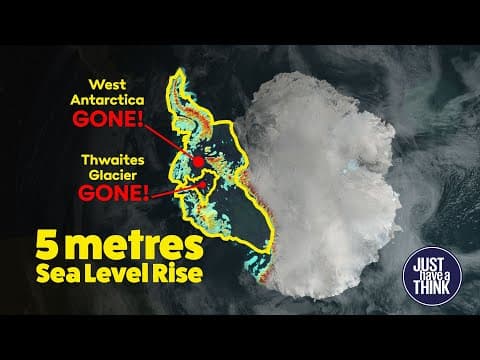
The Doomsday Glacier, or Thwaites Glacier, poses a significant threat to global sea levels due to its instability and the warming waters surrounding Antarctica. Recent scientific debates highlight the urgency for human intervention to mitigate potential catastrophic outcomes, despite the controversies surrounding geoengineering solutions.
If you’re a long-term viewer of this channel, you’ll no doubt have seen various videos attempting to decipher the latest scientific research data from Antarctica, the frozen desert at the bottom of our planet. When discussions about climate change began in 2017, Antarctica was seen as a stable counterpart to the Arctic, where significant climatic changes were occurring. However, recent years have shown alarming developments in the waters surrounding and flowing beneath this icy wasteland.
In the past year, there has been a surge in research papers and articles focusing on Antarctica, particularly concerning the infamous Thwaites Glacier, also known as the Doomsday Glacier. This glacier is roughly the size of Florida or Great Britain and is located in West Antarctica, which is precariously perched between land and sea. Unlike East Antarctica, which sits on solid bedrock and has remained stable for millions of years, West Antarctica's glaciers are at risk of rapid melting.
Research indicates that if Thwaites Glacier were to collapse completely, it could lead to a sea level rise of approximately one meter, threatening coastal communities housing about a quarter of a billion people. Moreover, the loss of Thwaites Glacier could trigger a domino effect, causing the entire West Antarctic ice sheet to slip into the ocean, resulting in a potential five-meter rise in sea levels. This scenario would devastate many of the world’s most populous cities, including New York, Miami, London, Shanghai, and Tokyo, while also inundating regions like Bangladesh.
In the last twelve months, global ocean surface temperatures have reached unprecedented levels, causing disruptions in the Antarctic region. While the recent El Niño event has contributed to this warming, it does not fully explain the temperature increases, leaving scientists puzzled.
Two conflicting papers published in 2024 have intensified the debate among researchers. One study from the University of California, Irvine, and the University of Waterloo supports the idea that warm water erosion is destabilizing Thwaites Glacier. Conversely, a paper from Dartmouth College and the University of Edinburgh challenges the Marine Ice Cliff Instability (MICI) hypothesis, suggesting that the thinning of the glacier might actually stabilize its ice cliffs, contrary to previous beliefs.
As the scientific community grapples with these findings, the question arises: should we intervene? Any direct human intervention aimed at altering the natural processes in Antarctica falls under the umbrella of geoengineering. This concept is controversial, with critics arguing that such interventions could have unforeseen consequences and distract from addressing the root causes of climate change.
Proponents of geoengineering argue that we have surpassed the point where merely reducing greenhouse gas emissions is sufficient. They advocate for radical interventions to reverse the damage already done, claiming that we have nothing to lose by attempting these solutions.
Several geoengineering strategies have been proposed, each with its own set of challenges:
Underwater Curtain: One idea suggests constructing an 80-kilometer wide, 100-meter high underwater curtain to shield the West Antarctic Ice Sheet from warm water influx. However, the feasibility, cost, and governance of such a project raise significant concerns.
Seawater Snow Conversion: Another proposal involves pumping seawater onto the ice surface and converting it into snow using wind turbines to increase ice mass. This would require immense infrastructure and energy, raising questions about its environmental impact.
Robotic Interventions: Some suggest deploying remotely operated vehicles to build mounds of impervious material in front of glaciers to pin them in place. However, the harsh Antarctic environment presents logistical challenges that make this idea seem impractical.
Reflective Materials: Scattering highly reflective materials like silica beads over the ice surface to increase its albedo and reduce heat absorption has also been proposed. Yet, the logistics of transporting and applying such materials on a continental scale are daunting.
Despite the ongoing debates and proposed solutions, the consensus among scientists is that we must act urgently to address the climate crisis. The recent COP climate summit has drawn criticism for its ineffectiveness, highlighting the need for a serious commitment to phasing out fossil fuels and investing in renewable energy systems, particularly in developing nations.
In conclusion, the potential collapse of the Doomsday Glacier poses a significant threat to global sea levels and coastal communities. While the scientific community continues to debate the best course of action, the urgency for human intervention cannot be overstated. Without decisive action, we risk leaving future generations with a planet that is increasingly uninhabitable.
As we navigate these complex issues, it is crucial to engage in discussions and consider all perspectives. The future of our planet depends on our ability to think critically and act responsibly in the face of climate change.



















