
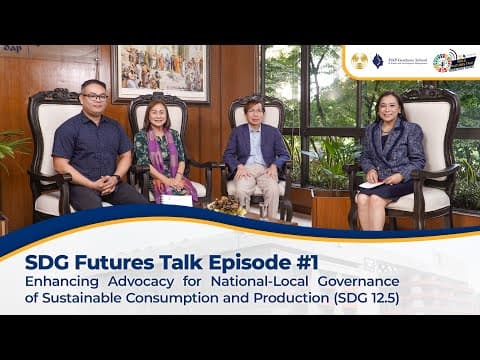
This blog post discusses the key insights from the SDG Futures Talk episode on enhancing national and local governance for sustainable production and consumption. It highlights the importance of sustainable consumption and production (SCP), the role of local governments, and the need for collaborative efforts to address waste management and environmental challenges.
Welcome to the first episode of SDG Futures Talk, a series dedicated to exploring sustainable development goals (SDGs) through a multidisciplinary lens. This episode features a discussion with research fellows Dr. Jalon Tagal, Dr. Malu Rola, and Dr. Eduardo Gonzalez, focusing on their paper titled "Enhancing Advocacies for National and Local Governance of Sustainable Consumption and Production."
Sustainable consumption and production (SCP) is a concept deeply rooted in sustainable development. Dr. Malu Rola explains that SCP aims to produce goods and services that meet the needs of the current population while minimizing the use of natural resources. This approach ensures that future generations will also have access to these resources.
Dr. Jalon Tagal emphasizes the need to understand consumption and production patterns to ensure they are sustainable. He highlights the significance of waste management, particularly in relation to SDG 12.5, which focuses on waste reduction and resource efficiency.
Dr. Eduardo Gonzalez discusses the dual responsibility of individuals and communities in promoting SCP. He stresses the importance of resource conservation and the need for communities to share innovations that lead to better resource utilization. This collective effort is essential for achieving sustainable development.
The motivation behind this research stems from a long-standing advocacy for environmental protection, dating back to the 1990s. Dr. Malu Rola notes that increasing waste and declining air quality prompted the need for legislation, such as the Ecological Solid Waste Management Act (Republic Act 9003). The COVID-19 pandemic has further exacerbated waste issues, highlighting the urgency of addressing solid waste management.
Each researcher shared their personal motivations for pursuing this study. Dr. Gonzalez expressed concern over environmental risks and the slow pace of change, while Dr. Tagal's background in sustainable energy informed his interest in SCP. Together, they aimed to contribute their expertise to a unified research project.
The research aims to assist local government units (LGUs) in crafting informed policies and interventions for SCP. The researchers found that solid waste management is not merely an administrative issue but also intersects with ecological, environmental, and public health concerns.
The study identified various local initiatives addressing SCP issues. However, many existing policies require localization to be effective. The Department of the Interior and Local Government plays a crucial role in supporting LGUs in implementing these policies.
Decoupling refers to the ability to maintain economic growth while reducing resource consumption. The researchers argue that achieving a sustainable economy requires innovative approaches to resource efficiency and productivity.
The circular economy emphasizes reusing and recycling materials to minimize waste. Dr. Rola highlights the importance of intergenerational responsibility in resource management, urging both producers and consumers to adopt sustainable practices.
The researchers emphasize the need for specific targets in SCP initiatives. They advocate for technical assistance to help LGUs establish measurable goals and monitor progress.
Decentralization is crucial for effective SCP implementation. Each LGU faces unique challenges and should have the autonomy to develop tailored solutions. Collaboration between national and local governments is essential for creating coherent policies.
The private sector must also play a role in promoting SCP. The researchers call for legislation that encourages businesses to adopt resource-efficient practices and contribute to sustainable development.
Local governments can implement literacy programs to educate residents about SCP. This awareness can foster a culture of sustainability within communities.
A significant challenge identified in the research is the lack of data for monitoring SCP initiatives. Establishing collaborative information systems can help LGUs track progress and make informed decisions.
The insights shared in this episode of SDG Futures Talk underscore the importance of enhancing national and local governance for sustainable production and consumption. By fostering collaboration among individuals, communities, and governments, we can work towards a more sustainable future. The research serves as a valuable tool for policymakers, providing evidence-based recommendations for effective interventions.
As we move forward, it is crucial to continue advocating for sustainable practices and to engage all stakeholders in the journey towards achieving the SDGs beyond 2030.



















