
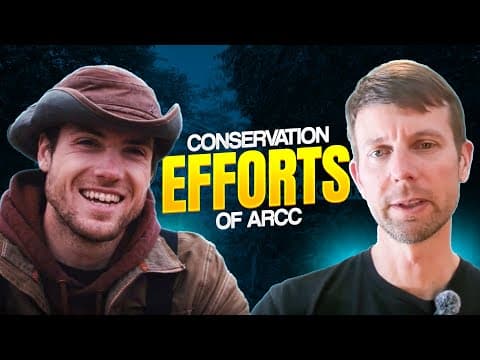
Ethan Duvall, president of the Amazon Research and Conservation Collaborative (ARC), discusses the organization's mission to protect biodiversity and cultural heritage in the Ecuadorian Amazon. He highlights the importance of community engagement, sustainable practices, and the challenges posed by human activities such as oil extraction and illegal mining. Through research, collaboration, and innovative funding strategies, ARC aims to create a sustainable future for both the environment and local communities.
In a recent interview, Ethan Duvall, the president and executive director of the Amazon Research and Conservation Collaborative (ARC), shared insights into the organization's mission and the challenges faced in conserving the Amazon rainforest. With a focus on biodiversity and cultural heritage, ARC aims to address the pressing issues threatening this vital ecosystem.
Ethan's journey into ecology began in his childhood, growing up in the mountains of Washington State. His passion for wildlife conservation was nurtured during his college years, where he was guided by inspiring mentors. Currently, he is completing his PhD in ecology and evolutionary biology in New York. In early 2024, he launched ARC to tackle biodiversity loss and cultural survival in the Amazon rainforest.
The Amazon rainforest is vast, but ARC concentrates its efforts in the western Amazon, particularly in the Ecuadorian Amazon. Despite being a smaller country, Ecuador is home to some of the most biodiverse areas of the Amazon basin. However, this biodiversity is under threat from human activities such as oil extraction, illegal mining, and deforestation.
ARC's mission is encapsulated in its name, emphasizing research, community engagement, and communication. The organization operates on three main pillars:
One of the communities ARC collaborates with has an ancestral territory covering over a million acres in the Ecuadorian Amazon. The community's ability to defend their land is vital for biodiversity conservation. ARC focuses on empowering these communities to protect their land sustainably, rather than succumbing to extractive industries that offer inequitable deals.
ARC is exploring sustainable practices such as eco-tourism and non-timber forest products. The organization is also investigating opportunities in carbon and biodiversity markets to ensure that local communities are compensated for their role in protecting biodiversity.
As a nonprofit, ARC relies on donations, corporate sponsorships, and grant writing. Duvall emphasizes the importance of collective efforts in conservation, stating that saving the Amazon requires contributions from many passionate individuals and organizations.
Duvall highlights the significant impact of corporate sponsorships, such as the partnership with Pale Blue, which provides essential resources like rechargeable batteries for camera traps used in wildlife research. This partnership not only supports ARC financially but also helps reduce waste in the sensitive Amazon environment.
To build a larger support base, ARC actively engages with the public through social media and other communication channels. Duvall notes that many people are unaware of how their consumption habits, such as gold jewelry, are linked to illegal mining practices in the Amazon. By raising awareness, ARC hopes to inspire more individuals to support their mission.
ARC is committed to helping local communities develop independent economies that align with conservation efforts. This includes promoting traditional crafts and connecting these communities with broader markets. For instance, women from the Warani community create beautiful handmade bags that can be marketed to tourists and beyond.
As ARC continues to grow, Duvall acknowledges the need for ongoing financial and material support. The organization is looking for individual patrons, corporate sponsors, and product donations to help scale their impact. Duvall emphasizes that the urgency of protecting the Amazon requires a collective response from all sectors of society.
Duvall shares memorable experiences from his time in the Amazon, including encounters with rare wildlife such as tapirs and jaguars. These moments highlight the incredible biodiversity of the region and the importance of protecting it.
Ethan Duvall's work with the Amazon Research and Conservation Collaborative exemplifies the critical efforts needed to conserve the Amazon rainforest. Through research, community engagement, and innovative funding strategies, ARC is making strides toward a sustainable future for both the environment and the indigenous communities that call it home. As the organization continues to grow, the support of individuals and businesses will be vital in driving meaningful change in the Amazon.



















