
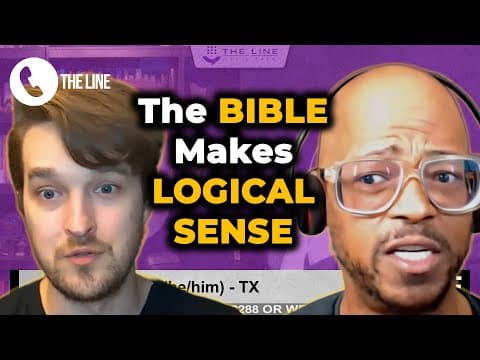
In a heated discussion, Stevie argues that the Bible makes logical sense, while hosts Forrest and Dante challenge this claim by highlighting contradictions in biblical texts. They explore creation narratives in Genesis and resurrection accounts in the New Testament, questioning the consistency and interpretation of scripture. The debate reveals differing perspectives on biblical literalism and the importance of context in understanding religious texts.
In a recent discussion, a caller named Stevie asserted that the Bible makes logical sense. This claim sparked a lively debate with hosts Forrest Valkai and Darante LaMar, who challenged Stevie's interpretation by highlighting contradictions within the biblical texts. The conversation delved into the creation narratives in Genesis and the resurrection accounts in the New Testament, raising questions about the consistency and interpretation of scripture.
Stevie began by stating that he believes the Bible is true in every aspect and that its message makes logical sense. He expressed concern that many people do not fully understand the Bible and its teachings. When asked to clarify his assertion, Stevie maintained that a plain text reading of the Bible is often sufficient, although he acknowledged that some passages require interpretation.
The discussion quickly turned to the creation story in Genesis. The hosts pointed out that Genesis 1 describes God creating birds and sea creatures on the fifth day, while land animals and humans are created on the sixth day. Stevie agreed with this sequence but hesitated to confirm that this indicated a contradiction when compared to Genesis 2, which suggests that all creatures were formed from the ground after the creation of man.
The hosts argued that these verses present conflicting accounts of when and how birds were created. Stevie maintained that Genesis 2 serves as a summary rather than a contradiction, but the hosts countered that the sequential order in Genesis 1 clearly indicates separate creation events.
The debate then shifted to the resurrection of Jesus, where the hosts examined the differing accounts in the Gospels of Matthew, Mark, Luke, and John. Each Gospel presents unique details about the events surrounding the resurrection, leading to further questions about their reliability.
The hosts pointed out that these discrepancies raise significant questions about the reliability of the biblical accounts. Stevie argued that differences in eyewitness accounts are common in historical narratives, but the hosts countered that the inconsistencies in the resurrection stories are particularly problematic given their theological significance.
Throughout the conversation, Stevie maintained that the Bible's lack of explicit contradictions allows for a variety of interpretations. He suggested that the absence of specific details in some accounts does not negate the truth of the events described. However, the hosts argued that this approach leads to a form of post hoc rationalization, where one assumes the Bible is correct unless explicitly contradicted.
The hosts emphasized the need for critical thinking and context when interpreting biblical texts. They argued that simply stating that the Bible is true without engaging with its complexities does a disservice to both the text and its readers. They encouraged Stevie to explore the historical and literary contexts of the scriptures to gain a deeper understanding.
The debate between Stevie, Forrest, and Dante highlights the complexities of biblical interpretation and the challenges of reconciling seemingly contradictory accounts within the scriptures. While Stevie holds a firm belief in the logical consistency of the Bible, the hosts argue for a more nuanced approach that considers context, interpretation, and the nature of historical narratives. This discussion serves as a reminder of the ongoing dialogue surrounding faith, reason, and the interpretation of sacred texts.



















