
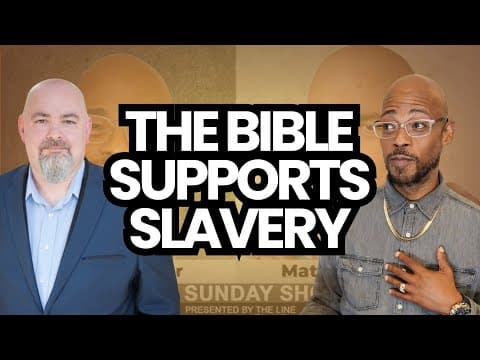
In a heated discussion, Darante' LaMar and Matt Dillahunty confront a caller's defense of slavery in the Bible. They explore the implications of biblical texts on slavery, questioning the morality and historical context of such practices. The conversation highlights the complexities of interpreting ancient texts and the ethical considerations surrounding slavery, ultimately arguing against its justification in any form.
In a recent episode, Darante' LaMar and Matt Dillahunty engaged in a thought-provoking discussion with a caller named Jimmy from Iowa, who defended the concept of slavery as presented in the Old Testament of the Bible. This conversation delved into the moral implications of biblical slavery, the historical context, and the ethical considerations surrounding the practice.
Jimmy, identifying as a theist, argued that slavery in the Old Testament is not as severe as the hosts portrayed it. He attempted to justify the existence of slavery by referencing the societal norms of ancient agricultural societies. However, his arguments quickly faced scrutiny from LaMar and Dillahunty.
The hosts posed several critical questions to Jimmy:
These questions highlighted the troubling aspects of biblical slavery, which the hosts argued were often downplayed or ignored by apologists.
LaMar and Dillahunty emphasized that the Bible not only condones slavery but also provides guidelines that allow for the mistreatment of slaves. They pointed out that:
The hosts challenged Jimmy to explain how his interpretation of biblical slavery could be considered acceptable. They questioned the morality of a system that allows for the ownership of human beings and the justification of such practices based on historical context.
Jimmy attempted to contextualize slavery by claiming it was a necessity in ancient times. However, LaMar and Dillahunty countered this argument by asking for specific historical references, which Jimmy struggled to provide. They pointed out that:
LaMar and Dillahunty argued that even if one were to accept the existence of slavery in ancient times, it does not justify its moral implications. They highlighted that:
The discussion also touched on the importance of ethical frameworks in evaluating historical practices. LaMar introduced the concept of the "veil of ignorance," which suggests that one should design societal rules without knowing their own position within that society. This principle raises critical questions about the acceptability of systems that allow for slavery.
The conversation between Darante' LaMar, Matt Dillahunty, and Jimmy serves as a powerful reminder of the complexities involved in interpreting ancient texts. It challenges readers to critically assess the moral implications of slavery as depicted in the Bible and to consider the ethical frameworks that guide our understanding of human rights today. Ultimately, the discussion underscores the importance of recognizing the historical context while firmly rejecting any justification for slavery in any form.



















