
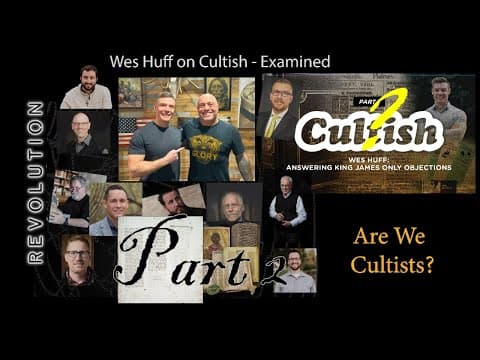
This blog post delves into the ongoing debate surrounding the King James Version (KJV) of the Bible, particularly in the context of its classification as a cult by some modern scholars. It explores the historical and textual criticisms of the KJV, the arguments for and against its exclusivity, and the implications of these discussions on contemporary Christianity.
In the second part of the discussion on the YouTube series "Cultish," Nick Sayers and Wes Huff tackle the contentious issue of King James Version (KJV) onlyism. This debate raises the question of whether adherents to the KJV should be classified as cultists. The conversation navigates through various categories of KJV supporters, textual criticisms, and the implications of these beliefs on modern Christianity.
KJV onlyism refers to the belief that the King James Version of the Bible is the only legitimate English translation of the Scriptures. Sayers points out that this belief is often mischaracterized, with many scholars lumping all KJV supporters into a single category, regardless of their actual beliefs or practices. He highlights five categories of KJV supporters as outlined by James White, emphasizing the inconsistencies and inaccuracies in these classifications.
Sayers argues that the broad categorization of KJV supporters leads to misunderstandings and mischaracterizations, particularly when scholars label them as cultists.
The discussion transitions into the realm of textual criticism, where Sayers critiques the methodologies employed by modern scholars. He argues that many contemporary translations, including the New King James Version (NKJV), have deviated from the original texts and have introduced errors.
Sayers emphasizes the importance of manuscript evidence in determining the authenticity of biblical texts. He points out that many modern translations rely on a limited number of manuscripts, often overlooking the vast majority of historical texts that support the KJV. He cites the example of the comma Johanneum (1 John 5:7-8), which is often excluded from modern translations despite its presence in numerous historical manuscripts.
The comma Johanneum refers to a passage that explicitly mentions the Trinity. Sayers argues that its exclusion from modern translations is indicative of a broader trend among textual critics to undermine traditional beliefs. He asserts that the KJV's inclusion of this passage is crucial for maintaining the doctrine of the Trinity and that its absence in modern translations reflects a theological bias.
The implications of KJV onlyism extend beyond textual debates; they touch on the identity and beliefs of contemporary Christians. Sayers argues that labeling KJV supporters as cultists not only misrepresents their beliefs but also fosters division within the Christian community. He calls for a more nuanced understanding of the KJV's role in Christianity and the motivations of its supporters.
Sayers critiques modern scholarship for its tendency to dismiss traditional beliefs in favor of contemporary interpretations. He argues that this shift has led to a dilution of core Christian doctrines and has created confusion among believers. He encourages Christians to engage with the historical and textual evidence surrounding the KJV and to consider the implications of abandoning traditional texts.
The debate surrounding the King James Version and its supporters is complex and multifaceted. As Sayers and Huff illustrate, the classification of KJV supporters as cultists is not only inaccurate but also detrimental to the unity of the Christian faith. By examining the historical and textual evidence, believers can better understand the significance of the KJV and its role in preserving core Christian doctrines. The conversation serves as a reminder of the importance of engaging with Scripture thoughtfully and critically, recognizing the rich history and tradition that informs our understanding of God's Word.



















