
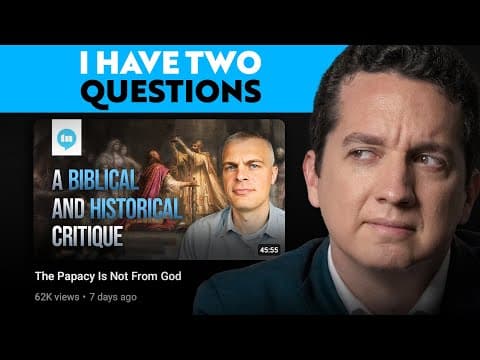
This blog post analyzes Gavin Ortlund's arguments against the papacy, demonstrating how his methodology inadvertently supports Catholicism. It explores the historical and scriptural evidence for the papacy, contrasting it with Protestant views, and addresses the authority structure within the early church.
In today's discussion, we will delve into Gavin Ortlund's arguments against the papacy and explore how his methodology may actually provide evidence in favor of Catholicism rather than Protestantism. This examination will not only clarify the Catholic position but also challenge the assumptions held by many Protestants regarding church authority.
Before we begin, I would like to express my gratitude to Gavin for reviewing the script for this episode. Such reviews are invaluable as they help us refine our arguments and better understand the perspectives of those we critique. Additionally, I want to thank our supporters at trenhornpodcast.com, whose contributions make the Council of Trent possible. If you appreciate our content, please consider supporting us for as little as $5 a month or $50 a year. Liking this episode and subscribing to our channel are also greatly appreciated.
The papacy is a fascinating subject for debate, as it touches on the fundamental question of what offices Christ instituted within His church. There is a significant variance in the common ground that Catholics share with critics of the papacy. For instance, both Catholics and Eastern Orthodox Christians agree that bishops and patriarchs possess apostolic authority. However, they diverge on the pope's jurisdictional power and infallibility. Anglicans, many Lutherans, and some Methodists acknowledge the existence of bishops alongside pastors and deacons but dispute the notion that one bishop holds greater authority than others. Other Protestant denominations may reject the governance of bishops altogether, advocating for congregational autonomy.
To persuade many Protestants of the validity of the papacy, one must demonstrate that the principle of sola scriptura is flawed, as the pope and the bishops united with him can teach infallibly, and that God indeed established the office of bishop with varying degrees of authority.
In addressing Gavin's arguments, I propose two straightforward approaches and invite Protestants to reflect on their own positions regarding church offices. In a previous episode, I discussed the fallacy of assuming that if one side's arguments fail, the opposing side automatically prevails. This is akin to the reasoning some atheists employ when they argue that the lack of convincing evidence for God validates atheism. Similarly, in theological debates, Protestants may claim victory simply because they find Catholic arguments unpersuasive, neglecting their own doctrinal responsibilities.
Gavin expressed concern that comparing Protestantism and Catholicism might lead to an apples-to-oranges fallacy, as the papacy is an ecclesiastical office while the canon of scripture is a concept. However, this distinction is problematic because Catholics acknowledge the evidence supporting the existence of other offices, such as bishops, priests, and deacons, which many Protestants accept. Therefore, arguments against the papacy could inadvertently undermine the legitimacy of the office of bishop itself.
To engage in a fruitful discussion, both sides must carry their respective burdens of proof. For instance, if Protestants assert that the church consists solely of pastors and deacons or operates under a congregational model, they must provide evidence from scripture and early church history to support this claim. Conversely, Catholics can argue from silence against the notion that the papacy represents a heretical innovation, as early Christians did not express objections to the existence of the papacy or the office of bishop.
Let us begin by examining the gospel evidence. In Luke 22, the apostles inquire about who will be the greatest among them. Jesus does not dismiss the idea of a hierarchy but instead indicates that the greatest will be a servant. This aligns with the tradition of popes referring to themselves as "servants of the servants of God." Furthermore, Jesus specifically prays for Peter, indicating a unique role for him in strengthening his brethren. The keys of the kingdom are given to Peter, paralleling the governance structure seen in ancient Israel.
Protestant scholar D.A. Carson acknowledges that the combined teachings of Jesus regarding Peter lend plausibility to the argument for Petrine primacy. While Gavin contests this interpretation, many Protestant scholars recognize that these passages suggest a special leadership role for Peter that transcends the duties shared by the other apostles.
Gavin argues that the New Testament does not explicitly state the existence of an enduring Petrine office. However, this argument from silence can be problematic. Just as some Pentecostals argue against the validity of the Trinitarian baptismal formula due to its absence in early texts, so too can Protestants be challenged on their rejection of the papacy based on a lack of explicit mention in the New Testament.
The writings of the apostles do not definitively outline the perpetual leadership structure of the church, and caution should be exercised when extrapolating from these texts. Ephesians 4:11 mentions various roles within the church, but most Protestants agree that the office of apostle has ceased, despite the absence of explicit scriptural teaching on this matter.
Moving beyond the apostolic period, we turn to the writings of early church figures such as Clement of Rome and Ignatius of Antioch. Gavin posits that Clement's letter to the Corinthians does not imply papal supremacy, as he was merely one elder among many. However, Clement's authority in addressing the Corinthian church suggests that the church of Rome held a special status, which is further supported by Ignatius's acknowledgment of the Roman church's preeminence in love.
The writings of these early church leaders indicate that authority was vested in the successors of the apostles rather than solely in their writings. For instance, Clement emphasizes obedience to the church's leaders, while Ignatius insists that churches must have bishops, priests, and deacons. This reinforces the notion that the early church recognized a hierarchical structure.
In conclusion, the evidence presented from the gospels, apostolic writings, and early church history suggests that the papacy is not merely a later development but rather a continuation of the authority established by Christ and the apostles. While Gavin Ortlund raises important questions regarding the papacy, his arguments inadvertently highlight the strengths of the Catholic position. As we engage in these theological discussions, it is essential to approach them with an open mind and a commitment to seeking the truth together. Thank you for joining me in this exploration of the papacy and its significance within the Christian tradition.



















