
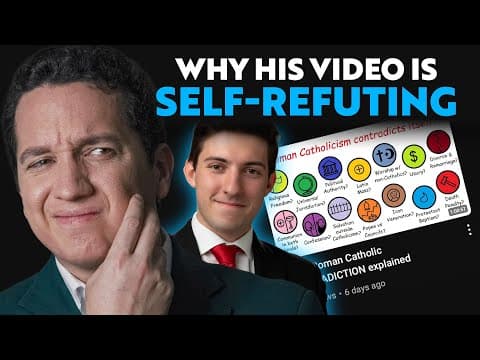
This blog post analyzes Redeem Zoomer's claims of contradictions within Catholic doctrine, addressing both logical and evidential arguments against Catholicism. It emphasizes the importance of understanding infallibility and doctrinal development, while also comparing Catholicism's reliability to Protestantism.
Recently, Redeem Zoomer (RZ) released a video discussing 14 alleged contradictions in the historical teachings of the Catholic Church. In this post, we will explore these claims and evaluate them in light of RZ's two main arguments against Catholicism.
Before diving into the arguments, I want to express my gratitude to Redeem Zoomer for reviewing this script to ensure I understood his points. Additionally, I want to address a common sentiment among some Protestants who may perceive a response from Catholic apologists as a sign of panic or weakness. The number of apologists responding to a video does not inherently validate or invalidate the arguments presented. It simply indicates that the content has garnered attention and may contain errors that warrant correction.
RZ presents two primary arguments against Catholicism:
These arguments parallel the logical and evidential arguments from evil against the existence of God. The logical argument states that any contradiction in infallible teachings disproves Catholicism, while the evidential argument suggests that the frequency of changes in non-infallible teachings should make us skeptical of the Church's divine authority.
Now, let's examine the specific contradictions RZ claims exist within Catholic doctrine. I will address each point and clarify why they do not support RZ's arguments against Catholicism.
RZ cites documents like Unum Sanctum and the Council of Florence, which may contain infallible declarations about salvation. However, modern documents he references, such as those from the Second Vatican Council, are not infallible. The Church recognizes that God can save individuals outside of formal membership in the Church under certain conditions, which does not contradict earlier teachings.
RZ argues that there is a contradiction between papal authority and the authority of ecumenical councils, particularly during the Western Schism. However, the historical context shows that the majority of bishops supported papal infallibility, and claims of extreme papal authority are often exaggerated or misrepresented.
The Second Council of Nicaea addressed the veneration of icons, but RZ admits this is not his strongest argument. Even if the origins of icon veneration are debated, this can be seen as a legitimate development of doctrine rather than a contradiction.
RZ claims a contradiction between the Council of Trent and the current catechism regarding confession. However, the catechism is not infallible, and the distinction between public penance and private confession has been misunderstood. Evidence suggests that private confession existed long before the Middle Ages.
RZ points to a shift in the Church's teaching on the death penalty from the Council of Trent to the current catechism. This change reflects a development in understanding rather than a contradiction. The Church's stance on the death penalty has evolved in response to changing societal conditions.
RZ interprets Pope Pius XI's Mortalia Animos as a rejection of ecumenism. However, the document regulates how Catholics can engage with non-Catholics rather than outright condemning ecumenical efforts. This regulation can change over time.
RZ claims that the Second Lateran Council made an infallible declaration against usury. However, this council did not define usury as intrinsically immoral. The Church's teaching on lending money has evolved, reflecting changing economic contexts.
RZ argues that the practice of offering communion under both kinds is contradictory. However, the Church teaches that receiving either form is sufficient for the sacrament, and early Protestant theologians acknowledged this as well.
RZ discusses the relationship between papal authority and temporal power, suggesting contradictions in the first millennium. However, the understanding of papal authority has changed over time, and the Church's teachings on this matter are not infallibly defined.
RZ claims that Pope Francis's Amoris Laetitia contradicts infallible teachings on remarriage after divorce. However, the document raises questions about culpability and does not negate the Church's teaching on the nature of sin.
RZ cites the Syllabus of Errors and Vatican II on religious liberty, claiming contradictions. However, past condemnations focused on the idea that error has no rights, while Vatican II recognizes the importance of religious freedom in civil society.
RZ points to changes in the language of the Mass as a contradiction. However, the Church has the authority to determine non-essential elements of the liturgy, including the language used.
In summary, the examples RZ presents do not constitute a solid logical argument against Catholicism. Most of the alleged contradictions do not involve infallibly defined teachings, and many can be understood as authentic developments of doctrine. While RZ's evidential argument raises questions about the frequency of changes in non-infallible teachings, it also opens the door for critiques of Protestantism, which has experienced its own significant doctrinal changes.
Ultimately, Catholics can find reassurance in the Church's role as the pillar and foundation of truth, even amidst ongoing discussions and debates about doctrine. The belief in the Church's authority and its ability to safeguard the faith remains a cornerstone of Catholic conviction, despite the challenges presented by critics.



















