
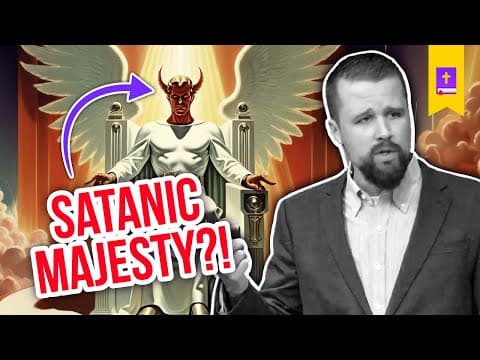
This blog post critically analyzes the Seventh-day Adventist Church's teachings on Satan's pre-fall status and authority, contrasting them with biblical scripture. It emphasizes that Satan is a created being, lesser than Christ, and discusses the implications of attributing majesty to Satan.
The Seventh-day Adventist (SDA) Church presents a unique interpretation of the fall of Satan, particularly through the writings of Ellen White. In her work, The Spirit of Prophecy, Volume 1, she describes Satan as a high and exalted angel, second only to Christ before his rebellion. This characterization raises significant questions about the biblical basis for such claims.
Ellen White describes Satan as having a mild countenance, a high and broad forehead indicative of powerful intellect, and a perfect form. She asserts that a special light shone around him, making him more beautiful than other angels. However, she also claims that Jesus, as God's Son, held preeminence over all angels, and that Satan's envy led him to gradually assume authority that was meant for Christ alone.
In response to these claims, it is essential to examine whether the Bible supports the notion that Satan was once next in honor to Christ. The conclusion drawn from scripture is an emphatic no. The biblical narrative does not provide evidence for the exalted status attributed to Satan by Ellen White. Instead, it presents Satan as a created being, fundamentally lesser than the Creator.
The Bible consistently emphasizes the distinction between the Creator and the created. Key passages, such as Colossians 1 and Ephesians 1, affirm that Christ is above all created powers, including angels. This distinction is crucial in understanding Satan's role within the biblical framework.
Satan is depicted as evil, real, and ultimately a defeated enemy. The scriptures do not support the idea of Satan being comparable to Christ in any capacity. Instead, they portray him as a being who has fallen from grace and is now in opposition to God's purposes.
The claims made by the SDA Church regarding Satan often stem from extra-biblical sources. Many offshoots of Christianity, including those with cultish tendencies, tend to elaborate on Satan's character and authority in ways that scripture does not support. This leads to a dualistic worldview where good and evil are seen as equally matched forces, which is not consistent with biblical teaching.
A particularly concerning aspect of the SDA narrative is the language used to describe Satan. For instance, the phrase "satanic majesty" is a troubling juxtaposition. In biblical terms, majesty is reserved for God alone. To ascribe such a title to Satan is a significant distortion of biblical language and undermines the sovereignty of God.
In summary, the teachings of the SDA Church regarding Satan's pre-fall status and authority lack a solid foundation in scripture. The biblical narrative clearly defines Satan as a created being, inferior to Christ, and emphasizes the victory of Christ over all evil forces. It is crucial for believers to ground their understanding of spiritual matters in the truth of scripture rather than in speculative or extra-biblical claims.
As we navigate discussions about spiritual warfare and the nature of evil, it is essential to remember that God's word is intended to illuminate, not confuse. The story of redemption through Christ is one of beauty and hope, and it is vital to focus on that truth as we engage with complex theological issues.



















