
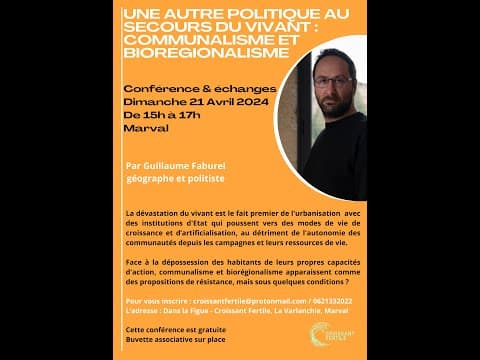
Guillaume Faburel discusses the urgent need for a shift from urbanization to biorégionalism and communalism, emphasizing the importance of local governance, ecological sustainability, and the reorganization of society to address the challenges posed by metropolitan living and climate change.
In a recent conference, Guillaume Faburel, a geographer and political scientist, shared his insights on the pressing issues surrounding urbanization and the need for a paradigm shift towards biorégionalism and communalism. With over twenty years of experience in ecological issues related to land use and urban planning, Faburel's perspective is rooted in extensive research and community engagement.
Faburel begins by highlighting the problems associated with generalized urbanization and metropolization. He argues that the current urban model is not merely about green roofs or urban agriculture; it is a deeper, more systemic issue. The urban environment, as it stands, is unsustainable and poses significant risks to both human and ecological health.
Currently, 19% of the global population lives in cities that are sinking under the weight of concrete and unsustainable practices. By 2100, it is projected that 70% of the world's population will experience deadly heatwaves, with urban areas being the most affected. Cities like Paris and Lyon are expected to face extreme temperatures, raising urgent questions about the viability of urban living.
Faburel emphasizes that the solutions proposed by public policies are often inadequate. The focus on superficial measures, such as promoting organic products or cycling, fails to address the underlying economic and ecological crises. The neoliberal urban model has led to a disconnection from local resources and a reliance on unsustainable practices.
The idea of "déménagement" (relocation) is introduced as a necessary response to the failures of urban planning. This concept, rooted in the critiques of urban theorists from the 1970s, suggests that we must rethink how we organize our societies and consider moving away from densely populated urban centers.
Faburel argues that the current political structures are inadequate to address the challenges posed by urbanization. He calls for a re-examination of political forms and the need for a new political organization that prioritizes ecological sustainability and local governance.
Biorégions are proposed as a viable alternative to the current urban-centric model. A biorégion is defined as a territory governed by natural ecosystems rather than human institutions. This concept encourages a reconnection with local resources and a focus on sustainable living practices.
Faburel outlines the potential of biorégions to foster sustainable communities. By emphasizing local governance and ecological practices, biorégions can serve as models for a new way of living that prioritizes the health of both people and the planet.
While the concept of biorégions is still developing, there are emerging examples in France and beyond. These regions focus on creating alliances among various stakeholders, including local communities, ecological initiatives, and even sympathetic institutions. The goal is to build a network of support that fosters sustainable practices and resilience.
Guillaume Faburel's vision for biorégionalism and communalism presents a compelling case for rethinking our relationship with urban environments. By embracing local governance and ecological sustainability, we can create communities that are better equipped to face the challenges of the future. The transition to biorégions is not just a theoretical exercise; it is a necessary step towards a more sustainable and equitable world.



















