
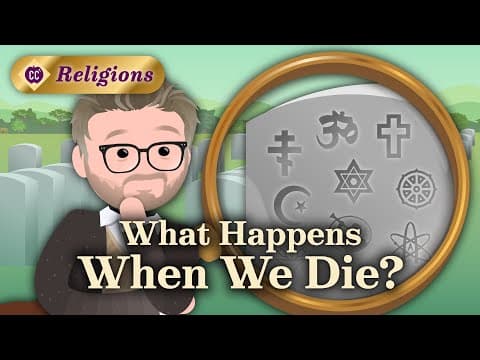
This blog post delves into various religious perspectives on death and the afterlife, examining concepts from ancient beliefs to modern interpretations of Heaven and Hell, and how these ideas have evolved over time.
In this exploration of death and the afterlife, we delve into the myriad beliefs held across different cultures and religions. From ancient myths to contemporary interpretations, the question of what happens after we die has fascinated humanity for centuries.
Death is often viewed as the ultimate mystery, a finality that has been interpreted in various ways throughout history. A story from the Maasai people of East Africa illustrates this notion: a man named Leeyio mistakenly stated that "Moon dies and comes back again, man dies and stays away," which led to the belief that death is irreversible.
The Epic of Gilgamesh, an ancient Mesopotamian text, describes the afterlife as a dark, desolate place devoid of light, where dust is the food of the dead. This bleak view contrasts sharply with the more cyclical understanding of life and death found in religions such as Jainism, Buddhism, Sikhism, and Hinduism, which propose reincarnation and the cycle of Saṃsāra.
For many, particularly in Western cultures, death is perceived as a fork in the road leading to Heaven or Hell. Surveys indicate that nearly three-quarters of U.S. adults believe in Heaven, while about sixty-one percent believe in Hell. But where did these concepts originate?
To understand the evolution of Heaven and Hell, we must look back to the ancient Israelites. They envisioned the world as a three-tiered structure: gods above, humans in the middle, and the dead in a shadowy realm called Sheol. Sheol was not a place of torment but rather a quiet, shadowy existence. However, during times of crisis, such as the Assyrian oppression, the Israelites began to focus on a singular deity, Yahweh, and speculation about the afterlife diminished.
The Babylonian conquest of Judah in 586 BCE prompted a new theological development. The idea emerged that God would resurrect the nation, which eventually extended to individual resurrection. This belief in a coming Judgment Day, where the righteous would be rewarded and the wicked punished, became central to early Christian thought.
Jesus inherited these apocalyptic views, predicting a future reckoning where God would restore justice. Those who believed would enjoy a utopia, while non-believers would face annihilation, often associated with Gehenna—a cursed valley outside Jerusalem. Over time, the concept of Hell evolved, influenced by literature and art, leading to the vivid depictions we see today.
The portrayal of Hell has been shaped significantly by cultural and artistic expressions. Medieval mystery plays depicted Hell with chains, smoke, and boiling cauldrons, while Dante’s "Inferno" in the 14th century provided a detailed vision of Hell as nine concentric circles, each punishing sinners in increasingly horrific ways. This imaginative construction of Hell has persisted through the ages, influencing how many perceive eternal punishment.
Not all Christians view Hell as a separate place. Many Orthodox Christians believe that Heaven and Hell are experiences rather than locations, shaped by one's life choices. This perspective emphasizes the duality of divine experience, where the second coming of Jesus could be either a paradise or a punishment.
Heaven, too, has been a subject of extensive imagination. Scholars identify two primary views: theocentric, which focuses on a direct relationship with God, and anthropocentric, which envisions Heaven as a place filled with loved ones and personal joys. Historical figures like Irenaeus imagined Heaven as a utopia free from suffering, a vision that resonates with many today.
Beliefs about the afterlife are deeply influenced by cultural contexts. The hope of reuniting with loved ones after death reflects a timeless desire for connection, even in the face of mortality. As we grapple with the inevitability of death, these beliefs provide comfort and meaning.
Death remains a universal truth, and our concepts of Heaven and Hell are not static; they evolve with cultural values and human experiences. As we continue to explore these themes, we find that the quest for understanding what lies beyond death is as relevant today as it has ever been. In the next episode, we will delve into the intersection of the paranormal and faith, further exploring humanity's enduring fascination with the afterlife.



















