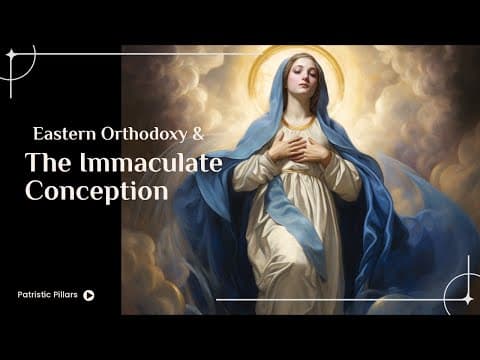
This blog post delves into the teachings of key Eastern Orthodox theologians, particularly Gregory Palamas and Joseph Brenos, regarding the Immaculate Conception of the Virgin Mary. It highlights their affirmations of Mary's sinlessness and divine grace, contrasting these views with contemporary Eastern Orthodox beliefs that often reject the doctrine. The post aims to uncover the historical and theological roots of this divergence and calls for a return to the foundational teachings of the faith
In the previous part of our examination of the Eastern Orthodox perspective on the Immaculate Conception, we focused on Gregory Palamas, a pivotal figure in Eastern Orthodox theology. This post continues that exploration, diving deeper into Palamas's teachings and introducing Joseph Brenos, a lesser-known but significant theologian from the 15th century. Together, they illuminate the historical and theological foundations of the Immaculate Conception within Eastern Orthodoxy, a doctrine that many contemporary Eastern Orthodox Christians often deny.
Gregory Palamas, in his homily 52, presents a breathtaking account of the Virgin Mary as a young child in the temple, emphasizing her unique sanctity and divine election. He describes Mary as possessing "Godlike Grace above all men," a revolutionary assertion that underscores her total sinlessness at every stage of her life. This teaching aligns closely with the Catholic doctrine of the Immaculate Conception, which posits that Mary was preserved from original sin from the moment of her conception.
Palamas's view is that Mary was not merely cleansed at the Annunciation, as some Orthodox theologians suggest, but was inherently sinless throughout her life. He asserts that her extraordinary grace is not developmental but innate, highlighting her unique status as the mother of God. This perspective is crucial in understanding the theological implications of Mary's role in salvation history.
Palamas further teaches that Mary dwells in the Holy of Holies, the innermost part of the temple, signifying her unparalleled purity and closeness to God. This detail is rich with theological significance, as traditionally, access to the Holy of Holies was reserved for the high priest. By placing Mary in this sacred space, Palamas emphasizes her unique sanctity, which surpasses that of any other human being, including angels.
Moving into the 15th century, we encounter Joseph Brenos, a monk and theologian who was a disciple of Gregory Palamas. Brenos's writings reflect a deep spiritual understanding of the faith intertwined with a profound devotion to the Virgin Mary. His contributions to the theology of the Immaculate Conception are particularly noteworthy, as he articulates the belief that Mary was pre-purified and sanctified in her mother's womb, preparing her for her role as the Theos, or mother of God.
In his second homily on the Annunciation, Brenos asserts that no other woman has been honored above Mary, emphasizing her unique sanctification by divine action. He argues that God, in His foreknowledge, chose Mary as the worthiest vessel to bear the Incarnate Word, rejecting all other women as unworthy. This sanctification is not a cleansing from sin but a divine grace that preserves her from sin entirely, aligning with the concept of the Immaculate Conception.
Brenos's teachings highlight the importance of divine foreknowledge and selection in Mary's role in salvation history. He emphasizes that her sanctification sets her apart from all other women, elevating her above every other virtue. This perspective is essential for understanding the theological implications of Mary's purity and her unique role in the divine plan.
Despite the clear teachings of Palamas and Brenos, many contemporary Eastern Orthodox theologians reject the doctrine of the Immaculate Conception, often viewing it as a Western innovation. This divergence raises important questions about the continuity of Eastern Orthodox theology and its relationship with its historical roots.
The rejection of the Immaculate Conception by modern Eastern Orthodox theologians often stems from a reactionary stance against the dogmatic definitions of the Western Church. This is particularly evident in the debates surrounding the language of sin and purity, where terms that sound too Latin are dismissed, despite their biblical foundations.
The writings of figures like Brenos call for a return to the foundational teachings of Eastern Orthodoxy, urging the Church to reclaim the biblical and patristic vision of Mary as the pre-purified Theos. Only by doing so can the Orthodox Church truly honor the mother of God in the fullness of her grace and purity, as affirmed by the early fathers and theologians.
As we conclude this exploration of Eastern Orthodoxy's relationship with the Immaculate Conception, it is clear that the teachings of Gregory Palamas and Joseph Brenos provide a rich theological foundation that has been largely abandoned in contemporary discussions. The denial of the Immaculate Conception is not merely a trivial matter; it reflects a significant divergence from the faith of the early Church. In the upcoming part three, we will delve into the Council of Florence and examine the contributions of Mark of Ephesus, further illuminating this complex issue within Eastern Orthodoxy.