
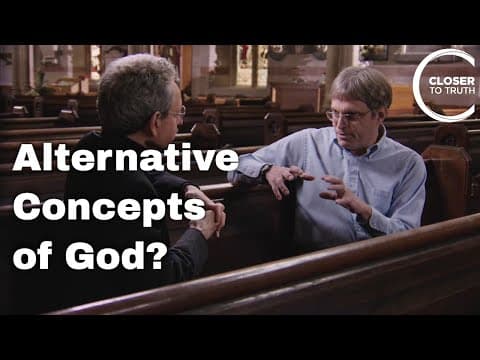
Eric Steinhart presents a unique polytheistic view of God, proposing an infinite hierarchy of 'little g' gods that evolve from simpler beings, challenging traditional theistic concepts and addressing issues like the problem of evil and the nature of creation.
In a thought-provoking discussion, philosopher Eric Steinhart presents an alternative view of divinity that diverges from traditional theistic beliefs. His concept revolves around the idea of multiple, evolving gods, which he refers to as 'little g' gods, as opposed to the singular, omnipotent 'Big G' God commonly found in classical theism. This blog post delves into Steinhart's intriguing ideas, exploring the implications of his polytheistic framework.
Steinhart begins by asserting that there are infinitely many gods, which he categorizes as 'little g' gods. Unlike the gods of mythology, such as Zeus or Thor, these gods do not exist in a physical sense. Instead, Steinhart posits that our universe is generated by a local little g god, which serves as the necessary foundation for all contingent beings within the universe. This idea aligns with the cosmological argument, which suggests that there must be a necessary being that grounds the existence of everything else.
Steinhart's argument continues by questioning the origin of this local god. He suggests that if a god exists, it must have been created by another god, leading to a chain of gods that extends back to a primordial, simple necessary being. This first god is the root of an endlessly branching tree of gods, each one more complex than the last. In this framework, the traditional theistic view of a singular, complex god is challenged, as Steinhart argues that a complex universe necessitates a complex god.
Drawing inspiration from Richard Dawkins' The God Delusion, Steinhart introduces an evolutionary perspective on the development of gods. He suggests that just as species evolve over time, so too do gods. The little g gods are seen as primordial beings that give rise to larger, more complex gods. This evolutionary process allows for a hierarchy of gods, each capable of creating their own universes and offspring.
In Steinhart's view, complexity is a crucial aspect of understanding divinity. He argues that a simple god can generate a universe, but as the gods evolve, they become more powerful and intelligent. This leads to a multitude of gods, each with their own unique attributes and capabilities. The gods are likened to computers that generate virtual worlds, with each new generation of gods creating increasingly complex realities.
One of the significant advantages of Steinhart's polytheistic model is its ability to address common problems associated with traditional theism. For instance, the paradoxes of omniscience and omnipotence are avoided in his framework. Since no single god possesses all power or knowledge, the logical problem of evil is also more easily explained. Each god operates to the best of its ability, but limitations exist, allowing for imperfections in the created worlds.
In traditional theism, the existence of evil poses a significant challenge, as an all-powerful, all-good god would not permit suffering. Steinhart's model circumvents this issue by positing that each god is not all-powerful or all-good. Instead, they do their best within their limitations, which can lead to imperfections in the universe they create. This perspective provides a more nuanced understanding of the existence of evil and suffering in the world.
Steinhart emphasizes that his view is grounded in a naturalistic understanding of the universe. He argues that gods do not interfere with the world but instead generate it through logical and programmatic means. This approach allows for a scientific account of creation and design, contrasting sharply with traditional theistic explanations that often rely on mystery.
The concept of an infinite hierarchy of gods raises questions about the nature of existence itself. Steinhart suggests that while there may be a first cause or necessary being, the existence of multiple gods allows for a richer and more complex understanding of divinity. Each god contributes to the overall tapestry of existence, creating a dynamic interplay of power and creativity.
Eric Steinhart's alternative concepts of god challenge traditional notions of divinity by introducing a polytheistic framework that emphasizes evolution, complexity, and naturalism. By proposing a hierarchy of little g gods, he addresses significant philosophical issues, including the problem of evil and the nature of creation. This innovative perspective invites further exploration and discussion about the nature of existence and the divine, encouraging a re-examination of long-held beliefs in the realm of theology.



















