
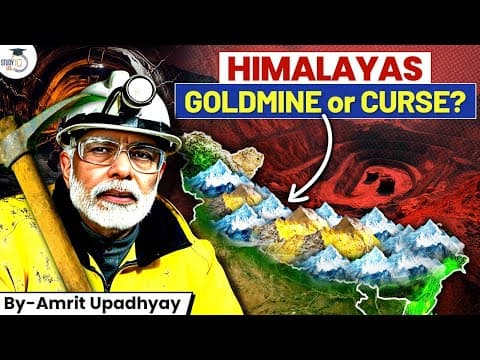
The blog discusses the potential of India's Himalayan region for mining rare earth minerals, comparing it with China's aggressive mining strategies, while highlighting the environmental and logistical challenges that need to be addressed for sustainable development.
In recent years, the Himalayan region has garnered attention for its vast mineral wealth, particularly rare earth minerals. This blog post delves into the potential of mining in the Himalayas, the reasons behind India's hesitance to exploit these resources, and the implications for the economy and environment.
In 2023, Chinese scientists discovered significant deposits of rare earth minerals in the Himalayas, particularly in the Tibetan Plateau, covering an area of 1000 km. This discovery was made possible by advanced artificial intelligence tools developed by China, which have revolutionized the search for these valuable minerals. The Chinese government has already initiated large-scale mining operations in the region, leading to increased tensions between India and China.
India's Himalayan region, which spans 12 states from Jammu and Kashmir to Arunachal Pradesh, is rich in various minerals. According to the Geological Survey of India (GSI), this region hosts a remarkable inventory of metallic and non-metallic minerals, including:
For instance, Arunachal Pradesh has an estimated 15.6 million tons of high-grade coal reserves, which could significantly contribute to India's annual coal demand. In 2023, India's coal imports amounted to 250 million tons, costing approximately 1.8 lakh crore INR. Utilizing local resources could save the country a substantial amount.
The extraction of minerals from the Himalayas is not just an economic opportunity; it also holds strategic importance. Critical minerals like lithium and cobalt are essential for modern technology and defense sectors. The recent discovery of 5.9 million metric tons of lithium in Jammu and Kashmir could pave the way for India to become self-sufficient in energy storage solutions.
Despite the potential benefits, mining in the Himalayas poses significant environmental risks. The region is home to diverse ecosystems and is one of the world's biodiversity hotspots. The temperature in the Himalayas is rising at an alarming rate, and mining activities could exacerbate issues like land degradation and landslides. Historical data shows that landslides in Himalayan states have increased by 40% since 2000, and mining could further escalate this risk.
To navigate the complexities of Himalayan mining, India can learn from global best practices. For example:
For India to harness its Himalayan mineral wealth sustainably, several steps must be taken:
The Himalayan region holds immense potential for mineral wealth that could significantly boost India's economy and strategic capabilities. However, this opportunity comes with substantial environmental challenges that must be addressed through careful planning and sustainable practices. By learning from global examples and investing in technology and infrastructure, India can develop a mining model that balances economic growth with environmental stability.
As we explore the future of mining in the Himalayas, it is crucial to engage in discussions about the implications and responsibilities that come with such endeavors. What are your thoughts on this topic?



















