
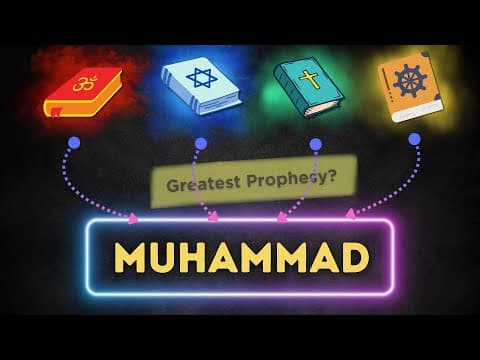
This article delves into the prophecies of Prophet Muhammad found in various religious texts, including the Old Testament, Hindu scriptures, and Buddhist texts, suggesting a unified truth regarding his significance as a prophet sent by God.
One of the common threads in all major world religions is the mention of a special Prophet sent by God to lead humanity. In some holy books, this Prophet is given a name, while in others, there are detailed descriptions about him. This raises the question: are these prophecies separate pieces of a puzzle, or are they fragments of a larger unified truth? Could it be that Muhammad (peace be upon Him) is the prophesized figure mentioned across the religions of the world? If so, why do the scriptures of entirely different faiths point to the Prophet of Islam? This claim warrants serious research and deep inquiry.
Back in the 6th Century, a group of Jewish people traveled to the Arabian Peninsula in hopes of meeting the awaited Prophet whose description and name were mentioned in the Old Testament. They found enough evidence in their holy scripture to pinpoint the location of this awaited Prophet. Their reference was likely from the Book of Isaiah, Chapter 42, which discusses a special person sent to bring justice to the nations. The chapter mentions the desert and its cities, and the village of Gad, which was inhabited by the descendants of Ishmael, indicating a connection to modern-day Saudi Arabia.
Additionally, the verse mentions a mountain called SAA, located in Medina, where Prophet Muhammad (peace be upon Him) established Islam. This suggests that the awaited Prophet would indeed come from this region.
Surprisingly, the name of this Prophet is also mentioned in the Old Testament. In the Book of Song of Solomon 5:16, it states, "His mouth is most sweet; yea, he is altogether lovely. This is my beloved, and this is my friend, O daughter of Jerusalem." In Hebrew, the text reads "hio m muhamad b Jerusalem," clearly mentioning the name Muhammad. The term "Muhammad" in Hebrew is used as a plural of respect, similar to its use in Arabic.
When Prophet Muhammad announced his prophethood, many Jews recognized him as the awaited Prophet based on the descriptions they had read. However, some did not believe him, as they did not expect him to be from the Arabs rather than the Children of Israel. This event is mentioned in the Quran, which states that those who were given the scriptures recognized him as they would their own children, yet some hid the truth knowingly.
The Old Testament describes Prophet Muhammad in detail across various books, including predictions of his triumph over enemies. For instance, Isaiah Chapter 21 discusses defeating enemies, which aligns with similar verses found in the Vedas, one of the oldest Hindu scriptures. In the Atharva Veda, it is stated that the awaited Prophet will defeat 690 enemies and 20 chiefs. The term "Aandu" in Sanskrit means one who praises, which is a literal translation of the name Muhammad (peace be upon Him). Historically, Muhammad (peace be upon Him) defeated approximately 20 chiefs of Makkah.
Moreover, the Rig Veda and Yajur Veda also mention this Prophet by name, describing him as a spiritual teacher who will guide his followers. The descriptions include characteristics such as being circumcised, keeping a beard, and calling to prayer, which align with Islamic practices.
Interestingly, Buddhism also contains references to a similar awaited figure. According to the Gospel of Buddha, it is mentioned that another Buddha will arise, and the criteria for identifying him closely match the life of Prophet Muhammad (peace be upon Him). The details include attaining supreme insight at night, dying a natural death, and looking exceedingly bright before death—all of which correspond to the life and death of Muhammad (peace be upon Him).
Jesus himself foretold the coming of an awaited Prophet. In the Gospel of John, he speaks of sending a comforter or advocate after his departure. Many interpret this comforter as the Holy Spirit; however, this interpretation raises contradictions, as the Holy Spirit was present before Jesus' departure. The Greek word for comforter, "paraclete," translates to one who praises, aligning perfectly with the meaning of the name Muhammad (peace be upon Him).
The references to Prophet Muhammad (peace be upon Him) in various religious scriptures suggest a significant and unified truth about his role as the final messenger of God. It is essential for believers to reflect on these prophecies and understand the importance of monotheism and the worship of one God. The Quran confirms that those who follow the messenger, the unlettered Prophet, are indeed following the path laid out by previous prophets.
In conclusion, the presence of Muhammad (peace be upon Him) in the scriptures of other religions invites deeper research and reflection on the nature of prophethood and the messages conveyed throughout history. It emphasizes the belief that God has sent numerous prophets to guide humanity, culminating in the final message delivered by Muhammad (peace be upon Him).



















