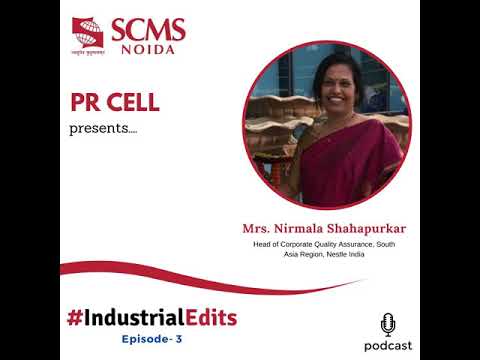
In this episode of the SCMS NOIDA podcast, Nirmala, a seasoned quality assurance leader at Nestlé, discusses the critical role of quality management within lean manufacturing, emphasizing the importance of a zero defect mindset, waste elimination, and the impact of digitization on quality assurance practices.
Welcome back to Industrial Edits, the first-ever podcast series of SCMS Noida. In this episode, hosts Ayushi Sahu and Akshay Chen are joined by a remarkable guest, Mrs. Nirmala, who has dedicated over 29 years to Nestlé. With a Master's degree in Food Science from CFTRI Mysore, she currently leads corporate quality assurance in South Asia for Nestlé. Today, we delve into the vital role of quality assurance and management within the lean manufacturing philosophy.
To kick off the discussion, Nirmala defines quality as the conformance to a set of requirements or the fulfillment of consumer expectations. She explains that when consumers perceive a defect—such as a product not meeting their expectations in color or functionality—they label it as a quality issue. Therefore, quality management processes are designed to minimize defects and maintain a zero defect mindset.
Achieving a zero defect mindset is crucial, especially in high-speed production environments where millions of products are manufactured daily. Nirmala emphasizes that manual checks for defects are impractical at such scales. Instead, organizations must focus on process stability and minimizing variations. Lean manufacturing plays a significant role in this by providing systems to eliminate defects.
Nirmala illustrates this with a practical example involving noodle packaging. Each noodle pack includes a taste maker masala. To ensure that every pack contains the masala, manufacturers can either design wrappers that stop production if the masala is missing or use sensors to detect and remove defective packs. This approach, known as "poka-yoke," is a fundamental aspect of lean quality management.
The lean manufacturing philosophy is not a new concept; it has been around for decades, focusing on the continuous elimination of waste in production processes. In Japanese, waste is referred to as "muda," which encompasses any activity that does not add value to the product. Nirmala stresses that consumers are unwilling to pay for inefficiencies, making it essential for manufacturers to deliver value through quality.
Lean principles can be applied across various sectors, including healthcare, administrative offices, and manufacturing. In manufacturing, lean implementation begins with establishing workplace basics, often referred to as the 5S methodology. Identifying waste in processes is crucial, and Nirmala outlines several types of waste, including:
By applying lean tools, organizations can enhance process stability and reduce defects, ultimately improving product quality.
As the conversation progresses, Nirmala shares her insights on emerging practices in quality assurance. She notes a significant shift from self-inspection to quality management, driven by advancements in automation and digitization. We are now entering the era of Quality 4.0, where real-time data and predictive AI controls are transforming quality management.
Digitization is revolutionizing how quality is managed. For instance, the traditional method of checking product weight has evolved from manual logging to automated systems that provide real-time data. This transition allows operators to respond quickly to variations, enhancing efficiency and reducing errors. Nirmala highlights that embracing digitization is essential for industries aiming to maintain a lean mindset and ensure high-quality products.
In conclusion, Nirmala's insights shed light on the integral role of quality assurance within lean manufacturing. By fostering a zero defect mindset, eliminating waste, and embracing digitization, organizations can enhance their competitive edge and meet consumer expectations. We thank Nirmala for sharing her valuable knowledge and insights in this episode.
Stay tuned for more engaging discussions in upcoming episodes of Industrial Edits. This is Ayushi Sahu and Akshay Chen signing off.