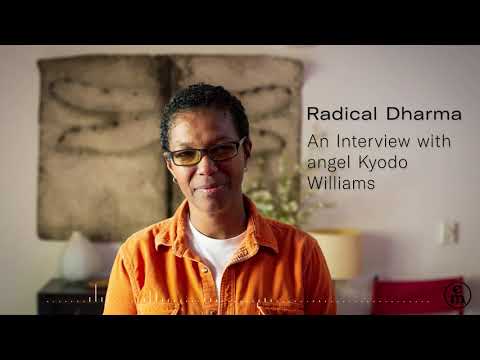
In an insightful interview, Reverend Angel Kyodo Williams discusses the concept of Radical Dharma, emphasizing the need for a new narrative that transcends traditional faith boundaries. She argues that spiritual leaders must guide individuals towards collective liberation by addressing the deeper spiritual crises underlying societal issues, advocating for a more inclusive understanding of faith and identity.
Welcome to Emergence Magazine's podcast, where we delve into the intersections of ecology, culture, and spirituality. In this episode, Emmanuel Vaughan-Lee interviews Reverend Angel Kyodo Williams, a prominent Zen teacher and author, about her philosophy of Radical Dharma and its implications for individual and collective liberation.
Reverend Angel Kyodo Williams is a sensei in the Japanese Zen tradition and the founder of the Center for Transformative Change. She is the author of Being Black: Zen and the Art of Living with Fearlessness and Grace and co-author of Radical Dharma: Talking Race, Love, and Liberation. Her work focuses on the intersection of spirituality and social justice, advocating for a more inclusive and compassionate understanding of faith.
During the interview, Williams discusses the widespread crisis of story in contemporary society. She argues that mainstream institutional religions are failing to provide a new way forward, leaving many individuals feeling disconnected from their spiritual roots. Williams believes that faith leaders must help people understand their place within the broader context of humanity, moving beyond singular narratives to embrace the complexity of our shared histories.
Williams emphasizes that the role of faith and spiritual traditions is to bridge divides rather than create them. She calls for a collective belonging that transcends individual faiths, urging leaders to communicate with those outside their traditions. This approach fosters a sense of unity and shared humanity, essential in addressing the spiritual crisis underlying our ecological, social, and political challenges.
In today's world, many individuals are increasingly sensitive to their sense of belonging. Williams notes that while some find this vastness exciting, others perceive it as a threat. This duality can lead to a narrowing of perspectives, where individuals retreat into exclusive identities rather than embracing diversity. Faith leaders must emphasize that the current crises cannot be resolved solely through political means; they require a deeper spiritual engagement.
Williams argues that we need a new story—one that encompasses all of humanity and acknowledges the complexities of our realities. She critiques the outdated narratives that have historically shaped nations, particularly in the United States, where the founding principles often excluded marginalized voices. The challenge lies in evolving these narratives to reflect contemporary realities and foster inclusivity.
An interesting trend observed in recent years is the increasing number of individuals identifying as spiritual but not religious. Williams attributes this shift to the failures of traditional religions to address the needs of contemporary society. Many young people are seeking meaning and connection outside of dogmatic structures, yearning for a more inclusive and compassionate spiritual framework.
Williams introduces the concept of Radical Dharma, which invites individuals to explore the layers of truth within their lives. This approach encourages a deep examination of personal and collective narratives, challenging oppressive systems and binaries that limit our understanding of self and others. Radical Dharma is about recognizing the multiplicity of truths and fostering a sense of curiosity and openness.
The liberation Williams speaks of is not merely about freeing the mind but also about liberating the body and spirit from harmful narratives. It involves taking responsibility for our own stories and recognizing how societal structures hinder our capacity to love and connect with others. This journey begins with self-exploration, leading to a deeper understanding of our interconnectedness with all beings.
Williams emphasizes that spiritual traditions must adapt to the complexities of modern life. Rather than nation-building around specific faiths, these traditions should offer individuals the language to connect with their own divinity and the divine in others. The goal is to create spaces for healing, inspiration, and community that transcend traditional boundaries.
In conclusion, Reverend Angel Kyodo Williams calls for a radical reimagining of our spiritual narratives. By embracing the complexities of our identities and histories, we can foster a more inclusive and compassionate society. The journey towards liberation begins with understanding ourselves and recognizing our shared humanity, paving the way for collective healing and transformation.
Emergence Magazine continues to explore these vital themes, inviting readers to engage with the interconnectedness of ecology, culture, and spirituality. Join us in this journey towards a more compassionate and inclusive world.