
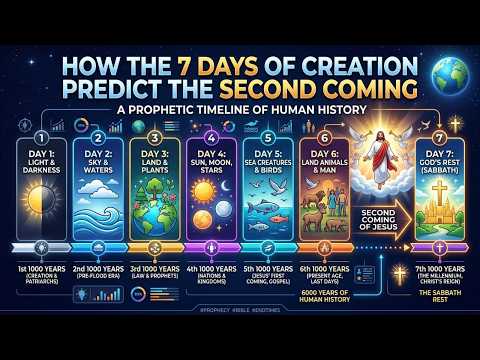
This blog post delves into the idea that the seven days of creation in the Bible correspond to 7,000 years of human history, culminating in the second coming of Christ. Each day represents a specific millennium, revealing patterns that connect biblical events and prophecies to God's overarching plan for humanity.
The concept of the seven days of creation in the Bible has long been a subject of theological discussion. Some believe that these days may serve as a prophetic blueprint for the 7,000 years of human history, culminating in the second coming of Jesus Christ. This post will explore how each day of creation corresponds to a millennium of human history, revealing patterns that may change the way we read the Bible.
To understand the prophetic significance of the creation week, we must first establish the principle that a day can represent a thousand years in God's sight. This idea is supported by several biblical passages:
This principle suggests that the creation days may not only describe the physical act of creation but also serve as a prophetic timeline for human history.
On the first day of creation, God separated light from darkness. This separation symbolizes the fall of Adam and Eve, who brought darkness into the world through sin. The first millennium of humanity reflects this separation, as humanity distanced itself from God, the source of light.
The second day of creation involved the separation of waters. This day prophetically points to the time of Noah's flood, which occurred in the second millennium. Just as God separated the waters during creation, He later flooded the earth, marking a significant judgment on humanity's sinfulness.
On the third day, God caused the land to yield seed-bearing fruit. This corresponds to the promise made to Abraham that his descendants would inherit the land. The Israelites, as the seed of Abraham, were planted in the Promised Land, fulfilling this prophetic pattern.
The fourth day saw the creation of the sun, which symbolizes Jesus, the light of the world. Jesus was born at the end of the fourth millennium, fulfilling the prophecy of the sun of righteousness rising with healing in its wings (Malachi 4:2).
On the fifth day, God created fish and birds, instructing them to multiply. This reflects the early church's mission to spread the gospel, where the disciples became "fishers of men." The Holy Spirit, represented as a dove, also signifies this multiplication of believers.
The sixth day involved the creation of mankind, who were commanded to multiply and take dominion over the earth. This period has seen exponential growth in the human population and technological advancements, fulfilling the command to fill the earth.
The seventh day represents the Sabbath, a day of rest. According to Hebrews 4, we are still awaiting the prophetic fulfillment of this rest, which is believed to correspond to the millennial reign of Christ. This period will be characterized by peace and rest, as Jesus reigns on earth for a thousand years.
The exploration of the seven days of creation reveals a fascinating pattern that connects biblical events and prophecies to God's plan for humanity. While this interpretation may not be definitive, it encourages readers to view the Bible through a lens of patterns and prophetic significance.
As we continue to explore these themes, we will uncover more insights into the nature of God and His relationship with humanity. The patterns found in the creation account, the tabernacle, and the journey of the Israelites all point to a divine narrative that transcends time and human understanding.
Stay tuned for future explorations of these patterns and their implications for our faith and understanding of God's word.



















