
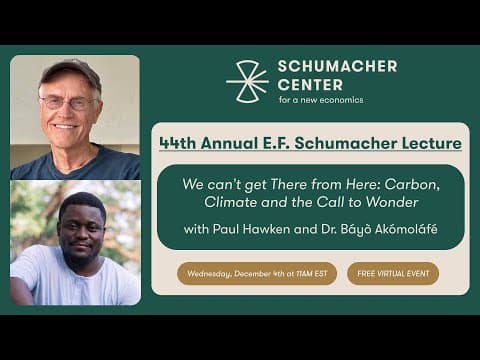
In a profound dialogue, Paul Hawken and Bio Kamala challenge conventional climate action narratives, advocating for a deeper understanding of our interconnectedness with nature and the importance of humility, wonder, and collective action in addressing the climate crisis.
In a recent conversation hosted by the Schumacher Center for New Economics, two prominent thinkers, Paul Hawken and Bio Kamala, engaged in a thought-provoking dialogue about the climate crisis. This event marked the first public conversation between the two, who come from vastly different backgrounds yet share a common goal: to inspire a new way of thinking about our relationship with the planet.
Alex Forester, a board member at the Schumacher Center, opened the lecture by acknowledging the urgency of the climate crisis. He emphasized that despite the overwhelming data on global warming, the necessary social and political energy to address it has yet to materialize. This has led to a reconsideration of the fundamental questions surrounding climate action.
What if the problem isn't merely how to change the world or combat carbon emissions? Perhaps, as Forester suggested, we need to step back and reevaluate our assumptions and strategies. This conversation invites us to explore a different rhythm and a call to wonder, humility, and a deeper appreciation of life on Earth.
Bio Kamala began the discussion by sharing a story about the Bodélé Depression in the Sahara Desert, a seemingly desolate place that plays a crucial role in the ecosystem. Each year, dust from this region carries diatoms—single-celled organisms essential for life—across the Atlantic to the Amazon rainforest. This process illustrates the interconnectedness of life and the importance of recognizing that even the most inhospitable places contribute to the vitality of our planet.
Kamala emphasized that the logic of our familiar solutions often fails to address the complexity of the climate crisis. He introduced the concept of the "logic of veness," which suggests that our attempts to solve problems often stem from a misunderstanding of our current situation. Instead of viewing our location as merely a point on a map, we should recognize it as a relationship—a dynamic interplay with the world around us.
Paul Hawken echoed Kamala's sentiments, expressing concern that the climate movement often embodies the very problems it seeks to solve. He pointed out that the language used in climate discourse—terms like "combat" and "fight"—reinforces a dualistic mindset that separates humans from nature. Instead, Hawken advocates for a shift in perspective, urging us to see carbon not as a villain but as a vital flow of life.
Hawken's upcoming book, titled "Carbon: The Book of Life," explores the significance of carbon in our ecosystems. He argues that carbon is not merely a pollutant but an essential element that sustains life. By reframing our understanding of carbon, we can begin to appreciate the intricate relationships that exist within the natural world.
As the conversation progressed, the topic of fear emerged. Both speakers acknowledged the justified fear surrounding the climate crisis but emphasized the need to transform that fear into courage. Hawken stated that hope often masks fear, and what we truly need is the courage to confront our reality and act from the heart.
Kamala added that discomfort can be a holy ally, prompting us to engage with the world in new ways. He shared a story about fishermen in Brazil who have formed a symbiotic relationship with dolphins, illustrating how collaboration with nature can lead to abundance. This example highlights the importance of recognizing our interconnectedness and the potential for collective action.
In closing, both Hawken and Kamala called for a radical rethinking of our approach to the climate crisis. They urged us to embrace a sense of wonder and humility, recognizing that we are part of a larger web of life. Rather than seeking to save the planet, we should honor and nourish the vibrant ecosystems that sustain us.
As we move forward, let us carry the insights from this conversation into our actions. By fostering connections with each other and the natural world, we can cultivate a more compassionate and effective response to the challenges we face. The journey ahead may be uncertain, but it is one that invites us to explore the depths of our relationship with the Earth and each other.



















